



Apple will make its iPhone 14 in India, the company said on Monday, as manufacturers shift production from China amid geopolitical tension and pandemic restrictions that have disrupted supply chains for many industries.
“The new iPhone 14 line-up introduces groundbreaking new technologies and important safety capabilities. We’re excited to be manufacturing iPhone 14 in India,” Apple said in a statement.
The company unveiled its latest line-up of iPhones earlier this month. They will have improved cameras, faster processors and longer-lasting batteries at the same prices as last year’s models.
India is the world’s second-largest smartphone market after China but iPhone sales have struggled to capture a large share of the market against cheaper smartphones from competitors.
The announcement from the California-based company dovetails with Prime Minister Narendra Modi’s push for local manufacturing, which has been a key goal for his government ever since he took office in 2014.
The tech company has bet big on India, where it first began manufacturing its iPhone SE in 2017 and has since continued to assemble a number of iPhone models there. Apple opened its online store for India two years ago, but the pandemic has delayed plans for a flagship store in the country, local media reported.
The latest model will be shipped out by Foxconn, a major iPhone assembler, whose facilities are on the outskirts of Chennai, a city in southern India.
Apple is likely to shift about 5 per cent of its iPhone 14 production to India from later this year, raising it to 25 per cent by 2025, a JP Morgan report quoted by the Press Trust of India news agency said.
Supply chain risks such as the stringent Covid-19 lockdowns in China are likely the trigger for such relocation efforts that will continue over the next two or three years, the report said.
iPhone 14 launch — in photos
-
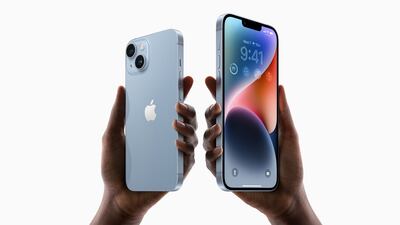
Available in a 6.1-inch display and a new, larger 6.7-inch size, the iPhone 14 and iPhone 14 Plus feature impressive camera upgrades and groundbreaking new safety capabilities. Photo: Apple -

The iPhone 14 and iPhone 14 Plus will be available in five colours: midnight, blue, starlight, purple, and (PRODUCT)RED. Photo: Apple -

Apple chief executive Tim Cook speaks at an Apple event on the campus of Apple's headquarters in Cupertino, California. AP -

Apple Watch Ultra features a new, customisable action button in high-contrast international orange that gives users quick physical control over a range of functions. Photo: Apple -
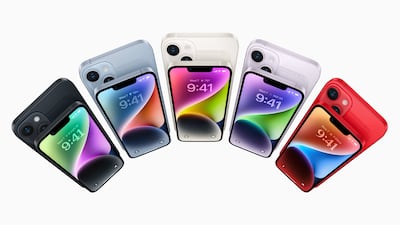
The iPhone 14 and iPhone 14 Plus offer industry-leading durability and amazing battery life, including the best battery life ever in an iPhone with iPhone 14 Plus. Photo: Apple -

Mr Cook arrives to speak at an Apple event in Cupertino. AP -

Visitors arrive at the Steve Jobs Theatre before the Far Out Apple event. Bloomberg -

Visitors arrive at Steve Jobs Theatre on the Apple campus. Bloomberg -

Members of the media await the arrival of Mr Cook in Cupertino. EPA -

Mr Cook presents the new iPhone 14 at the event. Reuters -

The new extra-small ear tip on the Apple AirPods Pro delivers a better fit to more customers. Photo: Apple -

The new AirPods Pro bring major upgrades to Transparency mode, Spatial Audio and convenience features while cancelling up to twice as much noise. Photo: Apple -

You can personalise the charging case with Memoji, Animoji and a curated list of stickers. Photo: Apple -

The new AirPods Pro. Photo: Apple -

Apple Watch Ultra, the most rugged and capable Apple Watch. Photo: Apple -
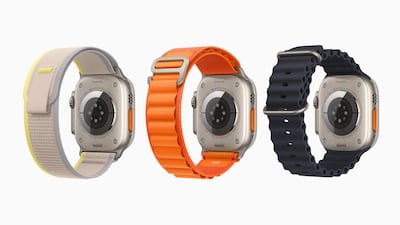
Three new bands — Trail Loop, Alpine Loop and Ocean Band — offer unique design features that provide a secure and comfortable fit. Photo: Apple -

The reimagined Lock Screen in iOS 16 offers a multilayered effect that sets subjects of photos in front of the time, along with newly designed widgets. Photo: Apple -

The Ultra Wide camera offers a new perspective for photos and video, and receives benefits from Photonic Engine — an enhanced image pipeline. Photo: Apple -

Crash Detection uses specialised components paired with Apple-designed algorithms to detect a severe car crash and automatically dial emergency services when a user is unconscious or unable to reach their iPhone. Photo: Apple -
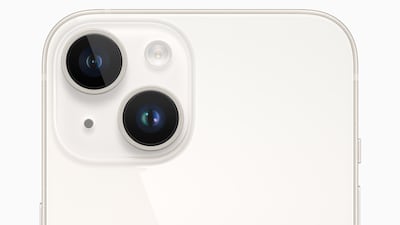
The iPhone 14 and iPhone 14 Plus contain a new 12MP Main camera, a new front TrueDepth camera and the Ultra Wide camera. Photo: Apple -

The iPhone 14 line-up includes Emergency SOS via satellite, enabling the user to contact emergency services when outside of cellular or Wi-Fi coverage. Photo: Apple


“Apple has been trying to diversify its supply chain for a while, but these efforts have grown in the last two years over trade sanctions between the US and China,” said Sanyam Chaurasia, an analyst at Canalys.
Last year, the tech company manufactured about seven million iPhones in India. This news is likely to significantly increase India-made Apple smartphones, he added.
Most of Apple’s smartphones and tablets are assembled by contractors with factories in China, but the company started to look at the possibility of moving some production to South-East Asia or other places after repeated shutdowns to fight Covid-19 disrupted the global flow of products.
Apple has not released details, but news reports say the company has planned to set up assembly of tablet computers and wireless earphones in Vietnam.
Other companies are keeping or expanding manufacturing in China to serve the domestic market while shifting export-orientated work to other countries due to rising wages and other costs, as well as the difficulty for foreign executives to visit China due to anti-Covid travel restrictions.
-

A medical worker collects a swab sample from a man for nucleic acid testing at a residential compound in Xi’an. Reuters -

Residents queue for Covid-19 tests in the city. AFP -

Security guards patrol an area of Xi’an that is under restrictions after the recent coronavirus outbreak. AFP -

People queue outside a pagoda at a mass testing centre in the city. Reuters -

Protective gear is worn at the entrance of university accommodation that is under lockdown. Reuters



