


Russia's rouble clawed back lost territory on Tuesday after plummeting more than 28 per cent the day before.
The currency was trading at 96.83 to the US dollar at 3.50pm UAE time after it hit a record low of 118 against the greenback in early trading yesterday.
On Monday, Russia’s central bank imposed capital controls and more than doubled interest rates to 20 per cent, their highest in nearly two decades, after the US and EU allies imposed tighter sanctions in response to its military offensive in Ukraine.
The punitive measures against Moscow disconnect certain Russian banks from the global Swift payments network, in addition to various sanctions aimed at tightening the noose around Moscow that include the US Treasury prohibiting Americans from engaging in transactions with the Bank of Russia, the Russian Direct Investment Fund and the country's Ministry of Finance.
These measures follow US and EU moves last week that limit Russia's ability to do business in dollars, euros, pounds and yen as well as the freezing of Moscow's assets and denying it access to their financial markets, curtailing its ability to raise funding.
-
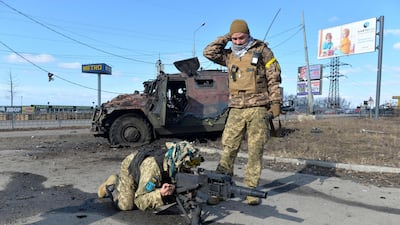
Ukrainian fighters test an automatic grenade launcher taken from a destroyed Russian infantry vehicle in Kharkiv. AFP -
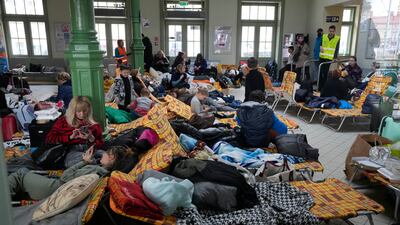
Refugees from Ukraine rest after arriving at a railway station in Przemysl, Poland. AP -
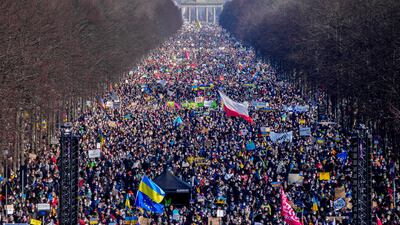
People walk down 17th June Street in Berlin before a rally against Russia’s invasion of Ukraine. AP -
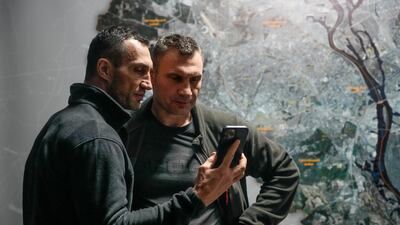
Vitali Klitschko, Mayor of Kiev and former heavyweight boxing champion, right, and his brother, Wladimir. AP -
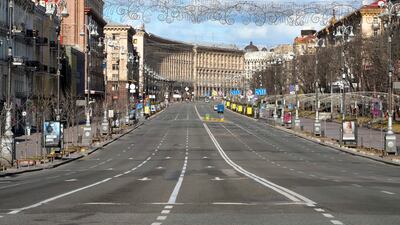
Khreshchatyk, Kiev’s main street, lies empty as a curfew comes into effect. AP -
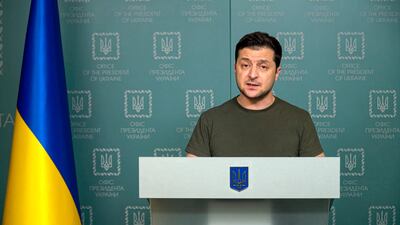
Ukrainian President Volodymyr Zelenskyy speaks to the nation from Kiev. AP -
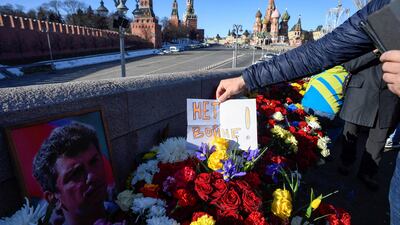
On February 27, the seventh anniversary of the assassination of opposition leader Boris Nemtsov, a note stating ‘No to war!’ is placed among flowers on the central Moscow bridge on which he was shot. AFP -
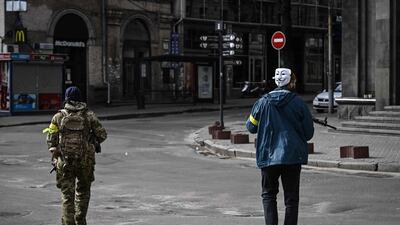
A member of the Ukrainian forces, wearing the Guy Fawkes mask popularised by Anonymous, patrols central Kiev. AFP -
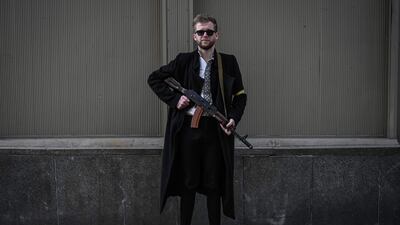
Sviatoslav Yurash, 26, a politician from President Volodymyr Zelenskyy’s Servant of the People party, poses with his assault rifle as he patrols Kiev. AFP -
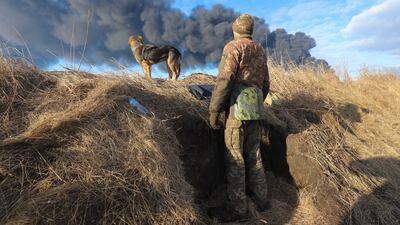
A Ukrainian serviceman and his dog look at smoke from a burning fuel storage depot after a Russian missile attack near Kiev. EPA -
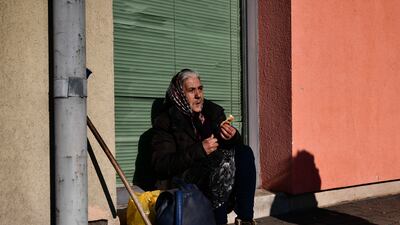
A refugee who fled conflict in Ukraine rests at a railway station after arriving in Zahony, Hungary. AP -
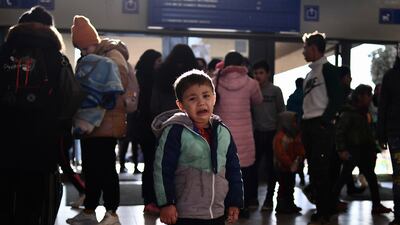
A refugee boy who fled Ukraine cries at the railway station in Zahony, Hungary. AP -
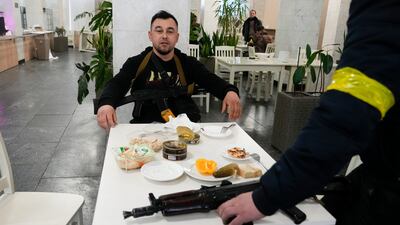
Civil defence members eat during a break at City Hall in Kiev. AP -

An Indian student is embraced by his family at Chennai Airport after returning from Ukraine. EPA -

An armed civil defence woman holds a Kalashnikov assault rifle while patrolling an empty street in Kiev. AP -
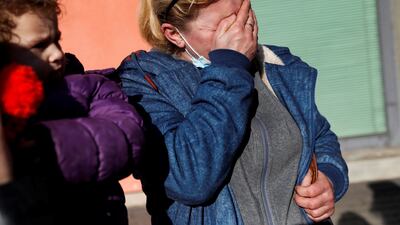
A woman fleeing from Ukraine cries as she waits to be taken to a shelter in Zahony, Hungary. Reuters -
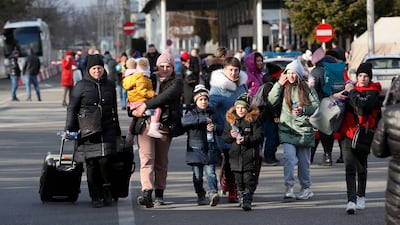
Ukrainian refugees cross the Romanian border at Siret, northern Romania. EPA -
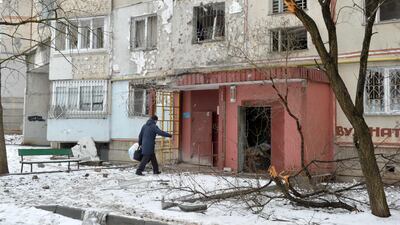
A residential building damaged by shelling in Kharkiv, north-eastern Ukraine. AFP -
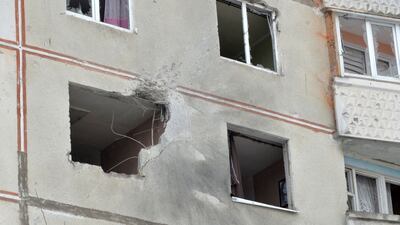
Apartments damaged by shelling in Kharkiv. AFP -

A girl protests against Russia's military operation in Ukraine, in front of the Russian embassy in Tel Aviv. AFP -
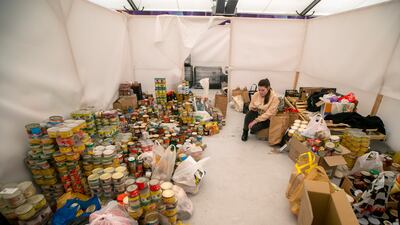
Supplies for Ukrainian refugees at one of three camps set up at the MoldExpo exhibition center, in Chisinau, Moldova. EPA -
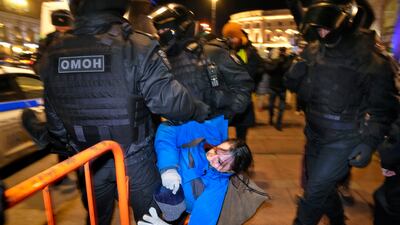
Police detain a demonstrator during a protest against Russia's incursion into Ukraine in St Petersburg. AP -
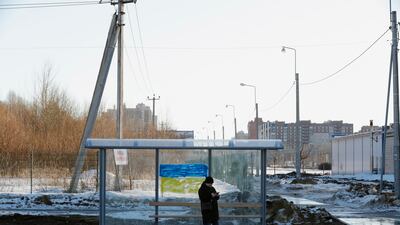
A man waits at a bus stop in St Petersburg, which has been with a painted in the colours of Ukraine's national flag. EPA -
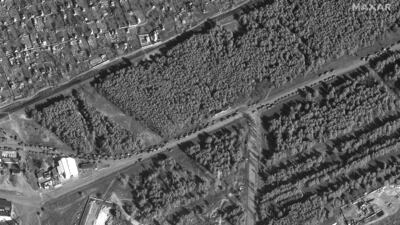
Russian ground forces approaching Nova Kakhovka, southern Ukraine. AP -
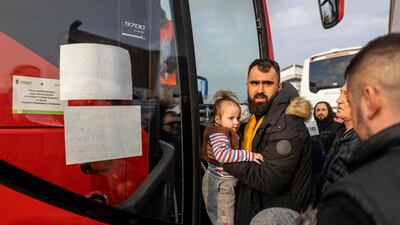
Refugees arrive with buses from the Medyka pedestrian border crossing, in Przemsyl, eastern Poland. AFP -
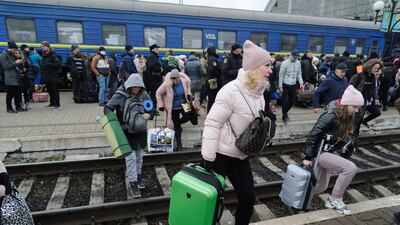
People gather to catch a train and leave Ukraine for neighboring countries at the railway station in Lviv, western Ukraine. AP -
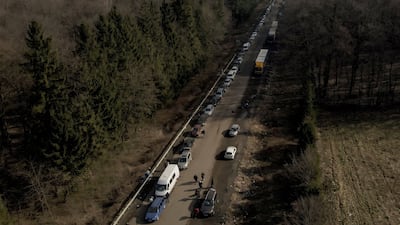
Cars form a line that stretches 35 kilometres from the Shehyni border crossing to Poland as people try to flee Russia's military operation against Ukraine. Reuters -
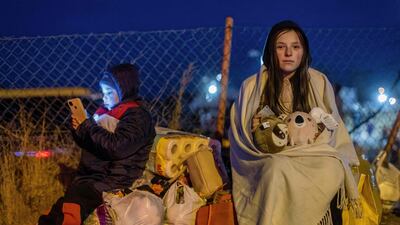
Helena, right, and her brother Bodia, left, from Lviv, wait at the Medyka border crossing in eastern Poland. AFP -
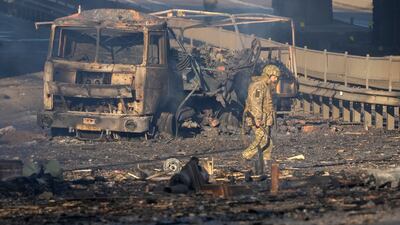
A Ukrainian soldier walks past debris of a burning military truck, on a street in Kiev. AP -
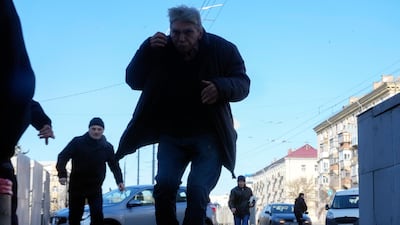
People run for cover during the shelling on the city of Kiev. AP -
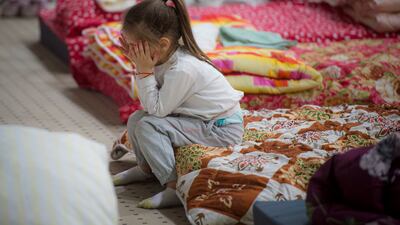
A child refugee who fled the conflict in Ukraine covers her face in the event hall of a hotel offering shelter in Siret, Romania. AP -
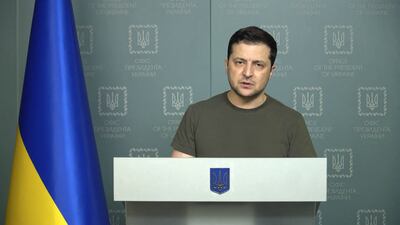
Ukrainian President Volodymyr Zelenskyy holding a briefing in Kyiv. He said that Azerbaijan's President Ilham Aliyev and Turkey's Recep Tayyip Erdogan have suggested talks with Russia, which 'can only be welcomed'. AFP -
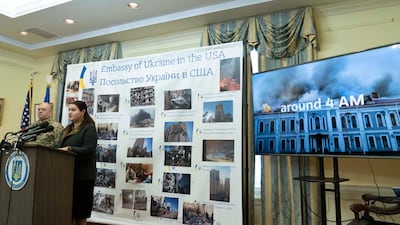
Ukraine's ambassador to the US, Oksana Markarova, at a news conference in the embassy of Ukraine, Washington. AP -
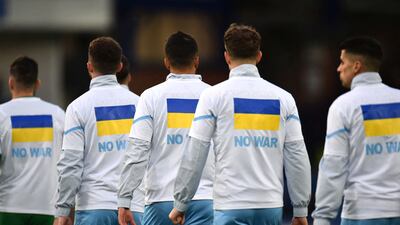
Manchester City footballers wear t-shirts in support of Ukraine before a match. Reuters -

Ukrainian refugees arrive in Warsaw by train from Kiev. EPA -
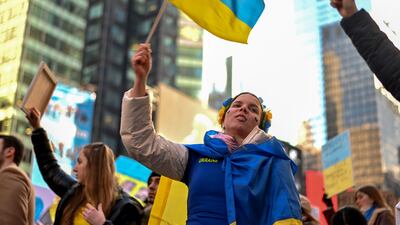
A woman waves a Ukrainian flag during a rally in Times Square, New York City. AFP -

A man sits next to his dogs in an underground car park turned into a bomb shelter during an air raid alert in Kiev. AP -
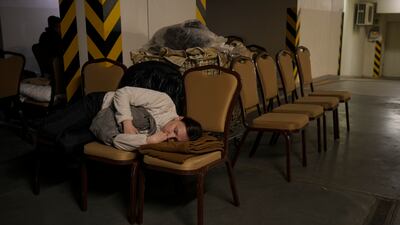
A woman sleeps on chairs in a Kiev bomb shelter. AP -
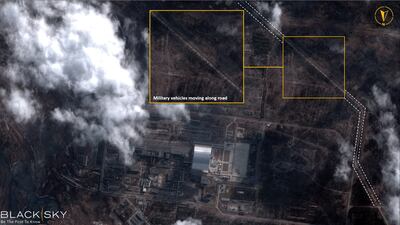
A satellite image with overlaid graphics shows military vehicles alongside the Chernobyl Nuclear Power Plant. Reuters -
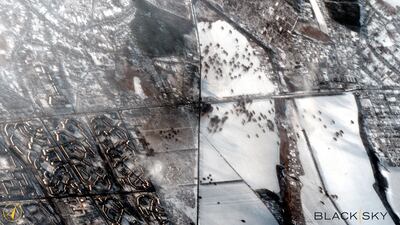
A satellite image shows the effects of shelling in open fields along Soborna Street in the north-east suburbs of Kharkiv. Reuters -
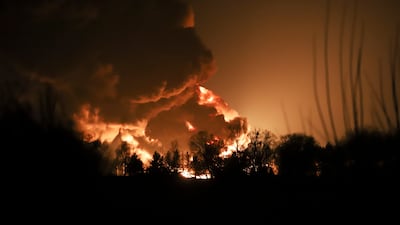
A big fire at a petroleum storage depot after a Russian missile attack, in Vasylkiv, near Kiev. EPA -
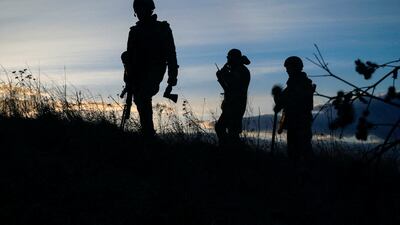
Ukrainian servicemen take positions at a military airbase in the Kyiv region. Reuters


"Markets may well feel that the worst of the bad news is now out there, especially on the sanctions front. I am not so sure of that, but the market is always right, and we have to respect the momentum from a short-term perspective," said Jeffrey Halley, senior market analyst at Oanda.
However, Hasnain Malik, head of equity research at Tellimer Research said the currency's devaluation "is likely not over after the sanctioning of the central bank and the likely move from fiscal surplus to deficit amid the continuation of the war in Ukraine".

The Institute of International Finance said it believes US and EU sanctions on Russia’s central bank will make it more difficult for the Bank of Russia to use its foreign currency reserves to soften the blow to the country’s financial system.
"This will have a significant effect on Russian banks — despite efforts in recent years to reduce the exposure to risks related to a loss of US dollar access and to maintain control over FX reserves," the IIF said.
Since Russia first came under sanctions in 2014, the Bank of Russia has reduced the share of its reserve assets in dollars and its holdings of US Treasuries with gold surpassing the dollar in Russia’s reserves, accounting for more than 20 per cent. The dollar’s share of reserves was reduced to 16 per cent from 43 per cent in early 2014 and China's renminbi accounts for 13 per cent.
While the Russian currency plunged, Bitcoin jumped more than 13 per cent overnight to above $44,000 as a result of rising demand for cryptocurrencies amid the Ukraine crisis. The world's largest cryptocurrency was trading at $43,327.90 at 2.49pm UAE time.
"Traders are pricing in the cryptos will become an alternative to roubles as Russian citizens desperately remove their money from local banks and switch it into any alternative they can get their hands on. I would have expected this trade to appear much sooner, but the European and US Swift announcements and the freezing of central bank and oligarch assets appear to have finally set that ball rolling," Mr Halley said.
Ipek Ozkardeskaya, senior analyst at Swissquote Bank said "the coin, which was moving along with the risk assets less than a couple of days ago is now the asset that Russians and Ukrainians rely on to get their funds out of the traditional system, which has become very hostile to them".
Trading on the Moscow's benchmark MOEX Index was suspended for a second day on Tuesday, the Bank of Russia said.
Last Thursday, the exchange briefly suspended trading after it plunged more than 45 per cent and closed 33 per cent lower, making it the fifth-worst plunge in stock market history.

Despite Western measures, the US and EU have notably not placed sanctions on Russia’s energy and commodity industries, which are integral to the global economy. That has averted an energy crisis. Russia is among the world's biggest producers of oil and natural gas, in addition to nickel, aluminium, palladium, cobalt, copper, wheat and barley.
Moscow has not disrupted energy supplies to European countries. On Tuesday, Gazprom said it was delivering 109.6 million cubic metres of gas to European customers through Ukrainian territory.
Brent, the benchmark for two thirds of the world's oil, was up 5.4 per cent trading at $103.26 per barrel at 4.24pm UAE time on Tuesday. West Texas Intermediate, the gauge that tracks US crude, was also 4.58 per cent higher at $100.10 per barrel.
The International Energy Agency is holding an emergency ministerial meeting on Tuesday on the impact of the Ukraine crisis on oil supply and how IEA members can play a role in stabilising energy markets. US Secretary of Energy Jennifer Granholm will chair the meeting in her capacity as 2022 IEA Ministerial Chair.
"The supply risk continues to drive the bullish trajectory in oil prices, and oil outages in the region are still a high probability. Continued fighting in Ukraine itself puts Black Sea trade at risk, and with 2 million bpd of Russia, Kazakh, and Azeri oil passing through the Novorossiysk terminal daily, any disruption would have a direct upward risk premium," said Rystad Energy’s senior oil market analyst Louise Dickson.
"At immediate risk is the transport of Russian oil via the Druzhba pipeline, which can carry 1 million bpd of exports to Europe. Unless there is a severe Russia-related supply disruption ahead of this Wednesday’s Opec+ meeting, we do not yet expect Saudi Arabia, the UAE and Iraq to lead the group and offer more supply to balance oil markets."
In 2020, Russia produced about 10.2 million barrels a day of crude oil and natural gas condensate, placing it second after the US, with Saudi Arabia in third place, according to the 2021 BP Statistical Review of World Energy. It is also the second-largest producer of natural gas in the world.

