WeWork is set to make its Wall Street debut two years after the company's spectacular collapse in its first attempt. AFP

WeWork belatedly makes Wall Street debut


  • English
  • Arabic

WeWork finally made its stock market debut on Thursday after spectacularly collapsing in its first attempt that led to the ousting of chief executive and co-founder Adam Neumann two years ago.

WeWork started trading on the New York Stock Exchange under the ticker symbol “WE”. It closed at $11.78 per share, up 13.49 per cent for the day.

The company is coming out more than a year into a pandemic that closed millions of square metres of office space and the hope is that a work environment turned upside down is the ideal time for a company that sells shared workspace to thrive.

The group abandoned its plans for an IPO in 2019 after its business model and Mr Neumann's exorbitant spending drew concerns from investors. The company had been valued at $47 billion before investors began to buck.

Now, two years later, and with significant changes to its top leadership, the company is trying again.

Shareholders from a special-purpose acquisition company (SPAC), called BowX, voted on Tuesday to merge with WeWork. The deal reportedly valued the company at $9bn, well below its 2019 valuation.

Japan’s SoftBank, a major early investor, will hold a majority stake as part of the SPAC. Mr Neumann is not out of the picture either and will hold voting power of more than 10 per cent in the newly formed company.

After the IPO disaster, WeWork’s business was further battered by the Covid-19 pandemic. Many customers cancelled leases and stopped paying rent when the economy turned and workers stayed at home. WeWork’s loss ballooned to more than $2bn in the first quarter of this year.

Things have rebounded in recent months, WeWork executives have said. Revenue in the first half of the year was $1.19bn.

The company has shifted its focus from young freelancers towards companies with hundreds of employees looking for spaces in urban centres, greatly accelerated by telecommuting policies implemented during the Covid-19 pandemic.

“WeWork has transformed its business by overhauling its operations and cost structure, rightsizing its real estate portfolio and most importantly, refocusing on its core product,” Anthony Yazbeck, the group's chief operating officer, told Agence France-Presse.

The group, which has 762 workspaces in 38 countries and 150 cities, generated $658 million in revenue between July and September, but continues to lose money.

Agencies contributed to this report

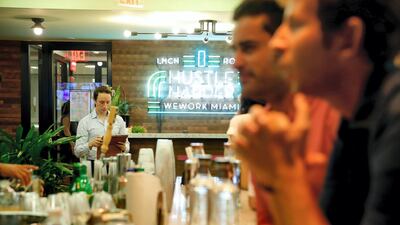
  • A view of a WeWork office in Miami, Florida. UAE's first WeWork location will opened in early 2020. Getty Images
    A view of a WeWork office in Miami, Florida. UAE's first WeWork location will opened in early 2020. Getty Images
  • Members work in a common room at the Embarcadero WeWork in San Francisco, California. The first WeWork space was established in Abu Dhabi's Hub 71. Bloomberg
    Members work in a common room at the Embarcadero WeWork in San Francisco, California. The first WeWork space was established in Abu Dhabi's Hub 71. Bloomberg
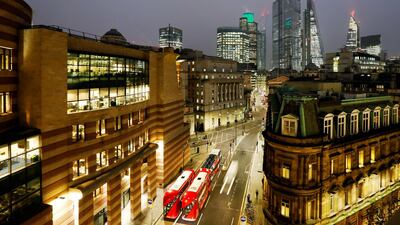
  • WeWork co-working space in the City of London. Abu Dhabi's Hub71, the technology and start-up enterprise based in Abu Dhabi Global Market (ADGM) at Al Maryah Island, has a WeWork space. Bloomberg
    WeWork co-working space in the City of London. Abu Dhabi's Hub71, the technology and start-up enterprise based in Abu Dhabi Global Market (ADGM) at Al Maryah Island, has a WeWork space. Bloomberg
  • WeWork in Tokyo, Japan. WeWork is backed by Japan’s SoftBank VisionFund, which counts Abu Dhabi’s Mubadala Investment Company and Saudi Arabia’s Public Investment Fund. Bloomberg
    WeWork in Tokyo, Japan. WeWork is backed by Japan’s SoftBank VisionFund, which counts Abu Dhabi’s Mubadala Investment Company and Saudi Arabia’s Public Investment Fund. Bloomberg
  • WeWork in the Seaport neighborhood of Boston, Massachusetts. Bloomberg
    WeWork in the Seaport neighborhood of Boston, Massachusetts. Bloomberg
  • WeWork in Manhattan, New York. Bloomberg
    WeWork in Manhattan, New York. Bloomberg
  • A co-working space in Gurugram, India. Bloomberg
    A co-working space in Gurugram, India. Bloomberg
  • WeWork in the City of London. Bloomberg
    WeWork in the City of London. Bloomberg
Who has lived at The Bishops Avenue?
  • George Sainsbury of the supermarket dynasty, sugar magnate William Park Lyle and actress Dame Gracie Fields were residents in the 1930s when the street was only known as ‘Millionaires’ Row’.
  • Then came the international super rich, including the last king of Greece, Constantine II, the Sultan of Brunei and Indian steel magnate Lakshmi Mittal who was at one point ranked the third richest person in the world.
  • Turkish tycoon Halis Torprak sold his mansion for £50m in 2008 after spending just two days there. The House of Saud sold 10 properties on the road in 2013 for almost £80m.
  • Other residents have included Iraqi businessman Nemir Kirdar, singer Ariana Grande, holiday camp impresario Sir Billy Butlin, businessman Asil Nadir, Paul McCartney’s former wife Heather Mills. 
Hunting park to luxury living
  • Land was originally the Bishop of London's hunting park, hence the name
  • The road was laid out in the mid 19th Century, meandering through woodland and farmland
  • Its earliest houses at the turn of the 20th Century were substantial detached properties with extensive grounds


Benefits of first-time home buyers' scheme
  • Priority access to new homes from participating developers
  • Discounts on sales price of off-plan units
  • Flexible payment plans from developers
  • Mortgages with better interest rates, faster approval times and reduced fees
  • DLD registration fee can be paid through banks or credit cards at zero interest rates
SECRET%20INVASION
%3Cp%3E%3Cstrong%3EDirector%3A%3C%2Fstrong%3E%20Ali%20Selim%20%3Cbr%3E%3Cstrong%3EStars%3A%3C%2Fstrong%3E%20Samuel%20L%20Jackson%2C%20Olivia%20Coleman%2C%20Kingsley%20Ben-Adir%2C%20Emilia%20Clarke%20%3Cbr%3E%3Cstrong%3ERating%3A%3C%2Fstrong%3E%203%2F5%26nbsp%3B%3C%2Fp%3E%0A
Ten tax points to be aware of in 2026

1. Domestic VAT refund amendments: request your refund within five years

If a business does not apply for the refund on time, they lose their credit.

2. E-invoicing in the UAE

Businesses should continue preparing for the implementation of e-invoicing in the UAE, with 2026 a preparation and transition period ahead of phased mandatory adoption. 

3. More tax audits

Tax authorities are increasingly using data already available across multiple filings to identify audit risks. 

4. More beneficial VAT and excise tax penalty regime

Tax disputes are expected to become more frequent and more structured, with clearer administrative objection and appeal processes. The UAE has adopted a new penalty regime for VAT and excise disputes, which now mirrors the penalty regime for corporate tax.

5. Greater emphasis on statutory audit

There is a greater need for the accuracy of financial statements. The International Financial Reporting Standards standards need to be strictly adhered to and, as a result, the quality of the audits will need to increase.

6. Further transfer pricing enforcement

Transfer pricing enforcement, which refers to the practice of establishing prices for internal transactions between related entities, is expected to broaden in scope. The UAE will shortly open the possibility to negotiate advance pricing agreements, or essentially rulings for transfer pricing purposes. 

7. Limited time periods for audits

Recent amendments also introduce a default five-year limitation period for tax audits and assessments, subject to specific statutory exceptions. While the standard audit and assessment period is five years, this may be extended to up to 15 years in cases involving fraud or tax evasion. 

8. Pillar 2 implementation 

Many multinational groups will begin to feel the practical effect of the Domestic Minimum Top-Up Tax (DMTT), the UAE's implementation of the OECD’s global minimum tax under Pillar 2. While the rules apply for financial years starting on or after January 1, 2025, it is 2026 that marks the transition to an operational phase.

9. Reduced compliance obligations for imported goods and services

Businesses that apply the reverse-charge mechanism for VAT purposes in the UAE may benefit from reduced compliance obligations. 

10. Substance and CbC reporting focus

Tax authorities are expected to continue strengthening the enforcement of economic substance and Country-by-Country (CbC) reporting frameworks. In the UAE, these regimes are increasingly being used as risk-assessment tools, providing tax authorities with a comprehensive view of multinational groups’ global footprints and enabling them to assess whether profits are aligned with real economic activity. 

Contributed by Thomas Vanhee and Hend Rashwan, Aurifer

Why are asylum seekers being housed in hotels?

The number of asylum applications in the UK has reached a new record high, driven by those illegally entering the country in small boats crossing the English Channel.

A total of 111,084 people applied for asylum in the UK in the year to June 2025, the highest number for any 12-month period since current records began in 2001.

Asylum seekers and their families can be housed in temporary accommodation while their claim is assessed.

The Home Office provides the accommodation, meaning asylum seekers cannot choose where they live.

When there is not enough housing, the Home Office can move people to hotels or large sites like former military bases.

Last 10 NBA champions

2017: Golden State bt Cleveland 4-1
2016: Cleveland bt Golden State 4-3
2015: Golden State bt Cleveland 4-2
2014: San Antonio bt Miami 4-1
2013: Miami bt San Antonio 4-3
2012: Miami bt Oklahoma City 4-1
2011: Dallas bt Miami 4-2
2010: Los Angeles Lakers bt Boston 4-3
2009: Los Angeles Lakers bt Orlando 4-1
2008: Boston bt Los Angeles Lakers 4-2

A cheaper choice

Vanuatu: $130,000

Why on earth pick Vanuatu? Easy. The South Pacific country has no income tax, wealth tax, capital gains or inheritance tax. And in 2015, when it was hit by Cyclone Pam, it signed an agreement with the EU that gave it some serious passport power.

Cost: A minimum investment of $130,000 for a family of up to four, plus $25,000 in fees.

Criteria: Applicants must have a minimum net worth of $250,000. The process take six to eight weeks, after which the investor must travel to Vanuatu or Hong Kong to take the oath of allegiance. Citizenship and passport are normally provided on the same day.

Benefits:  No tax, no restrictions on dual citizenship, no requirement to visit or reside to retain a passport. Visa-free access to 129 countries.

Guide to intelligent investing
Investing success often hinges on discipline and perspective. As markets fluctuate, remember these guiding principles:
  • Stay invested: Time in the market, not timing the market, is critical to long-term gains.
  • Rational thinking: Breathe and avoid emotional decision-making; let logic and planning guide your actions.
  • Strategic patience: Understand why you’re investing and allow time for your strategies to unfold.
 
 
Updated: October 21, 2021, 9:31 PM