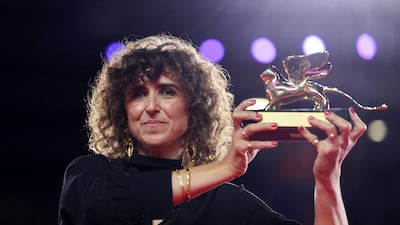
Before winning the Golden Lion for Woman Unknown, May el-Toukhy was already finding some humour in her film’s title.
“I’m probably the most known ‘woman unknown’ in my business, right?” she grins, meeting The National at the Hungaria Hotel on Venice’s Lido on a roasting hot afternoon.
The Danish-Egyptian filmmaker would go on to win the Venice Film Festival’s highest prize on Saturday for her third feature, with its lead, Mathilde Arcel, also receiving the Volpi Cup for Best Actress.

At the time of our conversation, however, much of the attention surrounding the film concerns how few women have been selected to compete.
El-Toukhy has built a career across television and film, including her 2019 Sundance audience award winner Queen of Hearts and episodes of The Crown on Netflix.
At Venice, she is the only woman directing a main competition entry solo, with Rachel Szor co-directing the documentary Naza alongside Yuval Abraham.
“I would have loved to have more female colleagues in competition,” she sighs. “I hope, for the sake of our daughters and the generations to come, that we’ll be able to turn this discourse around. But I think it takes all of us to do that and therefore I would have loved if this question was also asked to my male colleagues in competition and all the delegates here, because it’s really an issue that we all have to debate and chip in on in order to solve it.”

The treatment of women also drives Woman Unknown, set in Denmark shortly after the Second World War. Arcel plays Marie, a nanny preparing to marry her employer, a wealthy factory owner who knows nothing of the wartime relationship with a German soldier she is trying to keep secret.
El-Toukhy and her co-writer Maren Louise Kaehne began with photographs from 1943 that had been republished in a Danish newspaper. The images showed a woman being publicly humiliated.
“They showed this woman who had her clothes ripped off,” she explains. “She was sitting and lying on a bench, she was clearly in agony and there was a swastika painted on her back.
“These photos were actually propaganda photos, if you have an intimate relationship with a German soldier, this could happen to you, and so we started talking about the female body as part of a national property, almost national territory, in times of war and how that is a very universal theme.”
El-Toukhy wanted to examine the reprisals that followed the end of the occupation, including the targeting of women who had relationships with German soldiers. Her interest lay in the difficult questions surrounding guilt and punishment.
“Many European nations reacted against people who had had intimate relationships or had collaborated with the Germans, and understandably so,” she says. “And so for us there was a real potential to dive into all the perspectives of that. I always gravitate towards telling stories where it’s not easy for an audience.”
Some of the film’s most striking moments come as Marie witnesses other women being humiliated and abused, much like the woman in the photographs.
“The film is about the female body as a battleground,” El-Toukhy says, describing “these women who got dragged into the street and cut and assaulted … and spat on and stigmatised for life”.
The film also examines Denmark’s reckoning with its own conduct during the occupation. For El-Toukhy, the punishment of individuals raises questions about the compromises made by the country’s leaders.
“Denmark's government chose to collaborate with the Germans to avoid too many casualties because we’re such a small nation,” she says.
“They occupied us, but at the same time we were co-operating with them to some extent and so then afterwards, in a way, we had to rewrite the narrative, I think, in order to live with ourselves and the fact that we chose that path instead of putting up resistance from the get-go.”

El-Toukhy’s interest in people judged and excluded by those around them extends to her own childhood.
Raised in Denmark by a Danish mother, a social worker, and an Egyptian father, a computer scientist, she grew up conscious of how others saw her family.
“I think that stems from growing up in a predominantly white setting as a brown person, looking through my father’s eyes, who is a first-generation immigrant, sensing his stress.
“He felt that he was defined by the surroundings and didn’t have a voice himself and he unwillingly passed that gene on to his children. Somehow in my stories that’s always present.”
She studied at the Danish National School of Performing Arts and the National Film School of Denmark, and has predominantly lived and worked in Europe. Asked whether she feels connected to her Egyptian heritage and has stories from that part of her life she wants to tell, she is emphatic.
“I do feel connected. When I was younger, I would say I’m half Egyptian, half Danish. Now I feel like I’m double! I’m a double person. I carry both. I do have stories and I especially have stories about growing up outside of Egypt with an Egyptian Muslim background.
“I was born in 1977, so in the ’80s and ’90s there was a real right-wing wave that flushed over Europe. What did that mean for my family? I’m interested in investigating that.”

