
One of the stranger cases Ashraf Elashmawy investigated during his legal career involved a missing bird.
It was 1990, and the young Egyptian prosecutor was assigned a case involving a peacock stolen from Cairo Zoo.
“The bird was actually taken home by the zoo guard, slaughtered by his wife and served with molokhia, a traditional Egyptian dish,” Elashmawy recalls.

The incident later found its way into his 2019 novel The House of the Coptic Woman, which follows a young prosecutor investigating mysterious deaths in rural Egypt amid rising religious tension.
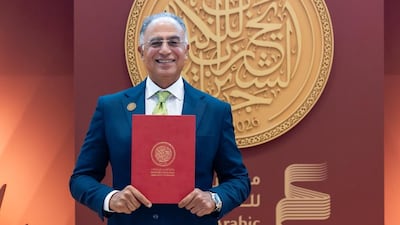
Now an established criminal court judge and acclaimed novelist, whose latest book Births in the Zoo won this year's Sheikh Zayed Book Award, Elashmawy says his legal career has given him a more intimate view of Egyptian society, where everyday events can be stranger than anything a novelist can conjure.
“I don't think I write fantasy as much as I write absurd realism. Because reality itself is actually very absurd.
“I think reality has surpassed the imagination of writers everywhere in the world,” he tells The National at Frankfurt Book Fair, where he confirmed that an English translation of Births in the Zoo is under way.
Originally published in Arabic in 2024, the book consists of three interconnected novellas about Egyptians whose attempts to improve their lives lead them into increasingly difficult circumstances.

One follows a young man who agrees to serve a prison sentence on behalf of someone from a wealthy family in exchange for financial security. Another tells the story of Fayez Hanna, a Christian pig farmer who adopts a Muslim identity to conceal his past after religious extremists burn down his farm. In the title novella, a veterinary graduate becomes entangled in the zoo's internal politics.
While satire and dark humour run through the collection, Elashmawy says the three stories are driven by frustration with social restrictions and the human tendency towards deception and self-interest.
“I think this preoccupation leads me to satirise the reality in which these people live. The satire comes naturally, without being deliberate,” he adds.
“You can't force satire. That's the difficult thing with using it, as readers know when you are being forceful with it, and I won't be able to defend what I've written. You have to write what you believe in.”
That combination of conviction and observation has been shaped partly by Elashmawy's 36 years in Egypt's judiciary, during which he rose from public prosecutor to president of the Cairo Criminal Court. The experience, he says, has influenced both his writing and how he approaches people appearing before him.
“The judiciary has made me a better writer, and I do feel I have an advantage that other writers don't necessarily have because every day I see thousands of stories, hundreds of stories, about people, criminals and victims,” he says.
“At the same time, publishing, literature, writing and meeting readers have made me a more merciful and more humane judge.”
For Elashmawy, being a judge and developing fictional characters require a similar understanding of human behaviour, looking beyond an offence to consider a person's upbringing, motivations and circumstances.
“A judge is not a machine that applies the law, opens a book, sees the punishment and applies it to the criminal. He takes into consideration the circumstances of a person's social upbringing. Was this criminal a victim of society? Was this criminal greedy? Was this criminal authoritarian? Was this criminal a victim of other people?” he says.

He brings a similar approach to his literary work, drawing on experiences accumulated over the years to develop stories and settings for his novels.
“As a novelist and a judge, they are interconnected. But when I write, I completely free myself from the judge. Completely. I take off the judge's robe.
“When I go to court, I put on the judge's robe, but my novelist's mind does not stop working. It remains occupied with what is around me. Sometimes I see images and scenes that could become novels, and I write them down on a piece of paper,” he says.
The title of Births in the Zoo also emerged from real-life research. Elashmawy discovered that children born to employees living inside Cairo Zoo could have the zoo officially recorded as their birthplace.
“There is a person who was born in the zoo. An Egyptian man born in 1951 in the zoo. He is still living in Cairo today, and his birth certificate and identity card say that he was born in the zoo.
“When I won the Sheikh Zayed Book Award, he called me and said, ‘I deserve half the prize.’ In a way, he is right.”

For Elashmawy, the award's value lies beyond its financial prize and recognition, particularly in the opportunities it provides to meet foreign publishers, attend international book fairs and reach readers through translation.
“I do feel a great sense of pride after winning the Sheikh Zayed Book Award, not simply because it is one of the biggest prizes in the Arab world,” he says. “There are other prizes that offer substantial financial rewards or lead to increased book sales. But this particular award offers you more after winning it than before. It provides a bridge to western culture, so this is extremely important.”
Yet despite the awards and growing international readership, Elashmawy says he continues to regard writing as a welcome break from his judicial work rather than a professional obligation.
“I love this hobby of mine. I still don't consider myself a professional. I'm still an amateur,” he says. “That is important to me because I love writing. I feel that it's a game, and that I'm a child at play.”

