
Most people heading to the Abu Dhabi International Book Fair will leave with something new to read. But scattered among the stands, often encased in the glass displays dotted through the halls, are books, manuscripts and photographs that have already survived for hundreds of years, and in one case for almost two millennia.
Rare-book dealers have been bringing their wares to Abu Dhabi for more than two decades, with objects spanning early Islamic history, ancient Greece, the first decades of European printing, Renaissance France and the history of the Gulf.
“I have been coming here for 20 years and you can see a growing respect for these kinds of books,” says Hugo Wetscherek, owner of Austria's Inlibris that specialises in buying and selling rare books, maps, manuscripts and autographs.

“This also comes as more museums have been built and opened in Abu Dhabi. It is all connected in terms of people appreciating history and understanding how some of these works come to these institutions.
“Years ago, people would ask me: ‘Why aren’t your pieces in museums?’ I would reply: ‘How do you think they got there?’ Sometimes it is through acquiring them from dealers like us. Now there is a much greater understanding of what we do,” adds Wetscherek.
Here are eight historic pieces to look out for at the Abu Dhabi International Book Fair, which is running at the Adnec Centre until Friday.
1. Fragment of Homer's Iliad

One of the oldest objects at the fair resembles little more than scraps of paper, yet the story they preserve helped inspire this summer’s blockbuster The Odyssey.
At the Inlibris stand, small pieces of papyrus contain some of the opening lines of the second book of Homer’s Iliad and date to the middle of the second century, making them about 1,850 years old.
The passage comes at the beginning of a new stage in the Trojan War, as Zeus sends a deceptive dream to Agamemnon, commander of the Greek forces. “These are the first 30 lines of Book II,” Wetscherek says. “The other part is in the Metropolitan Museum in New York, and this is one of only two known surviving fragments from this particular papyrus. It is something amazing to be able to find.”
2. First edition of Galileo’s The Starry Messenger

Circles marked by uneven patches of light and shade may look like simple drawings, but in 1610 they helped change the way people looked at the sky.
These appear in Galileo Galilei’s Sidereus Nuncius, or The Starry Messenger, published after the astronomer used a telescope to study the moon and stars. His observations showed a lunar surface marked by mountains and depressions rather than the smooth, perfect sphere imagined in older cosmology. The copy on display was printed in Venice in 1610, from an original print run of about 550 copies, and is being offered for £650,000 ($875,000) at the Peter Harrington stand.
3. A 1903 photograph from the Trucial Coast

A faded photograph with the handwritten caption “Sheik of Sharjah and Staff” is among the most intriguing UAE-related objects at the fair. Displayed by Forum Rare Books, it comes from an album compiled by Royal Navy officer Charles Courtenay Bell between 1900 and 1909, and was taken aboard HMS Argonaut during then Viceroy of India Lord Curzon’s Gulf tour in 1903.
Although the men pictured have not been firmly identified, Laurens Hesselink of Forum Rare Books says the photograph is the centrepiece of the album. “It is really the earliest photo of any sheikh from the Trucial States,” he tells The National.
The album contains dozens of photographs from the Gulf and wider region and is being offered for €250,000, with images from other ports and cities visited during Bell’s naval career alongside the photograph taken off Sharjah.
4. An Arabic book of wisdom made in Renaissance France

One of the more striking manuscripts at the fair carries a story stretching from Fatimid Egypt to the French Renaissance.
Mukhtar al-Hikam wa Mahasin al-Kalim, or The Choicest Maxims and Best Sayings, was compiled in the 11th century by Abu al-Wafa al-Mubashshir ibn Fatik. The French translation gathers biographies, sayings and moral teachings associated with figures from the ancient world and circulated widely in the centuries that followed.
The copy on display at the Inlibris stand was made in Paris between 1520 and 1525 for French noblewoman Anne de Polignac. Written on vellum, it contains elaborate decoration and miniature paintings associated with the workshop of French illuminator Etienne Colaud.
5. Photographs of Sheikh Zayed in Pakistan before the UAE was formed

Forum Rare Books has a photographic archive documenting UAE Founding Father, the late Sheikh Zayed bin Sultan Al Nahyan, during visits to Pakistan in the years before the country's unification. The collection contains 183 photographs and original negatives from trips in 1967 and 1970, when Sheikh Zayed was ruler of Abu Dhabi.
One album follows his visit to Lahore in November 1967, while another group records an official trip in January 1970. The photographs range from formal receptions and meetings to quieter moments with members of the Abu Dhabi delegation, with former Pakistani president Yahya Khan and banker Agha Hasan Abedi among those pictured.
Hesselink believes the photographs, which Forum acquired privately, originally came from official sources connected to the visits.
6. Miniature Quran from Qajar Persia
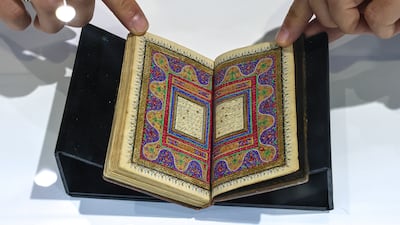
A miniature Quran from Qajar Persia is among the smaller objects on display at the Peter Harrington stand. Produced in the Islamic Hijri year 1286 AH, corresponding to 1869, it remains in its original lacquer binding.
Inside, tiny lines of Arabic script sit within red, blue and gold illumination, with the decoration continuing across pages small enough to hold comfortably in one hand. The manuscript is being offered for £9,750.
7. An 1838 history of Arabia

At San Francisco's Anis Press stall, chief executive Reza Anvar is displaying Andrew Crichton’s The History of Arabia: Ancient and Modern, a two-volume account published in New York by Harper & Brothers in 1834.
The work covers the region’s geography, history and literature, as well as the Hajj and political life across the Arabian Peninsula, accompanied by engravings and a folding map.
The books also come with illustrations and a map showing how the peninsula was being presented to readers in Britain and America during the 19th century.
8. Vintage Arabic Grendizer comics

At the Arab Heritage Foundation stall, Mohamed Sadek has old Arabic Grendizer comics alongside children’s publications that once circulated widely around the region.
He estimates some of the issues are between 40 and 50 years old, and remembers a much broader world of children’s magazines. “People of a certain generation will remember waiting for titles such as these to appear weekly or monthly, with different editions circulating across the Arab world. Each country had its own editions,” Sadek says.
Individual issues at his stall sell for Dh30 to Dh50, depending on their size and whether they are sold separately or as part of a bound volume.
Abu Dhabi International Book Fair runs until September 18 at Abu Dhabi National Exhibition Centre

