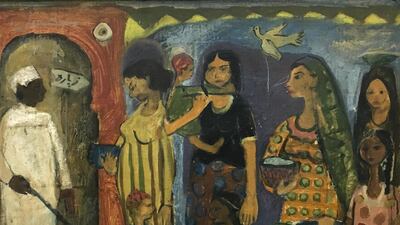
Mariam Abdel-Aleem’s ‘Clinic’ (1958) depicts healthcare in Egypt from the perspective of women. Barjeel Art Foundation

New Barjeel display promotes parity with equal split of artworks by men and women


Melissa Gronlund
  • English
  • Arabic

About a year ago, art collector and lecturer Sultan Al Qassemi, who runs the Barjeel Art Foundation in Sharjah, pledged to make his collection of modern and contemporary Arab art representative of both male and female artists.

He acquired a greater number of works by women artists, and then applied these changes to the display of the collection, which is on long-term loan to the Sharjah Art Museum. Titled A Century in Flux: Highlights from the Barjeel Art Foundation: Chapter II, the show now finishes its first year of gender parity – but the decision remains controversial. What happens when, instead of working towards an equal representation of men and women through incremental change, you leapfrog to its realisation?

Inji Efflatoun's 'Motherhood', c.1950s, which shows a mother breastfeeding her child. Barjeel Art Foundation

The change to the exhibition itself is – to a degree I did not expect – palpable. More women are depicted, particularly in active roles within domestic life: looking after children, tending to pets, organising families. These portrayals are often heroic rather than cloying, such as Inji Efflatoun's stirring portrait from the 1950s, of a woman breastfeeding, her spine ramrod straight, her face aloft (Motherhood). Efflatoun was imprisoned for four years in 1959 for her activism.

Conflict and misfortune, major themes of the first exhibition, are refracted via images of care. The Hunger (1963), made by Lebanese-Syrian artist Derrieh Fakhoury in response to the 1961 Syrian drought, shows a mother holding a starving child. The skin of both are a sallow green; hers is a bit more sickly. And there are images of care in a less iconic sense, such as a woman cheerily feeding a peacock in Algerian artist Baya's Woman with Two Peacocks and Aquarium (1968), and in Tunisian artist Safia Farhat's Child with Heliotropes (1963), in which a young boy proudly shows off his pet bird.

Pets and children are represented in Tunisian artist, activist and journalist Safia Farhat’s 'Child with Heliotropes' (1963). Barjeel Art Foundation

“Women depict women,” says Al Qassemi. “One reason why you should show women, is that they know women. They depict scenes they have access to. [Saudi artist] Safeya Binzagr had access to women’s weddings and the henna ceremony. Men weren’t allowed in. How can you expect men to go in and paint the henna ceremony?”

Men wouldn't have been able to view scenes such as these, of women breastfeeding while waiting to be seen in Egypt's new health clinics. Menhat Helmy, 'Outpatient Clinic' (1958). Image courtesy of Barjeel Art Foundation, Sharjah

This access seems to have changed the works in subtle ways. Take the case of two works showing doctor's offices: Mariam Abdel-Aleem's Clinic and Menhat Helmy's Outpatient Clinic (both 1958). They depict the large-scale investment in Egypt's public-health infrastructure in the 1950s, after the country's new constitution of 1952 pronounced free medical care as a right for all.

In Abdel-Aleem’s portrayal, four women wait with their children in a line. A child hangs off the neck of one weary-looking mother; another carries a bowl and vegetables, perhaps as a snack to keep her children occupied. Abdel-Aleem’s painting abuts Helmy’s, in which the latter’s more stylised, folkloric figures sit on benches outdoors. Some hold children on their knees; others nurse while they all wait.

As I look back and forth between them, I feel myself trading my art critic's hat for my weekend one. Taking children to the doctor is a unique mix of boredom and anxiety, the two criss-crossing emotions of early motherhood: the waits are long, there is the worry that something might be discovered to be wrong, as well as the low-level stress of persuading children to be on their best behaviour in front of an authority figure who, the last time, poked them full of needles. Or, worse, the fear of judgment, where the forgotten start date for a rash could turn into a verdict on you, the suddenly unworthy mother. The apparently neutral space of the waiting room is rendered in all its emotional complexity.

Depictions of care predominate in the new Barjeel Art Foundation hang. Here, the Algerian artist Baya paints a woman and her pets in 'Woman with Two Peacocks and Aquarium' (1968). Image courtesy of Barjeel Art Foundation, Sharjah

But is the prevalence of these heroic and sensitive depictions art historically accurate? They might serve as an immense validation, but are they really the hidden half of Arab art history? It turns out that the decision to hang the works as 50/50 men and women has not been a straightforward one, and it has divided opinion even among those who worked on the show.

For Palestinian art historian and NYU Abu Dhabi professor Salwa Mikdadi, who curated the first chapter of A Century in Flux, in 2018, and assisted on this one, the move towards gender parity involves a revision of history. "While the exhibition is beautifully mounted, it does not reflect the reality, which is more complex than equal representation," she says.

Art historian and professor Salwa Mikdadi. NYUAD​​​​​​​​​​​​​​​​​​​​​​​​​​​​​​​​​​​

Sticking to an equal split means overstating the contribution of women artists at points in the historical narrative where they were simply not so present, and glosses over the details of how they were held back. “When I look at the history of women in art in the context of the region, I don’t see women as intentionally marginalised,” Mikdadi says.

In much of the 20th century, women were discouraged from professions such as law, civil engineering and medicine, and art was actually seen as an appropriate field for them. Their ability to contribute was suppressed, though, by social pressures against mixing with men, which kept them out of art academies and the male-dominated bastions of art societies and groups. Their subsequent lack of university degrees meant they were not selected for exhibitions and did not receive the respect their work deserved, explains Mikdadi. ​​​​​​​

Still, she says, from the 1920s, several women received government scholarships and studied in Europe and England, and local art academies were co-educational. By the 1950s, women artists were contributing to art education in the Arab world. Other female artists rose to lead art institutions, such as Wijdan Ali, who set up the Jordan National Gallery of Fine Arts, and the late Layla Al Attar, who directed the Iraqi National Art Museum.

Mikdadi has actively promoted women artists, curating the first major exhibition of female Arab artists, Forces of Change, in 1994, for the National Museum of Women in the Arts in Washington, DC.

Showing women who were not known at the time, Mikdadi argues, risks marginalising the women who challenged the restrictions. Al Qassemi welcomes Mikdadi's dissenting opinion – but remains unperturbed by the contention that Barjeel's display is misrepresentative. "Who says I'm interested in the official narrative?" he says.

“The narrative is that women were not shown, minority artists were not shown, underprivileged individuals were not shown, people who had no connections were not shown. If we were all to stick with displaying exhibitions that adhere to the official narrative, there will be no progress, no expansion of what art is.”

A group of artists at the opening of Taking Shape: Abstraction from the Arab World, 1950s–1980s, which was split 50/50 between men and women, at NYU's Grey Art Gallery last January. Courtesy Sultan Al Qassemi

Al Qassemi is in a privileged position to make the decision. Unlike a public national museum, which would have stronger constraints in terms of curatorial experiments, the arrangement between the privately run Barjeel Art Foundation and the Sharjah Art Museum allows for more risk-taking, including this kind of retroactive affirmative action. He says he is also seeking to show more work by religious and ethnic minorities, with paintings by Jewish, Baha'i and Amazigh artists, and he hopes other institutions will follow his lead.

“Do you really need to see more Picassos? You already are inundated with Picassos, so maybe three or four works will suffice, and then you start expanding what art is and showing other artists,” he says. “How much more enriched is the MoMA display with its Saloua Raouda Choucair [painting] on show. How much more enriched is humanity? Just think about it, the fact that you have young Americans seeing works by a Lebanese artist who was obscure a few years ago – unknown to them. The experience of going to the museum is so much more enriching, and nothing was taken away from it.”

Sultan Al Qassemi, pictured at Cambridge University in 2019 during the Barjeel's Gulf Modernist architecture symposium. Sultan Al Qassemi

Barjeel's decision has already brought new artists into the spotlight, particularly female Iraqi and Egyptian artists of the 1960s and 1970s, a period the collection is strong on. While filling out gaps in the art historical narrative is also a traditional role of scholarship, the artists here have been fast-tracked from research to museum exhibition: which means not only validation, but a larger chance for them to be seen by the public. And greater exposure means more scholarship, ultimately allowing the nuances of women's contribution (and its lack thereof) to be better discussed.

For now, Chapter II has opened the debate – and put the results of its proposition out there for all to consider or simply enjoy.

A Century in Flux: Highlights from the Barjeel Art Foundation: Chapter II is at the Sharjah Art Museum until March


Kandahar%20
%3Cp%3E%3Cstrong%3EDirector%3A%3C%2Fstrong%3E%20Ric%20Roman%20Waugh%3C%2Fp%3E%0A%3Cp%3E%3Cstrong%3EStars%3A%C2%A0%3C%2Fstrong%3EGerard%20Butler%2C%20Navid%20Negahban%2C%20Ali%20Fazal%3C%2Fp%3E%0A%3Cp%3E%3Cstrong%3ERating%3A%3C%2Fstrong%3E%202.5%2F5%3C%2Fp%3E%0A
MATCH INFO

Chelsea 4 (Mount 18',Werner 44', Hudson-Odoi 49', Havertz 85')

Morecambe 0

Our family matters legal consultant

Name: Hassan Mohsen Elhais

Position: legal consultant with Al Rowaad Advocates and Legal Consultants.

Quick pearls of wisdom

Focus on gratitude: And do so deeply, he says. “Think of one to three things a day that you’re grateful for. It needs to be specific, too, don’t just say ‘air.’ Really think about it. If you’re grateful for, say, what your parents have done for you, that will motivate you to do more for the world.”

Know how to fight: Shetty married his wife, Radhi, three years ago (he met her in a meditation class before he went off and became a monk). He says they’ve had to learn to respect each other’s “fighting styles” – he’s a talk it-out-immediately person, while she needs space to think. “When you’re having an argument, remember, it’s not you against each other. It’s both of you against the problem. When you win, they lose. If you’re on a team you have to win together.” 

The Details

Kabir Singh

Produced by: Cinestaan Studios, T-Series

Directed by: Sandeep Reddy Vanga

Starring: Shahid Kapoor, Kiara Advani, Suresh Oberoi, Soham Majumdar, Arjun Pahwa

Rating: 2.5/5 

The five pillars of Islam

1. Fasting 

2. Prayer 

3. Hajj 

4. Shahada 

5. Zakat 

Zidane's managerial achievements

La Liga: 2016/17
Spanish Super Cup: 2017
Uefa Champions League: 2015/16, 2016/17, 2017/18
Uefa Super Cup: 2016, 2017
Fifa Club World Cup: 2016, 2017

Who's who in Yemen conflict

Houthis: Iran-backed rebels who occupy Sanaa and run unrecognised government

Yemeni government: Exiled government in Aden led by eight-member Presidential Leadership Council

Southern Transitional Council: Faction in Yemeni government that seeks autonomy for the south

Habrish 'rebels': Tribal-backed forces feuding with STC over control of oil in government territory

The most expensive investment mistake you will ever make

When is the best time to start saving in a pension? The answer is simple – at the earliest possible moment. The first pound, euro, dollar or dirham you invest is the most valuable, as it has so much longer to grow in value. If you start in your twenties, it could be invested for 40 years or more, which means you have decades for compound interest to work its magic.

“You get growth upon growth upon growth, followed by more growth. The earlier you start the process, the more it will all roll up,” says Chris Davies, chartered financial planner at The Fry Group in Dubai.

This table shows how much you would have in your pension at age 65, depending on when you start and how much you pay in (it assumes your investments grow 7 per cent a year after charges and you have no other savings).

Age

$250 a month

$500 a month

$1,000 a month

25

$640,829

$1,281,657

$2,563,315

35

$303,219

$606,439

$1,212,877

45

$131,596

$263,191

$526,382

55

$44,351

$88,702

$177,403


Itcan profile

Founders: Mansour Althani and Abdullah Althani

Based: Business Bay, with offices in Saudi Arabia, Egypt and India

Sector: Technology, digital marketing and e-commerce

Size: 70 employees 

Revenue: On track to make Dh100 million in revenue this year since its 2015 launch

Funding: Self-funded to date


A little about CVRL

Founded in 1985 by Sheikh Mohammed bin Rashid, Vice President and Ruler of Dubai, the Central Veterinary Research Laboratory (CVRL) is a government diagnostic centre that provides testing and research facilities to the UAE and neighbouring countries.

One of its main goals is to provide permanent treatment solutions for veterinary related diseases. 

The taxidermy centre was established 12 years ago and is headed by Dr Ulrich Wernery. 

GAC GS8 Specs

Engine: 2.0-litre 4cyl turbo

Power: 248hp at 5,200rpm

Torque: 400Nm at 1,750-4,000rpm

Transmission: 8-speed auto

Fuel consumption: 9.1L/100km

On sale: Now

Price: From Dh149,900

Living in...

This article is part of a guide on where to live in the UAE. Our reporters will profile some of the country’s most desirable districts, provide an estimate of rental prices and introduce you to some of the residents who call each area home.

UAE currency: the story behind the money in your pockets
F1 The Movie

Starring: Brad Pitt, Damson Idris, Kerry Condon, Javier Bardem

Director: Joseph Kosinski

Rating: 4/5

Australia tour of Pakistan

March 4-8: First Test, Rawalpindi

March 12-16: Second Test, Karachi

March 21-25: Third Test, Lahore

March 29: First ODI, Rawalpindi

March 31: Second ODI, Rawalpindi

April 2: Third ODI, Rawalpindi

April 5: T20I, Rawalpindi

UAE currency: the story behind the money in your pockets
German intelligence warnings
  • 2002: "Hezbollah supporters feared becoming a target of security services because of the effects of [9/11] ... discussions on Hezbollah policy moved from mosques into smaller circles in private homes." Supporters in Germany: 800
  • 2013: "Financial and logistical support from Germany for Hezbollah in Lebanon supports the armed struggle against Israel ... Hezbollah supporters in Germany hold back from actions that would gain publicity." Supporters in Germany: 950
  • 2023: "It must be reckoned with that Hezbollah will continue to plan terrorist actions outside the Middle East against Israel or Israeli interests." Supporters in Germany: 1,250 

Source: Federal Office for the Protection of the Constitution

%20Ramez%20Gab%20Min%20El%20Akher
%3Cp%3E%3Cstrong%3ECreator%3A%3C%2Fstrong%3E%20Ramez%20Galal%3C%2Fp%3E%0A%3Cp%3E%3Cstrong%3EStarring%3A%3C%2Fstrong%3E%20Ramez%20Galal%3C%2Fp%3E%0A%3Cp%3E%3Cstrong%3EStreaming%20on%3A%20%3C%2Fstrong%3EMBC%20Shahid%3C%2Fp%3E%0A%3Cp%3E%3Cstrong%3ERating%3A%20%3C%2Fstrong%3E2.5%2F5%3C%2Fp%3E%0A
The specs
Engine: 3.0-litre twin-turbo flat-six

Power: 480hp at 6,500rpm

Torque: 570Nm from 2,300-5,000rpm

Transmission: 8-speed dual-clutch auto

Fuel consumption: 10.4L/100km

Price: from Dh547,600

On sale: now 

PROFILE OF CURE.FIT

Started: July 2016

Founders: Mukesh Bansal and Ankit Nagori

Based: Bangalore, India

Sector: Health & wellness

Size: 500 employees

Investment: $250 million

Investors: Accel, Oaktree Capital (US); Chiratae Ventures, Epiq Capital, Innoven Capital, Kalaari Capital, Kotak Mahindra Bank, Piramal Group’s Anand Piramal, Pratithi Investment Trust, Ratan Tata (India); and Unilever Ventures (Unilever’s global venture capital arm)