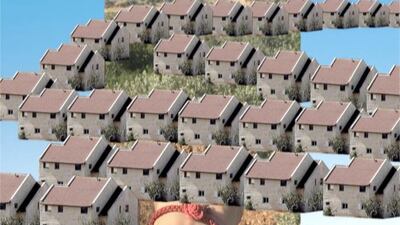
A screenshot of Khaled Jarrar's 'If I don't steal your home, someone else will steal it '. Courtesy the artist

In defence of his homeland: Khaled Jarrar's NFT artworks use the fertile soil of Palestine


Alexandra Chaves
  • English
  • Arabic

During his daily walks in the mountains around Ramallah, Khaled Jarrar began collecting handfuls of soil. Stored in jars, these pieces of Palestinian land are now part of the artist’s first blockchain project, with two new works issued as NFTs (non-fungible tokens).

“I see that these lands are in danger of annexation sooner or later, so I’m taking the soil and putting them in these jars,” he says.

Jarrar's NFT is an animated image entitled If I don't steal your home, someone else will steal it, which shows a valley in the West Bank overtaken by Israeli settlement homes cascading across the screen. In reality, the valley, situated between the villages of Kobar and Jibiya, is controlled by Israeli settlers who moved from the nearby Halamish – also known as Neveh Tzuf – settlement and live under the protection of the Israeli army.

The limited edition NFT comes with a handful of soil that will be sent from Ramallah to the collector.

The fight for land rights is not new in Palestine, nor is it for the Palestinian artist, whose work centres on politics and power, specifically linked to the Israeli occupation.

Palestinian artist Khaled Jarrar collected fertile soils from his village outside Ramallah and is presenting them alongside his NFT artwork. Courtesy Khaled Jarrar

The significance of the soil also references the ecological and agricultural violations inflicted on Palestinians by Israeli civilians, often with knowledge of the army, over the years. "They transform the soil. They burn the trees. They change the entire landscape," Jarrar says.

“They take the soil in these trucks and take it to the settlements. They’re not just stealing land, but soil as well ... they bring invasive trees and species. They don’t just change the demography, they also try to change nature and the land,” he says.

The artist is referring to incidents of topsoil stripping and the transfer of piles of fertile soil from Palestinian villages to Israeli settlements for horticultural use. He also decries the planting of non-native species on Palestinian land, including destroyed villages, resulting in biodiversity loss and what the artist calls “green-washing colonialism”. Reports of water and soil contamination, as well as the restriction of access to safe and clean water to the West Bank and Gaza by the Israeli government, have been cited by human rights groups for years.

Jarrar says that Palestinian youths are responding to this with “agricultural and farming-based activism” as a form of decolonisation, employing permaculture practices long established by their ancestors over centuries. A portion of the proceeds from his NFT sale will be used to plant indigenous seedlings and trees in the farmlands of Kobar.

Artist Khaled Jarrar. Photo by Annemarie Jacir

His second work, State of Palestine Postage Stamp, is a unique NFT edition of his 2012 series, which featured the Palestine sunbird and the phrase "State of Palestine" in English, Arabic and Hebrew. The stamps were later produced and used by countries such as Germany, the Czech Republic, Belgium and Norway.

For the 2021 version, the artist traded in the sunny yellow background of the previous work with a blood-red splatter, and added a glitch, so that pixelated elements now cover the bird's body as it flies over a jasmine flower. The word "annexation" is written at the bottom of the image.

“It reflects what is happening in Palestine ever since the British occupation ... there have been divisions between people since 1947 until now,” he says. “When you go to one place, within years, you will see one house becomes 100 houses by settlers.”

These offences are being thrust back into international consciousness after evictions in the neighbourhood of Sheikh Jarrah and Israeli air strikes in Gaza in response to rockets fired by Hamas.

With his entry into the world of NFTs, the artist acknowledges that he is still familiarising himself with the technology and is working closely with the blockchain-focused collective Strc prst skrz krk (SPSK) that minted his works on the Our Zora platform. The works will also be presented at the Crypto and Digital Art Fair in Paris, with the third edition taking place in June.

"I have concerns [about NFTs], but I don't want them to prevent me from my goal and fight for freedom," he says. "Travel is also not easy now ... and that is the good thing about this medium, is that it also will be available online."

He says that his focus continues to be on Palestinian freedom and that his latest project will highlight the political power of boycott and sanctions against Israel. "That's our strongest power as Palestinians. That's our weapon as Palestinians," he says.

"I hope that this project will highlight that we have a responsibility to the Earth, the people living here, to the trees and the water," he says. "What is happening in Palestine are crimes against humanity that is supported by normalisation and the buying of Israeli weapons.

"When it comes to Palestinian rights, we have nobody but ourselves and the people, not governments, who have goodwill.”


SPEC%20SHEET
%3Cp%3E%3Cstrong%3EProcessor%3A%3C%2Fstrong%3E%20Apple%20M2%2C%208-core%20GPU%2C%2010-core%20CPU%2C%2016-core%20Neural%20Engine%3C%2Fp%3E%0A%3Cp%3E%3Cstrong%3EDisplay%3A%3C%2Fstrong%3E%2013.3-inch%20Retina%2C%202560%20x%201600%2C%20227ppi%2C%20500%20nits%2C%20True%20Tone%2C%20wide%20colour%3C%2Fp%3E%0A%3Cp%3E%3Cstrong%3EMemory%3A%3C%2Fstrong%3E%208%2F16%2F24GB%3C%2Fp%3E%0A%3Cp%3E%3Cstrong%3EStorage%3A%3C%2Fstrong%3E%20256%2F512GB%20%2F%201%2F2TB%3C%2Fp%3E%0A%3Cp%3E%3Cstrong%3EI%2FO%3A%3C%2Fstrong%3E%20Thunderbolt%203%20(2)%2C%203.5mm%20audio%3B%20Touch%20Bar%20with%20Touch%20ID%3C%2Fp%3E%0A%3Cp%3E%3Cstrong%3EConnectivity%3A%3C%2Fstrong%3E%20Wi-Fi%206%2C%20Bluetooth%205.0%3C%2Fp%3E%0A%3Cp%3E%3Cstrong%3EBattery%3A%3C%2Fstrong%3E%2058.2Wh%20lithium-polymer%2C%20up%20to%2020%20hours%3C%2Fp%3E%0A%3Cp%3E%3Cstrong%3ECamera%3A%3C%2Fstrong%3E%20720p%20FaceTime%20HD%3C%2Fp%3E%0A%3Cp%3E%3Cstrong%3EVideo%3A%3C%2Fstrong%3E%20Support%20for%20HDR%20with%20Dolby%20Vision%2C%20HDR10%2C%20ProRes%3C%2Fp%3E%0A%3Cp%3E%3Cstrong%3EAudio%3A%3C%2Fstrong%3E%20Stereo%20speakers%20with%20HDR%2C%20wide%20stereo%2C%20Spatial%20Audio%20support%2C%20Dolby%20support%3C%2Fp%3E%0A%3Cp%3E%3Cstrong%3EIn%20the%20box%3A%3C%2Fstrong%3E%20MacBook%20Pro%2C%2067W%20power%20adapter%2C%20USB-C%20cable%3C%2Fp%3E%0A%3Cp%3E%3Cstrong%3EPrice%3A%3C%2Fstrong%3E%20From%20Dh5%2C499%3C%2Fp%3E%0A

Mercer, the investment consulting arm of US services company Marsh & McLennan, expects its wealth division to at least double its assets under management (AUM) in the Middle East as wealth in the region continues to grow despite economic headwinds, a company official said.

Mercer Wealth, which globally has $160 billion in AUM, plans to boost its AUM in the region to $2-$3bn in the next 2-3 years from the present $1bn, said Yasir AbuShaban, a Dubai-based principal with Mercer Wealth.

Within the next two to three years, we are looking at reaching $2 to $3 billion as a conservative estimate and we do see an opportunity to do so,” said Mr AbuShaban.

Mercer does not directly make investments, but allocates clients’ money they have discretion to, to professional asset managers. They also provide advice to clients.

“We have buying power. We can negotiate on their (client’s) behalf with asset managers to provide them lower fees than they otherwise would have to get on their own,” he added.

Mercer Wealth’s clients include sovereign wealth funds, family offices, and insurance companies among others.

From its office in Dubai, Mercer also looks after Africa, India and Turkey, where they also see opportunity for growth.

Wealth creation in Middle East and Africa (MEA) grew 8.5 per cent to $8.1 trillion last year from $7.5tn in 2015, higher than last year’s global average of 6 per cent and the second-highest growth in a region after Asia-Pacific which grew 9.9 per cent, according to consultancy Boston Consulting Group (BCG). In the region, where wealth grew just 1.9 per cent in 2015 compared with 2014, a pickup in oil prices has helped in wealth generation.

BCG is forecasting MEA wealth will rise to $12tn by 2021, growing at an annual average of 8 per cent.

Drivers of wealth generation in the region will be split evenly between new wealth creation and growth of performance of existing assets, according to BCG.

Another general trend in the region is clients’ looking for a comprehensive approach to investing, according to Mr AbuShaban.

“Institutional investors or some of the families are seeing a slowdown in the available capital they have to invest and in that sense they are looking at optimizing the way they manage their portfolios and making sure they are not investing haphazardly and different parts of their investment are working together,” said Mr AbuShaban.

Some clients also have a higher appetite for risk, given the low interest-rate environment that does not provide enough yield for some institutional investors. These clients are keen to invest in illiquid assets, such as private equity and infrastructure.

“What we have seen is a desire for higher returns in what has been a low-return environment specifically in various fixed income or bonds,” he said.

“In this environment, we have seen a de facto increase in the risk that clients are taking in things like illiquid investments, private equity investments, infrastructure and private debt, those kind of investments were higher illiquidity results in incrementally higher returns.”

The Abu Dhabi Investment Authority, one of the largest sovereign wealth funds, said in its 2016 report that has gradually increased its exposure in direct private equity and private credit transactions, mainly in Asian markets and especially in China and India. The authority’s private equity department focused on structured equities owing to “their defensive characteristics.”

Who's who in Yemen conflict

Houthis: Iran-backed rebels who occupy Sanaa and run unrecognised government

Yemeni government: Exiled government in Aden led by eight-member Presidential Leadership Council

Southern Transitional Council: Faction in Yemeni government that seeks autonomy for the south

Habrish 'rebels': Tribal-backed forces feuding with STC over control of oil in government territory

UAE currency: the story behind the money in your pockets
The Perfect Couple

Starring: Nicole Kidman, Liev Schreiber, Jack Reynor

Creator: Jenna Lamia

Rating: 3/5

Timeline

2012-2015

The company offers payments/bribes to win key contracts in the Middle East

May 2017

The UK SFO officially opens investigation into Petrofac’s use of agents, corruption, and potential bribery to secure contracts

September 2021

Petrofac pleads guilty to seven counts of failing to prevent bribery under the UK Bribery Act

October 2021

Court fines Petrofac £77 million for bribery. Former executive receives a two-year suspended sentence 

December 2024

Petrofac enters into comprehensive restructuring to strengthen the financial position of the group

May 2025

The High Court of England and Wales approves the company’s restructuring plan

July 2025

The Court of Appeal issues a judgment challenging parts of the restructuring plan

August 2025

Petrofac issues a business update to execute the restructuring and confirms it will appeal the Court of Appeal decision

October 2025

Petrofac loses a major TenneT offshore wind contract worth €13 billion. Holding company files for administration in the UK. Petrofac delisted from the London Stock Exchange

November 2025

180 Petrofac employees laid off in the UAE

Who has lived at The Bishops Avenue?
  • George Sainsbury of the supermarket dynasty, sugar magnate William Park Lyle and actress Dame Gracie Fields were residents in the 1930s when the street was only known as ‘Millionaires’ Row’.
  • Then came the international super rich, including the last king of Greece, Constantine II, the Sultan of Brunei and Indian steel magnate Lakshmi Mittal who was at one point ranked the third richest person in the world.
  • Turkish tycoon Halis Torprak sold his mansion for £50m in 2008 after spending just two days there. The House of Saud sold 10 properties on the road in 2013 for almost £80m.
  • Other residents have included Iraqi businessman Nemir Kirdar, singer Ariana Grande, holiday camp impresario Sir Billy Butlin, businessman Asil Nadir, Paul McCartney’s former wife Heather Mills. 
Hunting park to luxury living
  • Land was originally the Bishop of London's hunting park, hence the name
  • The road was laid out in the mid 19th Century, meandering through woodland and farmland
  • Its earliest houses at the turn of the 20th Century were substantial detached properties with extensive grounds


Company%20Profile
%3Cp%3E%3Cstrong%3ECompany%20name%3A%3C%2Fstrong%3E%20Cargoz%3Cbr%3E%3Cstrong%3EDate%20started%3A%3C%2Fstrong%3E%20January%202022%3Cbr%3E%3Cstrong%3EFounders%3A%3C%2Fstrong%3E%20Premlal%20Pullisserry%20and%20Lijo%20Antony%3Cbr%3E%3Cstrong%3EBased%3A%3C%2Fstrong%3E%20Dubai%3Cbr%3E%3Cstrong%3ENumber%20of%20staff%3A%3C%2Fstrong%3E%2030%3Cbr%3E%3Cstrong%3EInvestment%20stage%3A%3C%2Fstrong%3E%20Seed%3C%2Fp%3E%0A