



It’s impossible to forget the work of Youssef Nabil.
Existing between memory and imagination, film and photography, monochrome and bold colours, to experience an exhibition of Nabil’s work is to enter the dreamscape of a considerate and vulnerable artist.
Nabil’s latest solo exhibition, entitled The Beautiful Voyage, now on show at The Third Line gallery in Dubai's Alserkal Avenue, is a curated selection of the internationally acclaimed artist, photographer and filmmaker’s work that draws the viewer in and keeps them spellbound.
The selection of works, from 2016 to the present, includes 15 photographs and the regional debut of Nabil’s fourth video, also called The Beautiful Voyage.
The photographic works in the exhibition include beach views with silhouetted flying birds against a blazing sky and horizon; curving carless roads; swaying, doubly exposed palm trees against a picturesque backdrop of a sun setting on a beach; or self-portraits of Nabil facing a mountainous terrain, an urban landscape and a star-studded sky, reclining as he floats over a glittering sea.
“It is about all the questions I have been asking myself recently about our journey in life,” Nabil tells The National.
“It is about us all and how fragile we all are in front of time and death. It is a reminder of our surreal nature experiencing life, knowing that we are all here for a limited time.”
The images vary from light touches of Nabil’s hand and colour manipulation to others with a more screen print or painterly quality. While diverse in their subject matter, the works are grouped by Nabil’s cinematic perspective and his ability to translate the monumental and the delicate in subliminal and sensitive ways.
Text appears across a number of self-portraits. Statements, prompts or parts of poems act like subtitles or credits at the end of a film. Nabil references cinema, contemporary culture and art history and combines these influences to inform his own visual vocabulary that feels filmic, nostalgic and symbolic.
“I grew up in Egypt watching a lot of movies, mainly on TV,” says Nabil.
“I loved those old Egyptian films because they introduced me to the idea of the camera and how powerful it is, being the first and only invention that can hold time and an image for us to watch years later.”

Nabil first came to prominence for his unique portraits of Egyptian and Western film stars and artists. This has included Egyptian actors such as Omar Sharif and Faten Hamama, belly dancer and actress Fifi Abdou, acclaimed Iranian visual artist Shirin Neshat, legendary French actress Catherine Deneuve, conceptual and performance artist Marina Abramovic, actor Robert De Niro and singer Alicia Keys. Nabil’s portraits are mesmerising not only for the way he captures his sitters but for his distinct hand-colouring technique on gelatin silver prints.
They, as with the rest of Nabil’s work, whether self-portraits or imaginary landscapes, reveal through technique, composition and a considered use of colour how we romanticise memories into beautiful images that are marred with melancholy.
“I was admiring all those beautiful Egyptian actors, and to my surprise, as a child, they were all dead people,” Nabil says when asked about the influence of Egyptian cinema on his work.
“It was a shock for me to discover that I have been in love with all those beautiful but dead people. I wanted to work with the camera later in life, I wanted to be an artist.”
Nabil’s latest video The Beautiful Voyage (2021) features his muse, actress Charlotte Rampling. The eight-minute autobiographical video is a portrait of the relationship between mother and son, of childhood, of longing and loss.
This is the first film Nabil both directs and appears in and it opens with his mother reciting Ithaka, the poem by C P Cavafy which she had read to him as a child growing up in Cairo. The film continues with stunning, intimate scenes of Rampling reciting Nabil’s story, written by him.
“This project is my most personal project,” Nabil says.
“I asked my mother to recite my favourite poem ... and I am also for the first time in front of my camera on film. It is very moving for me on all levels, from writing it, to editing it, to watching it in exhibitions.”
The film is an extension of Nabil’s photographic work. It also feels like a natural step for Nabil to make in his artistic practice.
“Photography is the reason films exist, and as an artist working with photography and inspired by cinema, making films came to me very naturally,” he says.
“I can't tell what filmmaking provides that photography doesn't or the opposite. For me, they are two different mediums and two different ways of expression.”
Through his sensitive crafting of ideas and emotions, whether in photography or film, Nabil’s ability, irrelevant of subject matter, to imbue an ethereal quality into his work is beyond par.
Youssef Nabil’s solo exhibition is on show at The Third Line at Alserkal Avenue until next Friday
The Cultural Foundation's three new exhibitions — in pictures
-
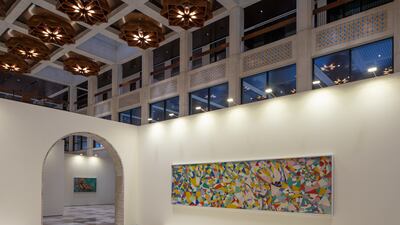
An installation at the Fahrelnissa and the Institutes: Towards a Sky exhibition. Photo: Cultural Foundation -
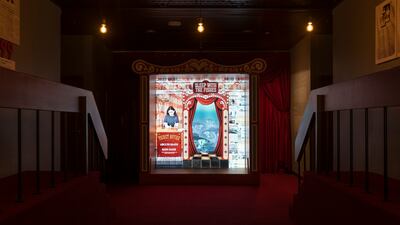
An installation at the Life is a Circus exhibition. Photo: Cultural Foundation -
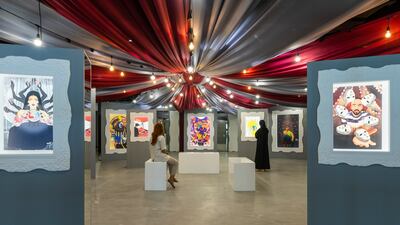
Life is a Circus exhibition. Photo: Cultural Foundation -
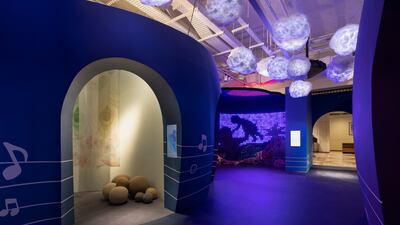
An installation at Lullabies: A Journey Through Song. Photo: Cultural Foundation -

'Untitled' (1950) by Fahrelnissa Zeid. Photo: Guggenheim Abu Dhabi -
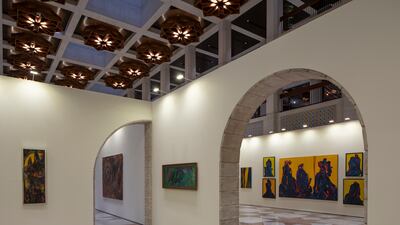
An installation at the Fahrelnissa and the Institutes: Towards a Sky exhibition. Photo: Cultural Foundation -

'The Red City' (1957) by Fahrelnissa Zeid. Photo: Barjeel Art Foundation -
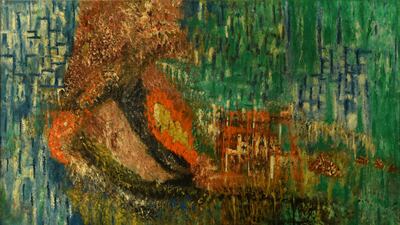
'Chateaux engloutis' (1979) by Ufemia Rizk. Photo: Guggenheim Abu Dhabi -

'Calligraphic Abstraction' (1971) by Wijdan. Photo: Guggenheim Abu Dhabi -
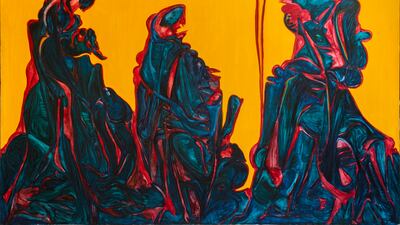
'The Warriors' (1995) by Hind Nasser. Photo: Wadi Finan Gallery -

'Untitled' (1980) by Hind Nasser. Photo: Guggenheim Abu Dhabi



