



Sharjah Art Foundation has just launched a striking collaboration with New Delhi's Kiran Nadar Museum of Art, exploring South Asian pop culture and art.
Titled Pop South Asia: Artistic Explorations in the Popular, the exhibition features more than 100 pieces by artists from Afghanistan, Bangladesh, India, Nepal, Pakistan, Sri Lanka and the diaspora.
Playful and profound, the exhibition has been curated across four galleries throughout Sharjah Art Foundation, highlighting a multitude of voices that are both individually intriguing and collectively symbiotic.
Iftikhar Dadi, co-curator of the exhibition, an artist and professor at Cornell University, has long been fascinated with the theme of Pop Art within the South Asian context.
“The show is innovative in a number of ways,” Dadi tells The National. “Unlike many other shows on Pop Art, even on international or global pop, we have not delimited the time frame because we find a lot of intergenerational dialogue."
When he and co-curator Roobina Karode, director of the Kiran Nadar Museum of Art, began researching the show, they quickly realised how broad the field was.
“We are discovering parallel journeys across the region and that is very interesting,” Karode says. “When we go through the spaces, I'm seeing new conversations happening, very unexpected juxtapositions which are allowing us to see how artists have had parallel journeys or how artists have been thinking about the popular in similar and dissimilar ways.”
While the exhibition presents a diverse range of techniques, references and perspectives, there are touch points, from the cultural to the experiential, where visual conversations and ideas are simultaneously explored, bridging chasms of medium, geography and generations.
The exhibition approaches the world of Pop Art with a suitably wide-ranging set of ideas and visual languages, which fit under the movement, while broadening its meaning. “This was also one of the premier preoccupations as curators,” Karode says. “To think about where all this begins in the 1960s and then how it percolates, distils and circulates itself.”

Both Dadi and Karode say that Pop Art is an immediate force, which infuses everyday lives with the dramatic and fantastical, the banal and unnoticeable. It penetrates the monotony of life through our physical and digital public and private spaces: our homes, our cinemas, our memes, even our phone screens.
From its inception, Pop Art has dissected contemporary popular culture and mass media, while simultaneously critiquing and reaffirming traditional fine art values. By including imagery from everyday culture — whether films, comic books, advertising or mass-produced objects — its enduring power is its continued accessibility and vitality.
From paintings and collages to multimedia installations and sculptures, the new exhibition is immersive in its scope of mediums and the explorations of artists around themes of identity, politics and borders within the popular. Humorous, sardonic, and at times surprisingly poignant, it is a journey of arresting and entertaining voices.
“The show is very fun to look at,” Dadi says. “It's full of colour and different mediums, but there's also an underlying seriousness to it. So we hope that it works at both those levels.”
The duality that Pop Art straddles between historical and current reference points is an integral part of its dynamic appeal — and is thoughtfully explored throughout the exhibition.

Walking through the spaces, one is not only taken by the range of works within the collection but by the extensive ideas, themes and techniques on show. While most of the works are from the 1960s to the present, there are pieces that trace the lineage of pop culture back to the late 19th century.
“In India, the people's culture is a very synchronistic one,” Karode says. “And in that syncretism, there are so many different strands that make it very complex, very layered and very subversive at various levels.”
Ayesha Jatoi is a Pakistani artist, living and working in Lahore, whose practice has explored traditional manuscripts and the relationship between image and text and spatial division.
In her latest collection of work, which features in the exhibition, Jatoi uses “non-poetry but kind of an abstract sort of concrete poetry” inspired by Sufi texts, which she designs into bold, graphic, punchy posters and plasters in different areas of Lahore.
Jatoi’s work takes the personal into the public in a very pop way. Her posters use an advertorial visual language that instantly connects with people, drawing them into the emotive and intangible ideas behind her words.
“It’s a good form,” Jatoi says. “It’s a way to bring the text to people. It’s more immediate for them to connect to through very big, bold statements.”
Sometimes the posters are removed, or plastered over one another, making them relevant and irrelevant, existing but replaceable, immediate and fleeting — unlike the ways in which mass production feeds our momentary needs.
Through another facet of the Pop Art prism, photo and visual artist Pushpamala N, who lives in Bangalore, invites us to dismantle and re-examine popular images and concepts when she recreates them, using herself as a model in the work.
Pushpamala recreates images of mythology and history, infusing them with wit and irony, while critiquing various facets of contemporary society.
“I'm very interested in this traditional method of teaching, which is copying,” Pushpamala says. “I'm physically constructing something, an image. What is flat actually becomes three-dimensional, because from a two-dimensional image, I make a three-dimensional set, and then again, I make it into a two-dimensional image by photographing that set and by being part of it.”
Pushpamala plays with the idea of the artist being the subject and the woman as a subject to the audiences’ gaze — a notorious notion in the histories of both fine art and pop culture. She transforms herself into famous archetypal characters, bringing them into the present day through stunning visual pieces, while blurring the lines between who they are, how we see them and the contexts from which they arose.
A vital takeaway from Pop South Asia: Artistic Explorations in the Popular is not only the sense of fun throughout the exhibition, but the authenticity of diverse voices across South Asia and how the nuances of the region channel themselves through the accessibility and excessive nature of pop culture.
Pop South Asia: Artistic Explorations in the Popular will be on view at Sharjah Art Foundation until December 11, before travelling to Kiran Nadar Museum of Art in Delhi next year
Works by American Pop artist Claes Oldenburg - in pictures
-

Claes Oldenburg, the Swedish-born American artist and key figure in the pop art movement, has died at the age of 93. Getty Images -

The artist was famed for his giant sculptures. Here, he is seen with an oversized soft-sculpture toothpaste tube. Getty Images -
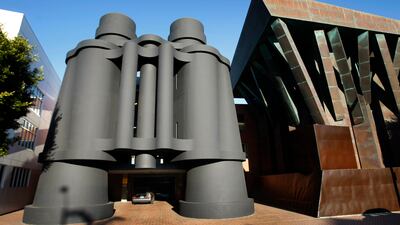
Exterior view of Oldenburg and Frank Gehry's 'Binoculars Building' in Venice Beach, California. Getty Images -
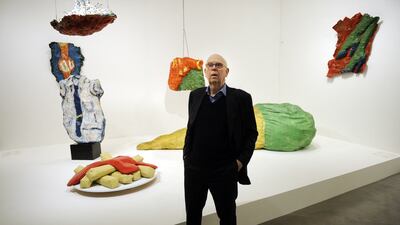
The artist had a solo exhibition at the Guggenheim Bilbao Museum in 2012. AFP -

'Moveyhouse Masks' by Oldenburg. AFP -
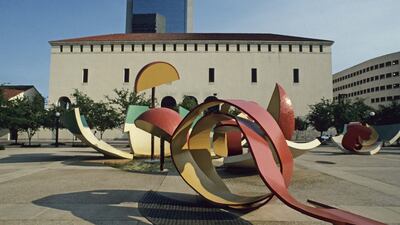
Oldenburg's sculpture in front of the Government Centre by architect Philip Johnson in Miami, Florida. Getty Images -
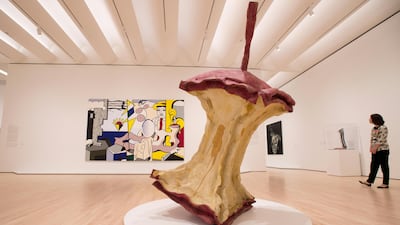
'Geometric Apple Core' by Oldenburg and his wife Coosje van Bruggen in the San Francisco Museum of Modern Art, California. AFP -
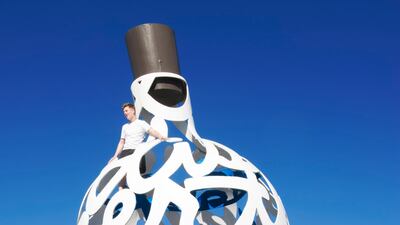
'Bottle of Notes' by Oldenburg and his wife in Centre Square, Middlesborough, England, which was created in 1993. Getty Images -
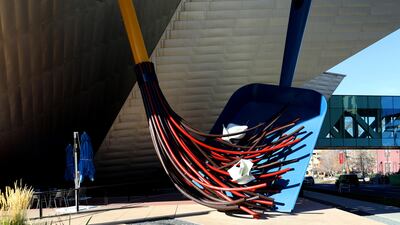
'Big Sweep' outside the Denver Art Museum, Colorado, which was also created by the husband and wife team. Getty Images -

The married artists also installed 'Plantoir, Blue' at the Channel Gardens in Rockefeller Center, New York City. AFP -
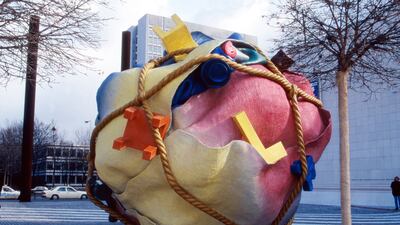
'House Ball' by Oldenburg, in Bonn, Germany, 1996. Getty Images -
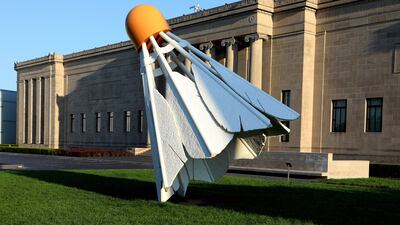
'Shuttlecocks' by Oldenburg and van Bruggen outside the Nelson-Atkins Museum Of Art in Kansas City, Missouri. Getty Images -
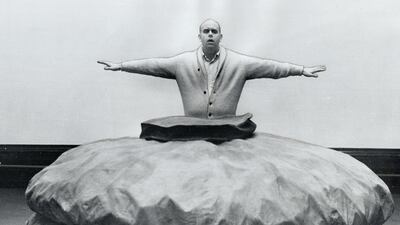
'Giant Hamburger' by Oldenburg 1962. Getty Images -
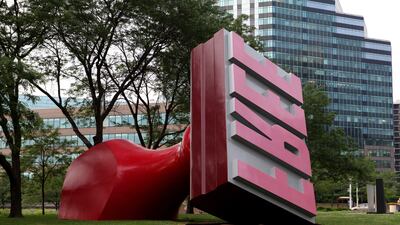
'Free Stamp' by Oldenburg and van Bruggen in Willard Park, Cleveland, Ohio. Getty Images -

'Giant 3-Way Plug' by Oldenburg outside the St Louis Art Museum, St Louis, Missouri. Getty Images -

'The Pickaxe' on the bank of the Fulda river, Germany. Getty Images -
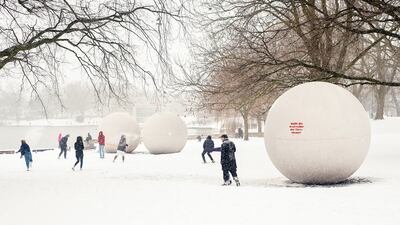
Oldenburg enjoyed placing his work in the middle of public areas for people to enjoy, such as 'Giant Pool Balls' in Aasee, Germany. Getty Images -
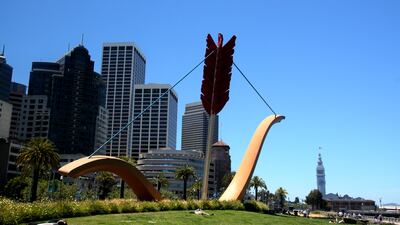
'Cupid's Span' by by Claes Oldenburg and Coosje van Bruggen in Rincon Park, San Francisco. Getty Images -
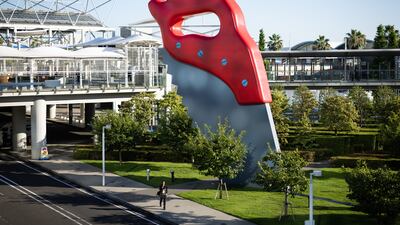
'Saw, Sawing' installed outside the Main Press Centre facility during the Tokyo Olympic Games, Japan, in 2021. Getty Images -
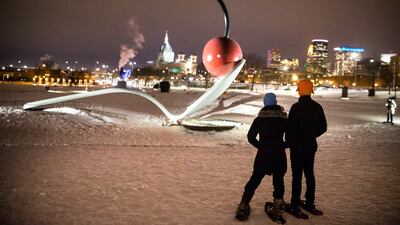
'Spoonbridge and Cherry' by Oldenburg and van Bruggen in Minneapolis Sculpture Garden, Minnesota. Getty Images



