Guggenheim Abu Dhabi, seen here in an artist's rendering, will be built on Saadiyat Island. Photo: Guggenheim Abu Dhabi

Guggenheim Abu Dhabi 'on track' to be completed by 2025


  • English
  • Arabic

The Guggenheim Abu Dhabi is on track to open its doors in 2025, according to the Department of Culture and Tourism – Abu Dhabi.

Designed by renowned architect Frank Gehry, who is also behind the Guggenheim Museum in Bilbao, Spain, the UAE site is set to be the latest and largest outpost of the Solomon R Guggenheim Foundation’s list of international museums.

The Guggenheim Abu Dhabi was first announced in 2006, and was initially meant to welcome visitors by 2012. The museum’s completion date was later pushed to 2017.

The museum aims to present global modern and contemporary art, said Mohamed Khalifa Al Mubarak, chairman of DCT Abu Dhabi.

He said the museum will “play a civic role through its mission to spark wider interest in global modern and contemporary art” and will be an “equitable platform for art from all over the world”.

“As we move forward with our plans, it is crucial to recognise the impact of this museum in realising our vision for the emirate’s culture and creative industries. Investing in these industries is pivotal to the economic development of our emirate, and to our contribution to the global art world,” said Al Mubarak.

"Guggenheim Abu Dhabi, along with other cultural institutions such as Louvre Abu Dhabi and Zayed National Museum, will undoubtedly contribute significantly to a thriving creative scene."

Sheikh Khaled bin Mohamed bin Zayed and architect Frank Gehry at the Guggenheim Abu Dhabi museum site on Saadiyat Island. Photo: Abu Dhabi Media Office

Richard Armstrong, director of the Guggenheim Museum, called the announcement “a significant milestone in the realisation of the Guggenheim Abu Dhabi”.

Armstrong said that the museum will house “an expansive and evolving collection of artworks that advance multiple perspectives on the global histories of modern and contemporary art, with a particular focus on art from West Asia, North Africa and South Asia”.

The Gehry-designed Guggenheim Abu Dhabi will cover 30,000 square metres, with its gallery spaces spread across four levels linked by glass bridges, with a central atrium at its core.

Anish Kapoor’s 'My Red Homeland'. Photo: Lisson Gallery

Despite the absence of a physical structure, the museum has been building its collection over the past few years, including acquiring a film commission by artist Sarah Morris.

It has also presented exhibitions in Abu Dhabi in 2014 and 2017. The former, titled Seeing Through Light: Selections from the Guggenheim Abu Dhabi Collection, featured works by Dan Flavin, Douglas Wheeler, Keith Sonnier, Bharti Kher, Rachid Koraichi and Yayoi Kusama. The latter, The Creative Act: Performance, Process, Presence, included Anish Kapoor’s large-scale installation My Red Homeland. Over the past year, the museum has also organised various virtual programmes.

When completed, the Guggenheim Abu Dhabi will join Louvre Abu Dhabi, Manarat Al Saadiyat and Berklee Abu Dhabi on Saadiyat Island, where the capital aims to build an arts and culture cluster.

_____________________

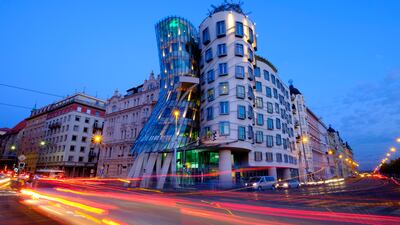
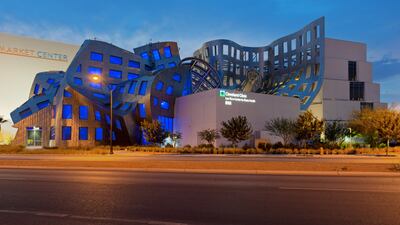
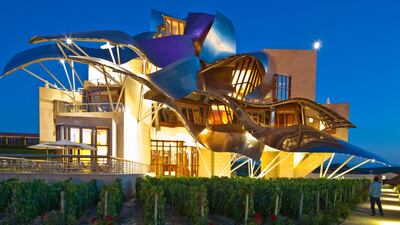
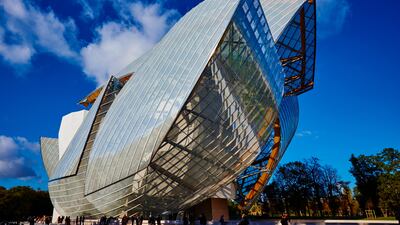
Frank Gehry's impressive structures

  • The Dancing House, also called 'Fred and Ginger', by architects Vlado Milunic and Frank Gehry, in Prague, Czech Republic. All Photos: Alamy Stock Photo
    The Dancing House, also called 'Fred and Ginger', by architects Vlado Milunic and Frank Gehry, in Prague, Czech Republic. All Photos: Alamy Stock Photo
  • Frank Gehry's Cleveland Clinic Lou Ruvo Centre for Brain Health, in Las Vegas, Nevada, USA
    Frank Gehry's Cleveland Clinic Lou Ruvo Centre for Brain Health, in Las Vegas, Nevada, USA
  • Hotel Marques de Riscal, designed by architects Frank Owen and Frank Gehry, in Elciego, Alava, Basque Country, Spain
    Hotel Marques de Riscal, designed by architects Frank Owen and Frank Gehry, in Elciego, Alava, Basque Country, Spain
  • Louis Vuitton Foundation art museum and cultural centre, designed by Frank Gehry, in Paris, France
    Louis Vuitton Foundation art museum and cultural centre, designed by Frank Gehry, in Paris, France
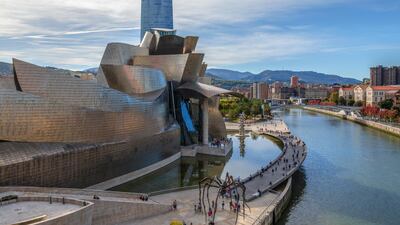
  • Guggenheim Museum in Bilbao, Basque Country, Spain
    Guggenheim Museum in Bilbao, Basque Country, Spain
  • Walt Disney Concert Hall in Los Angeles, California
    Walt Disney Concert Hall in Los Angeles, California
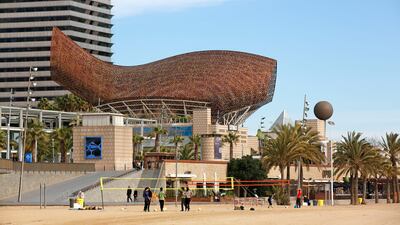
  • Sculpture Peix D'or, Hotel Arts Barcelona, Mapfre Tower, in Barcelona, Spain
    Sculpture Peix D'or, Hotel Arts Barcelona, Mapfre Tower, in Barcelona, Spain
Chef Nobu's advice for eating sushi

“One mistake people always make is adding extra wasabi. There is no need for this, because it should already be there between the rice and the fish.
“When eating nigiri, you must dip the fish – not the rice – in soy sauce, otherwise the rice will collapse. Also, don’t use too much soy sauce or it will make you thirsty. For sushi rolls, dip a little of the rice-covered roll lightly in soy sauce and eat in one bite.
“Chopsticks are acceptable, but really, I recommend using your fingers for sushi. Do use chopsticks for sashimi, though.
“The ginger should be eaten separately as a palette cleanser and used to clear the mouth when switching between different pieces of fish.”

Kill%20Bill%20Volume%201
%3Cp%3E%3Cstrong%3EDirector%3C%2Fstrong%3E%3A%20Quentin%20Tarantino%3Cbr%3E%3Cstrong%3EStars%3C%2Fstrong%3E%3A%20Uma%20Thurman%2C%20David%20Carradine%20and%20Michael%20Madsen%3Cbr%3E%3Cstrong%3ERating%3C%2Fstrong%3E%3A%204.5%2F5%3C%2Fp%3E%0A
Profile box

Company name: baraka
Started: July 2020
Founders: Feras Jalbout and Kunal Taneja
Based: Dubai and Bahrain
Sector: FinTech
Initial investment: $150,000
Current staff: 12
Stage: Pre-seed capital raising of $1 million
Investors: Class 5 Global, FJ Labs, IMO Ventures, The Community Fund, VentureSouq, Fox Ventures, Dr Abdulla Elyas (private investment)

Stats at a glance:

Cost: 1.05 billion pounds (Dh 4.8 billion)

Number in service: 6

Complement 191 (space for up to 285)

Top speed: over 32 knots

Range: Over 7,000 nautical miles

Length 152.4 m

Displacement: 8,700 tonnes

Beam:   21.2 m

Draught: 7.4 m

The specs

Engine: 4.0-litre V8 twin-turbocharged and three electric motors

Power: Combined output 920hp

Torque: 730Nm at 4,000-7,000rpm

Transmission: 8-speed dual-clutch automatic

Fuel consumption: 11.2L/100km

On sale: Now, deliveries expected later in 2025

Price: expected to start at Dh1,432,000

The specs
  • Engine: 3.9-litre twin-turbo V8
  • Power: 640hp
  • Torque: 760nm
  • On sale: 2026
  • Price: Not announced yet
What is graphene?

Graphene is a single layer of carbon atoms arranged like honeycomb.

It was discovered in 2004, when Russian-born Manchester scientists Andrei Geim and Kostya Novoselov were "playing about" with sticky tape and graphite - the material used as "lead" in pencils.

Placing the tape on the graphite and peeling it, they managed to rip off thin flakes of carbon. In the beginning they got flakes consisting of many layers of graphene. But as they repeated the process many times, the flakes got thinner.

By separating the graphite fragments repeatedly, they managed to create flakes that were just one atom thick. Their experiment had led to graphene being isolated for the very first time.

At the time, many believed it was impossible for such thin crystalline materials to be stable. But examined under a microscope, the material remained stable, and when tested was found to have incredible properties.

It is many times times stronger than steel, yet incredibly lightweight and flexible. It is electrically and thermally conductive but also transparent. The world's first 2D material, it is one million times thinner than the diameter of a single human hair.

But the 'sticky tape' method would not work on an industrial scale. Since then, scientists have been working on manufacturing graphene, to make use of its incredible properties.

In 2010, Geim and Novoselov were awarded the Nobel Prize for Physics. Their discovery meant physicists could study a new class of two-dimensional materials with unique properties. 


Profile

Company: Justmop.com

Date started: December 2015

Founders: Kerem Kuyucu and Cagatay Ozcan

Sector: Technology and home services

Based: Jumeirah Lake Towers, Dubai

Size: 55 employees and 100,000 cleaning requests a month

Funding:  The company’s investors include Collective Spark, Faith Capital Holding, Oak Capital, VentureFriends, and 500 Startups. 

Biog

Mr Kandhari is legally authorised to conduct marriages in the gurdwara

He has officiated weddings of Sikhs and people of different faiths from Malaysia, Sri Lanka, Russia, the US and Canada

Father of two sons, grandfather of six

Plays golf once a week

Enjoys trying new holiday destinations with his wife and family

Walks for an hour every morning

Completed a Bachelor of Commerce degree in Loyola College, Chennai, India

2019 is a milestone because he completes 50 years in business


The Byblos iftar in numbers

29 or 30 days – the number of iftar services held during the holy month

50 staff members required to prepare an iftar

200 to 350 the number of people served iftar nightly

160 litres of the traditional Ramadan drink, jalab, is served in total

500 litres of soup is served during the holy month

200 kilograms of meat is used for various dishes

350 kilograms of onion is used in dishes

5 minutes – the average time that staff have to eat
 

Updated: September 30, 2021, 3:57 AM