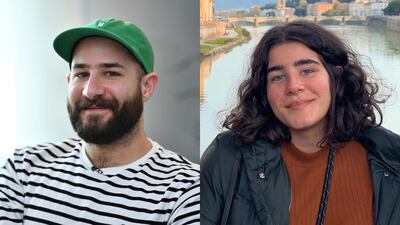
Over the past few years, via programmes such as the Salama bint Hamdan Emerging Artists Fellowship (Seaf), Campus Art Dubai, the Youth Takeover by Jameel Arts Centre, and new art and visual culture programmes at Zayed University and American University in Dubai, a new generation of artists have been emerging in the UAE.
These artists are looking at subjects such as the formation of memories, emotions, folkloric tales, science-fiction, techno-progressivism and the value of painstaking, labor-intensive craft practices. If that seems like a broad list, it is: the amount of young artists across Dubai, Sharjah and Abu Dhabi is mushrooming, and any attempt to summarise the focus of their inquiries will happily fall short.
With that in mind, here are a few of the artists The National has its eye on.
Moza Al Matrooshi
The Dubai-born artist recently returned from London where she received an MFA at the Slade School Art. Her work investigates the particularities embedded in language, via food. For the Lahore Biennale, she screened the video Glaze, of sweets sellers in Sharjah, at a Lahore tea house. A menu provided some of the food in the video so that the work could be literally consumed. Her other performances act as social experiments, testing to what extent food can be separated from the social life it gives rise to.
Sarah Al Mehairi
Raised in Abu Dhabi, Sarah Al Mehairi graduated in 2019 from NYUAD, and had her first solo show at Carbon 12 even before she finished her fellowship at Seaf. Her formal, puzzle-like sculptures of different shades of wood appear like painterly abstractions, which she underscores by staining the wood in different colours to achieve a trompe-l'oeil effect. For a series of plasterworks, A Filled Form is Familiar, now up at the Seaf show at Warehouse421, she cast a Styrofoam box in plaster 40 times in plaster, changing one element of the composition each time, so there is no original to the series.
Mariam Al Zayani & Nasser Al Zayani
The Bahraini-American brother and sister were commissioned by the Youth Takeover to show at Jameel Arts Centre, where they installed works throughout the buildings so that visitors would move through the pair's disjunctive memories. They continued this theme in a workshop, where they investigated how memory can live between people. They asked pairs of family members to recall an experience separately and together, co-creating a third document that amalgamated both member's reminiscences. Memory also inflects Nasser's individual work, such as when he cast script into tablets of crumbling sand.
Mona Ayyash
The Palestinian artist, who was raised in Dubai, is interested in the media imagery around sport, produced as a spectacle but given to smaller moments of stillness and even boredom. She took moments from found footage – a gymnast circling a bar, a swimmer diving into the water – and looped them, so that the forward momentum of the athletes was trapped, and their goal-orientated actions transformed simply into a mechanism of display. At the exhibition of this work, at the UAE Unlimited show Tashweesh at the Maraya Art Centre in 2019, she added bleachers to the video, inviting the audience to sit as sports fans for this truncated imagery. Ayyash is currently an artist-in-residence at Warehouse421.
Nadine Ghandour
The Egyptian artist, who lives and works in Dubai, reflects the world around her in the abstract language of shapes, rendered in charcoal drawings and Plasticine sculptures. Her work pays attention to the spaces in between or the proportions of a room, and considers how they might direct our experience without our even being aware. Working also as part of Office Run, with Ayyash, her work also has a curatorial dimension, converting disused spaces into sites of potential collaboration.
Sree
An Indian artist raised in Dubai, Sree recently made a work invoking Dubai through smell: pools of ground turmeric lay on the floor of the Jameel Arts Centre during its Youth Takeover. Across the wall, a video played of the city, shot from a low vantage point as if via the eyes of a child. The work, 1958_sand, took its title from the year the first Hindu temple was inaugurated in Dubai. It crosses this historic, if forgotten event with the domesticity of childhood memories. Looking back isn't easy: the smell of the turmeric was overpowering.
Mohamed Khalid
A graduate of Campus Art Dubai and the Seaf programme, Mohamed Khalid casts his eye on everyday items –those sold on Dubizzle or discarded receipts – and coaxes out of them their metaphoric potential. The malfunction of receipts from parking machines at Dubai Mall becomes a stand-in for the role of the artist, gumming up the societal machine but somehow failing, he says, to make a real difference. At the Jameel Arts Centre's Youth Takeover, Khalid overlaid graphite panels in the lift, mimicking those in his apartment block's lifts, which he saw as ad hoc message boards for unprompted exclamations such as "I love the UAE" or "I love Pakistan". The work turned out to be more successful than he or the curators had expected: by the end of the show, the panels had been etched with graffiti.
Tala Khalil
A Palestinian artist raised in the UAE, Khalil is interested in identity and heritage as living, changing practices. For the Jameel Arts Centre's Youth Takeover recently, part of her contribution was a workshop in how to dance the dabke, which took place online and outside in the centre's sculpture park. Elsewhere she works in a host of media, from writing to experimental film, installations, photography to understanding how traditions mediate between the individual and the collective. Her posterShu Baarfni (How Would I Know?) was one of the winners of the 100 Best Arabic Posters in 2018, shown at Warehouse421.
Augustine Paredes
The Filipino-born photographer documents life in Dubai, imbuing the city with the romanticism of the after dark hours. He has an eye for finding glamour in hidden places, and indeed the artist has also worked commercially for brands such as Gucci and Les Benjamins. For his contribution to A Picture Held Us Captive, the show curated by Nada Raza for Abu Dhabi Art, he read from his book of poetry Conversations at the End of the Universe. The story is a performance of empathy, segueing from his learning of a friend's unexpected death to reminiscences of his mother, talking to her husband at his graveside. Paredes is currently making a body of work about Mina Zayed with fellow participants of the W421 x GPP Photography Mentorship Programme. It will be on show at Gulf Photo Plus and Warehouse421 next year.
Malda Smadi
Smadi, who was born in Damascus and grew up in Dubai, began at Seaf with a portraiture practice that has expanded outwards into portraiture in the widest sense: paintings, photographs, drawings of people and the way they live and feel. Showing in the current sale on the 101 art platform, her drawings of women branch out into threads sewn on to collaged fabric, while a new series of work tackles the fear and dread experienced by many this year. Smadi also compiles In Transit Archives, in which she records a series of conversations with women in the UAE, discussing stories
that concern them.
Our family matters legal consultant
Name: Hassan Mohsen Elhais
Position: legal consultant with Al Rowaad Advocates and Legal Consultants.
Our legal consultant
Name: Dr Hassan Mohsen Elhais
Position: legal consultant with Al Rowaad Advocates and Legal Consultants.
The past Palme d'Or winners
2018 Shoplifters, Hirokazu Kore-eda
2017 The Square, Ruben Ostlund
2016 I, Daniel Blake, Ken Loach
2015 Dheepan, Jacques Audiard
2014 Winter Sleep (Kış Uykusu), Nuri Bilge Ceylan
2013 Blue is the Warmest Colour (La Vie d'Adèle: Chapitres 1 et 2), Abdellatif Kechiche, Adele Exarchopoulos and Lea Seydoux
2012 Amour, Michael Haneke
2011 The Tree of Life, Terrence Malick
2010 Uncle Boonmee Who Can Recall His Past Lives (Lung Bunmi Raluek Chat), Apichatpong Weerasethakul
2009 The White Ribbon (Eine deutsche Kindergeschichte), Michael Haneke
2008 The Class (Entre les murs), Laurent Cantet
WORLD CUP SQUAD
Dimuth Karunaratne (Captain), Angelo Mathews, Avishka Fernando, Lahiru Thirimanne, Kusal Mendis (wk), Kusal Perera (wk), Dhananjaya de Silva, Thisara Perera, Isuru Udana, Jeffrey Vandersay, Jeevan Mendis, Milinda Siriwardana, Lasith Malinga, Suranga Lakmal, Nuwan Pradeep
More from Neighbourhood Watch
How to tell if your child is being bullied at school
Sudden change in behaviour or displays higher levels of stress or anxiety
Shows signs of depression or isolation
Ability to sleep well diminishes
Academic performance begins to deteriorate
Changes in eating habits
Struggles to concentrate
Refuses to go to school
Behaviour changes and is aggressive towards siblings
Begins to use language they do not normally use
The Bio
Amal likes watching Japanese animation movies and Manga - her favourite is The Ancient Magus Bride
She is the eldest of 11 children, and has four brothers and six sisters.
Her dream is to meet with all of her friends online from around the world who supported her work throughout the years
Her favourite meal is pizza and stuffed vine leaves
She ams to improve her English and learn Japanese, which many animated programmes originate in
Virtual banks explained
What is a virtual bank?
The Hong Kong Monetary Authority defines it as a bank that delivers services through the internet or other electronic channels instead of physical branches. That means not only facilitating payments but accepting deposits and making loans, just like traditional ones. Other terms used interchangeably include digital or digital-only banks or neobanks. By contrast, so-called digital wallets or e-wallets such as Apple Pay, PayPal or Google Pay usually serve as intermediaries between a consumer’s traditional account or credit card and a merchant, usually via a smartphone or computer.
What’s the draw in Asia?
Hundreds of millions of people under-served by traditional institutions, for one thing. In China, India and elsewhere, digital wallets such as Alipay, WeChat Pay and Paytm have already become ubiquitous, offering millions of people an easy way to store and spend their money via mobile phone. Indonesia, Vietnam and the Philippines are also among the world’s biggest under-banked countries; together they have almost half a billion people.
Is Hong Kong short of banks?
No, but the city is among the most cash-reliant major economies, leaving room for newcomers to disrupt the entrenched industry. Ant Financial, an Alibaba Group Holding affiliate that runs Alipay and MYBank, and Tencent Holdings, the company behind WeBank and WeChat Pay, are among the owners of the eight ventures licensed to create virtual banks in Hong Kong, with operations expected to start as early as the end of the year.
NO OTHER LAND
Director: Basel Adra, Yuval Abraham, Rachel Szor, Hamdan Ballal
Stars: Basel Adra, Yuval Abraham
Rating: 3.5/5
Global state-owned investor ranking by size
|
1.
|
United States
|
|
2.
|
China
|
|
3.
|
UAE
|
|
4.
|
Japan
|
|
5
|
Norway
|
|
6.
|
Canada
|
|
7.
|
Singapore
|
|
8.
|
Australia
|
|
9.
|
Saudi Arabia
|
|
10.
|
South Korea
|
What is graphene?
Graphene is extracted from graphite and is made up of pure carbon.
It is 200 times more resistant than steel and five times lighter than aluminum.
It conducts electricity better than any other material at room temperature.
It is thought that graphene could boost the useful life of batteries by 10 per cent.
Graphene can also detect cancer cells in the early stages of the disease.
The material was first discovered when Andre Geim and Konstantin Novoselov were 'playing' with graphite at the University of Manchester in 2004.
SERIES SCHEDULE
First Test, Galle International Stadium
July 26-30
Second Test, Sinhalese Sports Club Ground
August 3-7
Third Test, Pallekele International Cricket Stadium
August 12-16
First ODI, Rangiri Dambulla International Stadium
August 20
Second ODI, Pallekele International Cricket Stadium
August 24
Third ODI, Pallekele International Cricket Stadium
August 27
Fourth ODI, R Premadasa Stadium
August 31
Fifth ODI, R Premadasa Stadium
September 3
T20, R Premadasa Stadium
September 6
Drivers’ championship standings after Singapore:
1. Lewis Hamilton, Mercedes - 263
2. Sebastian Vettel, Ferrari - 235
3. Valtteri Bottas, Mercedes - 212
4. Daniel Ricciardo, Red Bull - 162
5. Kimi Raikkonen, Ferrari - 138
6. Sergio Perez, Force India - 68
Islamophobia definition
A widely accepted definition was made by the All Party Parliamentary Group on British Muslims in 2019: “Islamophobia is rooted in racism and is a type of racism that targets expressions of Muslimness or perceived Muslimness.” It further defines it as “inciting hatred or violence against Muslims”.
Hili 2: Unesco World Heritage site
The site is part of the Hili archaeological park in Al Ain. Excavations there have proved the existence of the earliest known agricultural communities in modern-day UAE. Some date to the Bronze Age but Hili 2 is an Iron Age site. The Iron Age witnessed the development of the falaj, a network of channels that funnelled water from natural springs in the area. Wells allowed settlements to be established, but falaj meant they could grow and thrive. Unesco, the UN's cultural body, awarded Al Ain's sites - including Hili 2 - world heritage status in 2011. Now the most recent dig at the site has revealed even more about the skilled people that lived and worked there.
UAE currency: the story behind the money in your pockets
More from Rashmee Roshan Lall
Why it pays to compare
A comparison of sending Dh20,000 from the UAE using two different routes at the same time - the first direct from a UAE bank to a bank in Germany, and the second from the same UAE bank via an online platform to Germany - found key differences in cost and speed. The transfers were both initiated on January 30.
Route 1: bank transfer
The UAE bank charged Dh152.25 for the Dh20,000 transfer. On top of that, their exchange rate margin added a difference of around Dh415, compared with the mid-market rate.
Total cost: Dh567.25 - around 2.9 per cent of the total amount
Total received: €4,670.30
Route 2: online platform
The UAE bank’s charge for sending Dh20,000 to a UK dirham-denominated account was Dh2.10. The exchange rate margin cost was Dh60, plus a Dh12 fee.
Total cost: Dh74.10, around 0.4 per cent of the transaction
Total received: €4,756
The UAE bank transfer was far quicker – around two to three working days, while the online platform took around four to five days, but was considerably cheaper. In the online platform transfer, the funds were also exposed to currency risk during the period it took for them to arrive.
Pots for the Asian Qualifiers
Pot 1: Iran, Japan, South Korea, Australia, Qatar, United Arab Emirates, Saudi Arabia, China
Pot 2: Iraq, Uzbekistan, Syria, Oman, Lebanon, Kyrgyz Republic, Vietnam, Jordan
Pot 3: Palestine, India, Bahrain, Thailand, Tajikistan, North Korea, Chinese Taipei, Philippines
Pot 4: Turkmenistan, Myanmar, Hong Kong, Yemen, Afghanistan, Maldives, Kuwait, Malaysia
Pot 5: Indonesia, Singapore, Nepal, Cambodia, Bangladesh, Mongolia, Guam, Macau/Sri Lanka
Key facilities
- Olympic-size swimming pool with a split bulkhead for multi-use configurations, including water polo and 50m/25m training lanes
- Premier League-standard football pitch
- 400m Olympic running track
- NBA-spec basketball court with auditorium
- 600-seat auditorium
- Spaces for historical and cultural exploration
- An elevated football field that doubles as a helipad
- Specialist robotics and science laboratories
- AR and VR-enabled learning centres
- Disruption Lab and Research Centre for developing entrepreneurial skills
LA LIGA FIXTURES
Saturday (All UAE kick-off times)
Valencia v Atletico Madrid (midnight)
Mallorca v Alaves (4pm)
Barcelona v Getafe (7pm)
Villarreal v Levante (9.30pm)
Sunday
Granada v Real Volladolid (midnight)
Sevilla v Espanyol (3pm)
Leganes v Real Betis (5pm)
Eibar v Real Sociedad (7pm)
Athletic Bilbao v Osasuna (9.30pm)
Monday
Real Madrid v Celta Vigo (midnight)
The biog
First Job: Abu Dhabi Department of Petroleum in 1974
Current role: Chairperson of Al Maskari Holding since 2008
Career high: Regularly cited on Forbes list of 100 most powerful Arab Businesswomen
Achievement: Helped establish Al Maskari Medical Centre in 1969 in Abu Dhabi’s Western Region
Future plan: Will now concentrate on her charitable work
Stats at a glance:
Cost: 1.05 billion pounds (Dh 4.8 billion)
Number in service: 6
Complement 191 (space for up to 285)
Top speed: over 32 knots
Range: Over 7,000 nautical miles
Length 152.4 m
Displacement: 8,700 tonnes
Beam: 21.2 m
Draught: 7.4 m
Real estate tokenisation project
Dubai launched the pilot phase of its real estate tokenisation project last month.
The initiative focuses on converting real estate assets into digital tokens recorded on blockchain technology and helps in streamlining the process of buying, selling and investing, the Dubai Land Department said.
Dubai’s real estate tokenisation market is projected to reach Dh60 billion ($16.33 billion) by 2033, representing 7 per cent of the emirate’s total property transactions, according to the DLD.
Coffee: black death or elixir of life?
It is among the greatest health debates of our time; splashed across newspapers with contradicting headlines - is coffee good for you or not?
Depending on what you read, it is either a cancer-causing, sleep-depriving, stomach ulcer-inducing black death or the secret to long life, cutting the chance of stroke, diabetes and cancer.
The latest research - a study of 8,412 people across the UK who each underwent an MRI heart scan - is intended to put to bed (caffeine allowing) conflicting reports of the pros and cons of consumption.
The study, funded by the British Heart Foundation, contradicted previous findings that it stiffens arteries, putting pressure on the heart and increasing the likelihood of a heart attack or stroke, leading to warnings to cut down.
Numerous studies have recognised the benefits of coffee in cutting oral and esophageal cancer, the risk of a stroke and cirrhosis of the liver.
The benefits are often linked to biologically active compounds including caffeine, flavonoids, lignans, and other polyphenols, which benefit the body. These and othetr coffee compounds regulate genes involved in DNA repair, have anti-inflammatory properties and are associated with lower risk of insulin resistance, which is linked to type-2 diabetes.
But as doctors warn, too much of anything is inadvisable. The British Heart Foundation found the heaviest coffee drinkers in the study were most likely to be men who smoked and drank alcohol regularly.
Excessive amounts of coffee also unsettle the stomach causing or contributing to stomach ulcers. It also stains the teeth over time, hampers absorption of minerals and vitamins like zinc and iron.
It also raises blood pressure, which is largely problematic for people with existing conditions.
So the heaviest drinkers of the black stuff - some in the study had up to 25 cups per day - may want to rein it in.
Rory Reynolds
New schools in Dubai

