

Found, feted and then lost – the metal monolith discovered in Utah last month made headlines because of its mysterious origins. Just as quickly as visitors flocked to its site, however, the object has suddenly disappeared.
Utah's Bureau of Land Management stated on Facebook that the structure had been removed by an "unknown party", but a photographer has recently shared a witness account about its dismantling on Instagram, as reported by The New York Times.
In his Instagram post, Ross Bernards said that he and his three friends were visiting the monolith on November 28 to take photographs when four men arrived to break down the object and cart it away on a wheelbarrow.
Bernards explained that he and his group drove six hours to the site, arriving at 7pm. For 40 minutes, they were alone with the monolith, taking artistic photographs of it under the moonlight. One of the shots he produced, created with the help of lights attached to a drone, show a man standing on top of the silvery monolith, with a beam of light emanating from his outstretched arms.
“I had just finished taking some photos of the monolith… and was taking a break, thinking about settings I needed to change for my last battery of drone flight,” he wrote on Instagram. That’s when he heard the men approaching at around 8.40pm.
“Four guys rounded the corner and two of them walked forward. They gave a couple of pushes on the monolith and one of them said ‘You better have got your pictures.’ He then gave it a big push, and it went over, leaning to one side,” he continued.
According to Bernards’s account, the men then pushed the structure until it “popped out and landed on the ground with a loud bang”.
Read More
Utah monolith found: first visitors share images on social media
Mysterious Utah monolith vanishes from desert in removal by 'unknown party'
“They quickly broke it apart and as they were carrying to the wheelbarrow that they had brought. One of them looked back at us all and said, ‘leave no trace’,” he stated. He added that at one point, one of the men said, "this is why you don’t leave trash in the desert".
His friend, Michael James Newlands, managed to take a few photographs of the incident with his mobile phone.
In his post, Bernards explained why he did not attempt to stop the men from taking the structure down. "They had a right to take it out," he said, adding he and his friends stayed the night at the site and woke up to find "at least 70 different cars" in the area, presumably to try and visit the monolith.
“Cars parking everywhere in the delicate desert landscape… We could literally see people trying to approach it from every direction to try and reach it, permanently altering the untouched landscape. Mother Nature is an artist. It’s best to leave the art in the wild to her,” he wrote.
The monolith was discovered in the red canyon landscape of Utah as officials were surveying wildlife in the area from a helicopter. Though authorities shared photos of the object, they did not disclose its location to avoid visitors from wandering into the desert.
However, Reddit users were able to track down the location with the help of satellite imagery and within 48 hours, the first visitors had already arrived.
After the monolith’s disappearance, the state’s Bureau of Land Management stated that it did not remove the structure and was up to the local sheriff’s office to find those responsible for it vanishing. “We do not investigate crimes involving private property which are handled by the local sheriff’s office,” the agency said in a statement.
While the San Juan county sheriff did initially decline to investigate the case, the sheriff's office has since changed its mind and announced that it plans to open a joint investigation into the matter with the Bureau of Land Management.
Scroll through to see more photos of the Utah monolith while it was still up:
-
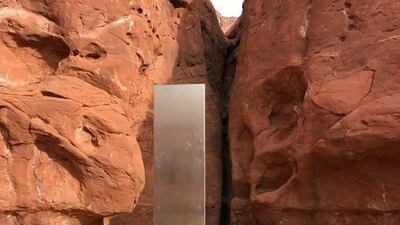
A monolith has been discovered by wildlife officials in southeastern Utah, US. Utah Department of Public Safety / EPA -
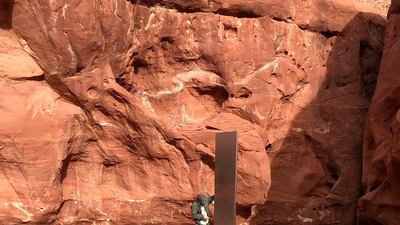
A Utah state worker inspects a metal monolith that was found installed in the ground in a remote area of red rock in Utah. Utah Department of Public Safety / AP -
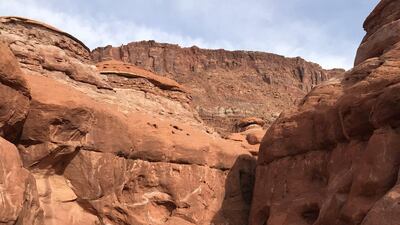
The pillar is made from either steel or metal. Utah Department of Public Safety / EPA -
It was spotted from a helicopter as officials were circling the area to count bighorn sheep last week. Utah Department of Public Safety / EPA -
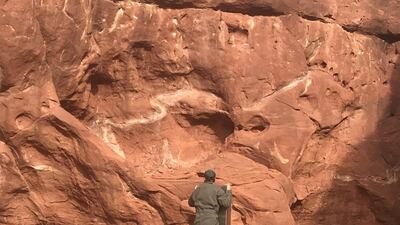
The pillar resembles the minimalist sculptures of American artist John McCracken. Utah Department of Public Safety / EPA -
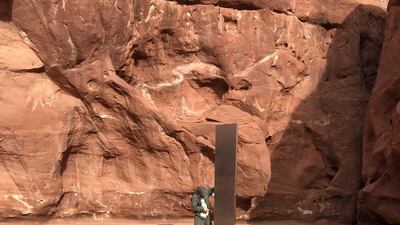
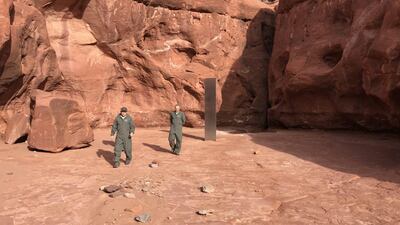
Officials have not disclosed the monolith’s exact location to avoid the curious from flocking to the site. Utah Department of Public Safety / EPA



