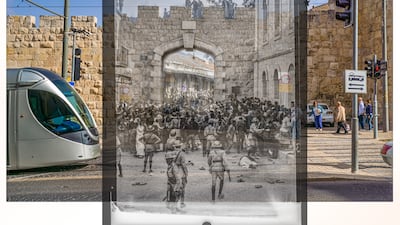
A doorway, a window or the outline of a wall can help Jack Persekian find his way into Jerusalem’s past. The details appear in photographs taken more than a century ago, offering clues that lead the artist back to the places where the images were made.
He returns with his camera, finds the original vantage point and takes a new photograph. By bringing the two images together, he reveals what has survived – and what has disappeared – in the city where he was born and raised.
The works form Jerusalem – Take II, a solo exhibition by the Palestinian artist and curator at Zawyeh Gallery in Dubai.

“The more focused photographic investigation began around 2016, when I started working extensively with historical photographs of Jerusalem, particularly those dating from the 19th and early 20th centuries,” Persekian tells The National.

“This developed into several related projects, including After Matson & Whiting, 100 Years and eventually Past Tense.”
The Dubai exhibition builds on that work. “I see it as another stage in an ongoing engagement with the city, one that has continued to evolve over more than a decade,” he says.
Persekian is director of the Black Gold Museum in Riyadh. He was previously the founding director of the Sharjah Art Foundation and artistic director of the Sharjah Biennial.
One of his principal sources is the US Library of Congress, which holds extensive collections of historical photographs of Jerusalem and Palestine. The images he draws upon date from the second half of the 19th century and the early decades of the 20th, including the late Ottoman period and the years around the start of the British Mandate.

Among them are photographs produced by the American Colony photographic enterprise, whose archive documented the city and the wider region.
“This was a particularly interesting period in the photographic history of Jerusalem,” Persekian says. “Photography was becoming an increasingly important means of documenting and representing the city, and a considerable body of visual material was produced by local photographers, European travellers, religious institutions and photographic studios.”
The images offer a view of Jerusalem before many of the urban, political and demographic changes of the 20th century. Looking closely at them, Persekian has found that some features endure even when their surroundings become almost unrecognisable.
“What has surprised me most in my photographic investigations is the remarkable persistence of certain details amid enormous transformations,” he says. “You can find a small architectural feature, a doorway, a window, or the outline of a wall that has survived almost unchanged, while everything around it has been completely altered.”

Other traces are harder to find. Buildings, neighbourhoods and streets that appear in the historical photographs have disappeared altogether.
Locating the sites requires close study of the original images and their architectural details. Once he has identified a location, Persekian works to match the earlier photographer’s perspective.
“Once I establish the original viewpoint, I return with my camera and attempt to reconstruct the framing as precisely as possible,” he says. “There is no fixed formula for combining the images. Sometimes the transition follows an architectural element, while at other times it cuts across the composition.”
His interest in the city extends beyond its physical transformation to the expectations people bring when looking at it.

“Jerusalem has been endlessly photographed, but so much of what we see is conditioned by what we already know, believe, or expect to find there,” he says. “Its religious significance, contested histories, and political realities often precede the actual experience of looking at it. I wanted, at least momentarily, to free my gaze from those expectations.”
The exhibition also considers traditions that place Jerusalem close to the Garden of Eden. Persekian turns his attention to the earthly city: its landscape, its details and the life within it.
“Perhaps this is what the project ultimately means to me: the possibility of looking at Jerusalem with a renewed sense of wonder, without ignoring its history or the realities of its present, but also without allowing them to determine everything I see.”
Jerusalem – Take II runs at Zawyeh Gallery, Alserkal Avenue, Dubai, until January 10

