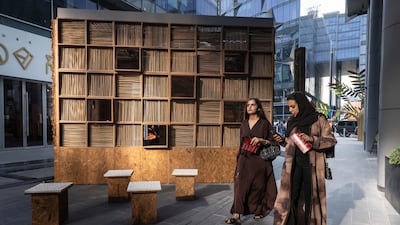

Standing in the centre of Dubai Design District, Three Gardens and a Room is hardly a secret. But walk into any of its spaces, past the curved walls painted pink, ochre and yellow, and you’ll find yourself amid desert trees, wondrously removed from the surrounding glass and steel. The spaces resemble secret gardens, sequestered from the rush of the corporate and commercial district.
Three Gardens and a Room won this year's Urban Commissions, an annual initiative of Dubai Design Week. Developed by NAO Architects, it shows how a few precisely placed architectural elements can transform a setting. The work responded to this year’s theme of Atmospheres, which sought to explore how spatial conditions can affect a person’s emotional and physical state.
“It was a very inspiring open call,” says Reem Nassour, founder of the Dubai-based NAO Architects. “It was very intuitive. It asked us to think as architects about colour, materiality, texture, shade and temperature.”

Each space within Three Gardens and a Room is devised around the “four dominant architectural components”, Nassour says.

Taking cues from the mid-19th-century book, The Four Elements of Architecture by German architect Gottfried Semper, she identifies these components as the roof, the hearth, the mound and the enclosure. In each case, the installation upends expectations of what these should or could be, often applying them according to local interpretations.
Here, the mound is perhaps the most direct. The concept manifests as a grassy mound enclosed within a yellow circular structure. A pair of desert acacias loom from the mound. In the adjacent ochre structure is the hearth. It isn’t so much a fireplace as a seating area within an open central space, with sidr trees providing shade. The roof, meanwhile, is in the pink structure. The branches of samr trees intertwine overhead, offering shade. The enclosure connects the three structures (or gardens) and includes a seating area and gravel.
“The gravel is meant to introduce a sense of sound,” Nassour says. It is also meant to evoke nostalgia, recalling the gravel paths that were and still are abundant across the UAE. The pop colours and the design of the circular structures, with their mashrabiya-like perforations, are a nostalgic nod, Nassour says.

“They were also the colours that we often see painted on older houses. These colours were often picked because they were bright and would reflect the heat. But also, we picked these carefully for the way they changed colour throughout the day. At noon, the yellow looks quite white. By the afternoon, it looks orange.”
An indoor installation transports visitors even farther afield to North Karnataka in India, exploring the language shared between Kuruba shepherds and their sheep.
Herding the Unheard: Traces of an Unwritten Language is a collaboration between the cultural programming platform Avid Learning ME and Dakhnii Diaries, a research lab founded by designer Varsha Rani Solanki.

The space presents Solanki’s five-year research process among a group of the shepherds. It features wall-sized panels of felted wool, listening spaces that replay the sounds of sheep and their shepherds' calls, videos that offer glimpses into their lives, and displays of cloaks woven from wool. One wall presents Solanki’s field notes, with photographs that delineate weaving techniques, as well as the wet felting methods that the designer introduced to the community herself.
“Everything here is inspired by my journey with this community,” Solanki says. Her research began when she noticed the high volume of wool that shepherds discarded because they couldn't compete with the rise of wool from domesticated breeds or wool imported from China. As a result, Deccani sheep, the breed indigenous to the area, and the community's traditional livelihood are being threatened.
“It’s happening everywhere, not just India. It’s happening here, in the UAE, as well as in Europe,” she says. “[Communities] are moving away from their traditional skill sets, which are hands-on and involve hand-weaving that involves a lot of craft. The grasslands are also disappearing.”

To better understand the issue, she now works with a group of 20 women in a village in North Karnataka, teaching them wet felting, a faster, more contemporary technique that may help them turn Deccani sheep wool into commodified goods.
The wool itself differs greatly in texture and colour from Merino varieties. It is darker, coarser. The objects around the installation, which visitors are welcome to touch, bear these qualities. Headsets in one woollen alcove, meanwhile, let visitors hear the unique call signals of the shepherds.
“There’s also the sounds of loom, of people felting,” she says. “The inspiration behind the installation is that there’s a language that is written beyond words. There is a special communication happening between the shepherds and the herd, the women and the craft.”

These alternative forms of communication and knowledge transmission echo throughout the Abwab exhibition.
Past iterations of the initiative presented monumental installations in the event's outdoor areas. This year, however, an exhibition has been organised in Building Seven of the venue, bringing together five commissioned works by practitioners from across Asia and Africa. The works are threaded together by the theme In Other Words.
“We wanted to open [the initiative] up to more voices, which plays quite well into the theme” says Caoimhe CJ Reynolds, curator and head of programme at Dubai Design Week.

In Other Words, the group exhibition for Abwab, questions the nature of language, she adds. “All acts of communication involve a design decision of what’s being visible and how things are interpreted, shaped and held. It's an inherited knowledge through material, typography, art and architecture.”
There is still some monumentality to marvel at. Stepping into the mezzanine of Building Seven, visitors will see a large-scale cubic installation that they can enter and sit within. The structure is imposing, even beneath a ceiling several storeys high.
Taleem is an installation conceived by Dubai-based architecture and research practice Varussi, founded by Owais Asif Khan and Samreen Junaid Wani. The installation’s design was inspired by Kashmiri weaving traditions, specifically a system of notating colours and patterns that is used when making hand-knotted carpets and Kani shawls.

The adjacent seven-metre-long installation brings another twist to theme. Titled Shhhhhhhh, the onomatopoeic work by Dalia Rafeh knots several iterations of the Arabic letter “sheen” in a red neon sign. Interestingly, as the sign urges silence, it also brings to mind the bold, loud aesthetics of illuminated storefronts and city signs.
“She takes inspiration from kind of signage and information systems,” Reynolds says. “Dalia says it beautifully, kind of like ‘there’s so much going on that sometimes there’s just not the words to say it'.”
The other works in the exhibition echo this idea of communicating beyond language.
In Cheent Devanagari, Kanaka Raghavan uses block printing and translucent textiles to confront the widespread use of Latin typography, instead drawing from the structural and material traditions of Devanagari, an alphabet used in Sanskrit and Hindi as well as other Indian languages.
In Grace Shieh’s A Library of Paper Memories, tufts and scraps of handmade paper are presented on platforms across the mezzanine space. Some of these pages bear lines of poems. Only some of the words are legible. The paper itself, in its varied textures and fibrous forms, is the primary mode of communication here, with traces of the papermaking process visible in the uneven clumps of lokta and cotton.

Carpeting the centre space is a work by Vivek Premachandran, who works under the name Ubik. Non/Sense has a cartographic quality in the way the printed texts curve and overlap.
The work is partly inspired by Philip K Dick’s How to Build a Universe That Doesn’t Fall Apart Two Days Later, bearing fragments of the text as well as Lorem Ipsum – placeholder language used in publishing and design that appears, as the exhibition literature says, “meaningful until it is actually read”.
The event runs at Dubai Design District until November 8

