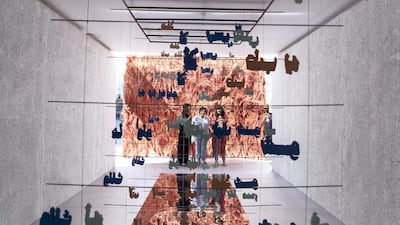

A seven-metre installation featuring red light and a structure inspired by the coded instructions used by Kashmiri weavers are among five new commissions announced for Dubai Design Week’s Abwab programme.
Abwab, which means doors in Arabic, commissions new work by practitioners from across Asia and Africa.
Dalia Rafeh, Grace Shieh, Kanaka Raghavan, Ubik and architecture and research practice Varussi have been selected to create this year’s commissions, under the theme In Other Words.

The exhibition will run from November 3 to 8 at Dubai Design District. It forms part of the festival’s 12th iteration, with Abwab bringing the commissions together in an indoor group exhibition for the first time, moving away from the individual pavilions of previous years.
Established in 2015, Abwab has supported more than 180 designers. This year’s works explore communication through lettering, textiles, paper and architecture, considering how meaning is conveyed through the materials and forms people encounter.
Rafeh’s Shhhhhhhh takes the Arabic letter sheen – ش – and its association with the call for quiet as its starting point. The letter is repeated in a seven-metre installation using red light, which draws on the visual language of public and commercial signage.
The work explores how the same call for quiet can suggest an order to remain silent, a pause for reflection or an invitation to listen.
Dubai-based architecture and research practice Varussi, founded by Owais Asif Khan and Samreen Junaid Wani, draws on Kashmiri weaving traditions in Taleem.
The installation takes its name from the traditional coding system used to design Kashmiri carpets and kani shawls.
Varussi will translate that system into an architectural structure visitors can enter, exploring how craft knowledge is recorded and passed between generations.

Dubai-based designer, educator and researcher Kanaka Raghavan turns to the construction of written language in Cheent Devanagari. Her work challenges the treatment of Latin typography as a universal starting point for design, drawing instead on Devanagari’s own structural and material traditions.
Using block printing, ornament and layers of translucent textiles, Raghavan creates letterforms that separate and come back together as visitors move around them. Their changing appearance allows viewers to examine how the script is constructed.
Writer and visual artist Grace Shieh explores the material qualities of paper in A Library of Paper Memories. Combining papermaking, poetry and experimental writing, the installation considers how fibres, textures and forms can carry memories and meaning alongside written words.
India-based conceptual artist Vivek Premachandran, who works under the name Ubik, examines the interpretation of language in Non/Sense, a floor-based installation inspired by science-fiction writer Philip K Dick’s How to Build a Universe That Doesn’t Fall Apart Two Days Later.
The installation uses translation, mistranslation, abbreviation and lorem ipsum – the placeholder text used in graphic design – to turn text fragments into patterns and spatial structures.
The exhibition’s layout will allow visitors to move around, between and through the commissions, as well as view them from above.
Entry is free. Three free curator-led walkthroughs with Alexie Glass-Kantor, Caoimhe CJ Reynolds and the participating practitioners will explore the research, materials and processes behind the works.

