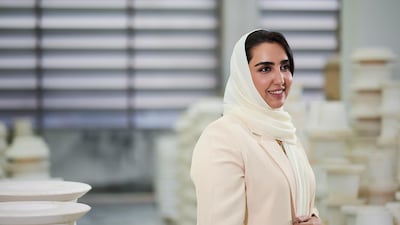

Discarded oyster shells, palm waste and by-products from desalination plants might seem unlikely starting points for a new generation of design products. Sheikha Hind bint Majid Al Qasimi, however, says they represent some of the most exciting possibilities being explored at Sharjah Design Centre.
The brains behind the institution, scheduled to open in 2029, have already spent almost three years researching ways to transform domestically sourced and discarded material into products suitable for architecture and design.
The work is being carried out through Theatrum Al Kimiya, a research project developed alongside Atelier Luma, a France-based programme exploring sustainable materials and production methods.

“It was very interesting seeing these different types of waste, for example demolition waste, sand, salt and palm, and creating plasters, paints, bricks and salt panels,” Sheikha Hind, director of Sharjah Design Centre, tells The National.
Researchers have also experimented with waste from desalination processes. Sheikha Hind recalls meeting people working in the industry who were eager to provide discarded materials because they had little use for them.
“They were like, 'please, if you need more, come take them because they don't know what to do with them,'” she says.
The experiments are intended to produce materials with practical applications beyond the research stage, an ambition Sheikha Hind considers important to the centre's long-term success.
Bridging the gap between design and production

Beyond materials research, Sharjah Design Centre aims to address another challenge facing the UAE's emerging designers: the difficulty of turning ideas into finished products.
Sheikha Hind understands the problem from personal experience. After studying fine arts, she founded the porcelain tableware company Designed by Hind in 2011. At one point, she had to travel abroad simply to produce a glass piece for her collection.
“If you want to do a prototype or a small quantity, it's hard to do it in the UAE, to be honest,” she says.
While Sharjah has established educational institutions and a substantial manufacturing sector, independent designers often lack access to the facilities needed to experiment with materials or produce work on a smaller scale.
The centre will feature seven specialist laboratories covering ceramics, glass, metal, wood, textiles, jewellery and rapid prototyping. Sheikha Hind says these labs will allow designers to produce up to 100 pieces before approaching larger manufacturers, potentially overcoming the financial obstacles associated with industrial production runs.
Sharjah Design Centre is already establishing connections with domestic manufacturers through an industrial-mapping project involving Sharjah Economic Department and the American University in the emirate.
The project has identified more than 4,000 industrial businesses in Sharjah, Sheikha Hind says, with about 1,000 contacted about potential collaboration. Initial efforts have focused on manufacturers working with wood, metal and glass.
A design identity rooted in Sharjah

The centre's architecture reflects a similar interest in using domestic materials and responding to the surrounding environment.
Designed by Mexican architectural practice Taller de Arquitectura – Mauricio Rocha in collaboration with Daniel Rossello, the building will incorporate rammed-earth construction.
The Mexican practice previously explored similar approaches at the School of Visual Arts in Oaxaca, which incorporates rammed-earth walls and courtyards. Its renovation and expansion of Mexico City's Anahuacalli Museum, originally conceived by artist Diego Rivera, won the 2023 Mies Crown Hall Americas Prize.
Sheikha Hind, who is also director of the Sharjah Business Women Council, says the decision to work with Mexican architects was influenced by similarities between the two countries, particularly their cultures and available building materials.
The architects were also keen to preserve the site's desert character after visiting Sharjah.
“They wanted to keep the land as it is because it looks like a desert,” she says.
Sheikha Hind believes the approach reflects Sharjah's wider design philosophy, which draws heavily on the emirate's cultural traditions and surroundings.
“Sharjah has this design identity deeply connected to culture, heritage, architecture, craftsmanship and the local environment,” she says.

Her own experience as a designer has strengthened her appreciation for traditional techniques and the possibilities of adapting them for contemporary applications.
It is an approach she hopes will shape the centre's activities, from its laboratories and educational programmes to the materials developed through its research partnerships.
“Our aim is to build a very strong foundation, exploring local materials and traditional techniques,” she says.
And that ambition extends beyond the centre's opening in 2029.
“It's not like we're just going to showcase these materials and then that's done,” Sheikha Hind says. “Our aim is more into long term, creating this foundation of the material research and the use of them.”

