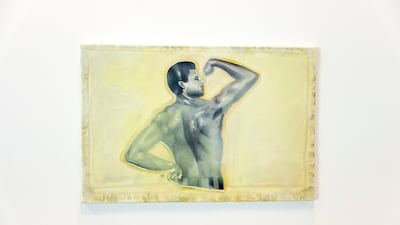

Every time we recall a memory, we risk changing it. Details shift, emotions take on new meaning and experiences we consider precious may bear increasingly little resemblance to what actually happened.
This phenomenon, known as memory reconsolidation, is the starting point for Consolidation is Reconsolidation, an exhibition that brings together five UAE-based artists at Region, in Abu Dhabi's MiZa district.
Running until Monday, the exhibition marks the launch of Hyphen Contemporary, a curatorial platform founded by Cecelia Jihu-Sara to champion emerging artists and introduce new collectors to contemporary art.

Through photography, painting, sculpture and scent, the artists question how memories are preserved, distorted and reconstructed, whether through family archives, digital records or personal experiences.
“The memories we recall most often are often actually the least reliable,” Jihu-Sara tells The National.

The exhibition arrives at a time when almost every experience can be documented, yet the resulting records may be no more permanent or trustworthy than our own recollections.
Jihu-Sara says the relationship between experiencing moments and recording them has changed. Concerts, gatherings and everyday encounters increasingly take place through smartphone screens, raising questions about what is preserved and what is lost.
“Are you truly experiencing it?” she asks. “If you're behind your phone, who are you then experiencing it for?”
Digital recordings may capture sights and sounds, but they cannot necessarily reproduce the emotions attached to an event. The vulnerability of online archives, from disappearing files to AI manipulation, further complicates the distinction between documentation and truth.
These concerns are reflected in the work of Sara Kamar, born in Abu Dhabi in 2003, whose paintings and sculptures examine memory, identity and digital infrastructure.

Her practice considers what happens when technology becomes an extension of human recollection, with smartphones and cloud storage increasingly replacing journals and physical photographs.
Jihu-Sara thinks the immediacy of digital photography has also changed how people value their records, pointing to camera rolls filled with screenshots and images that are rarely revisited.
A more sensory approach emerges in the work of Layla Doueidi, whose practice draws on her Syrian-Lebanese heritage, family archives and a recent return to Syria.
Born in Beirut in 2001, Doueidi uses photography and scent to explore inherited and lived memories. Her wax works incorporate fragrances influenced by her father's career as a perfumer.
Jihu-Sara says the appeal lies in how smell can trigger recollections that are difficult to access through images or words. A visit to Doueidi's studio, where the artist introduced her to various fragrances, demonstrated how differently people respond to the same scent.

“I really love the kind of activation of the work that happens with the scent works, like the leaning in,” she says. “You really have to engage with the work and everyone has a different reaction to it.”
Unlike photographs or paintings, scent demands physical participation. The same fragrance may evoke different memories depending on someone's experiences, while the blurred appearance of the wax reflects the haziness of recollection, particularly from childhood.
Photography takes on a more fragmented character in the work of Martin Ong Yambao, a Filipino artist who incorporates found photographic material and the traditional healing ritual of pagtatawas, usually performed by a folk healer using prayers and molten candle wax.
His unusual treatment of photographic images first caught Jihu-Sara's attention during Art Dubai earlier this year. Intrigued by the process, she arranged a studio visit and watched him manipulate the images using a candle.
“I hadn't seen anything like it,” she says. “I just really fell in love with the works.”
The process produces distorted imagery that reflects the way memories can change through repeated recollection.

Yambao's connection to the exhibition's location emerged when he revealed that he already had a roll of film from Mina Zayed, which became particularly relevant to a show taking place in the district.
Place and nostalgia are central to the work of Emirati artist Rayan Aljneibi, whose background in archival science informs her examination of how locations are documented, remembered and transformed.
Her new works, including the Fragmented Recall series and steel pieces, examine the changing character of familiar surroundings.
Jihu-Sara says she was struck by the distinctly local character of Aljneibi's photography. She had initially encountered the work through an Instagram post shared by fellow exhibiting artist Husna Samer, without knowing Aljneibi was Emirati.
“There's such a feeling of nostalgia around her photos and these everyday kind of imagery and places and feelings that everyone here can relate to and recognise,” she says.
Including an Emirati artist was not initially a curatorial requirement, but Jihu-Sara believes Aljneibi's work offers a meaningful examination of a country undergoing rapid transformation.
Samer, the exhibition's youngest participant, uses symbolism and surrealism to explore identity, remembrance and the shifting meaning of home.
Beyond its subject matter, Consolidation is Reconsolidation also establishes the ambitions of Hyphen Contemporary.

Jihu-Sara's route into curating was unconventional. Raised in the UK, she studied mechanical engineering and worked as a project manager specialising in highways and railways before moving to the UAE two years ago.
After working at a gallery in Alserkal Avenue, she enrolled in a master's programme in History of Art and Museum Studies at Sorbonne University Abu Dhabi.
An assignment to imagine a museum for the capital led to the concept of Hyphen Museum, which eventually inspired her independent curatorial platform.
Jihu-Sara says the hyphen represents connections between cultures, identities and experiences in the UAE, where people from different backgrounds constantly interact.
It also reflects her ambition to connect emerging artists with people considering buying art for the first time.
Drawing on her own experience purchasing her first artwork at an emerging gallery in East London, Jihu-Sara wants to make collecting more accessible while giving younger artists the space to present their practices seriously.
“You can walk into a gallery, and no matter how much money you have, you're not going to spend $20,000 on your first artwork,” she says. “It kind of has to start somewhere.”
That thinking informs the exhibition's deliberately restrained presentation. Jihu-Sara initially considered displaying twice as many works but reduced the selection to give each piece a distinct purpose within the wider narrative.
She thinks smaller tightly curated exhibitions can be more welcoming to audiences unfamiliar with contemporary art, allowing visitors to engage with individual works without becoming overwhelmed.
“I didn't want it to be like a bazaar,” she says. “It's not a shop. It's an exhibition.”
Consolidation is Reconsolidation runs until October 19 at Region, MiZa, Abu Dhabi. It's open daily from 9am to 9pm

