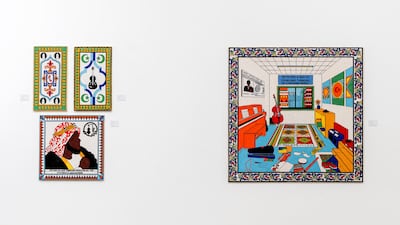

Sultan bin Fahad’s Supreme can be perceived as a flattened, two-dimensional stage of a jazz room.
The beads-on-canvas piece shows a grand piano on the left, facing a five-piece drum kit. Bass and horn sections are in the foreground. Each part of the band is positioned on an eight-pointed star, a common shape in Islamic design. The octagram – made of two overlapping squares – is known as Rub el-Hizb, literally translating to 'quarter of the group’.
Knowing this, it is hard not to think of the quarters in music, the measures of time and rhythm. It is hard not to consider Supreme, made of tens of thousands of beads, a visual musical arrangement, lilting with arabesques and lines that meet and diverge. It is hard not to ‘see’ the music.


But Supreme is not merely a vivid exercise in synaesthesia. Like much of Blue Note – Bin Fahad’s exhibition at Leila Heller Gallery – the work spotlights an overlooked part of jazz history: its associations with Islam.
The circular design at centre-stage bears the words A Love Supreme, referencing the 1965 jazz album by John Coltrane. Islamic faith and philosophy were known to have influenced the record. Its title was famously chanted at the end of the opening track, and many believe that “Allah supreme” is being said in some repetitions. Coltrane was also surrounded by many jazz musicians who had converted to Islam. His first wife Juanita Naima Grubbs was Muslim.
There is more to unpack in Bin Fahad’s Supreme. Text runs along the borders of the work, also beaded with a font that bears a passing, superficial resemblance to Arabic. The words read: “He went to Makkah a black Muslim and there he became only a Muslim.”

The quote is by Betty Shabazz. It refers to the experience of her husband, El Hajj Malik El Shabazz, better known as Malcolm X, during his visit to the Holy City in 1964. His pilgrimage was significant. It marked his break away from the black separatist ideology of the Nation of Islam, embracing instead the inclusive nature of Sunni Islam.
Coltrane attended a speech by Malcolm X at Birmingham University in the summer of 1964, just after the latter performed Hajj in Makkah, and was reportedly “quite impressed” by the civil rights activist – to quote a 1966 interview with the musician by historian Frank Kofsky.
This is just one strand of the multilayered connections between jazz and Islam. It was particularly the depth and diversity of these connections that inspired the works featured in Bin Fahad’s Blue Note.
“It started with a question,” the Saudi artist says. “One of my friends was talking about jazz being linked with Islam. This was very interesting because I never thought about music and the religion going together. I asked my friend to elaborate, and we found the links going back to Africa.”

The African roots of jazz are, of course, well-established, but Bin Fahad says he was particularly interested in how those influences merged with Islam in the US around the mid-20th century. The era is significant – the American Civil Rights Movement was gaining momentum and many saw the faith as a communal and spiritual force that promoted equality against racism and white supremacy.
“I researched and became quite familiar with jazz,” he says. “If you look at the famous concerts and songs, something interesting was happening. If you read the cover of A Love Supreme, for instance, you’d think a Muslim was writing those words.”
Bin Fahad is referring to the poem that Coltrane included in the sleeve notes of the 1965 album. The poem includes lines such as “He is gracious and merciful”, which can be considered a translation of Ar-Rahman and Ar-Raheem, two of Allah’s names.
“Coltrane never converted to Islam but he was an admirer. I think if he had more time, if he didn’t die suddenly, he would have converted,” Bin Fahad says.

Many, however, did convert. These figures included Yusef Lateef, Art Blakey and Ahmed Abdul-Malik – all of whom are depicted in oil paintings shown in Blue Note. Bin Fahad’s signature touch abstracts their facial features, giving them a larger-than-life quality.
The artworks – oil paintings and beads-on-canvas alike – all obliquely refer to the historical connections between jazz and Islam.
“I wanted to tell a story,” Bin Fahad says. “My medium is really storytelling. It starts with a spark, during a conversation or when I learn something new. I don’t pretend to be teaching but I am sharing a piece of knowledge that I came across through art.”
An installation featured within Blue Note is more explicit in these links. The room is built on one side of the exhibition and brings together materials that Bin Fahad researched while producing these works. Records by Dizzy Gillespie, Blakey and Coltrane line the shelves, alongside books on jazz and the Civil Rights Movement.

Also featured is the six-page letter Malcolm X sent to a friend from prison in 1950. “As Salaam Alaikum, your brother, Malcolm X,” it reads at the end, marking the first time the activist signed his last name with the letter X – to represent his lost ancestral African family name.
The letter is also considered one of the first times that Malcolm X announced his conversion to Islam. In it, he writes about the faith's spiritual power. “My brother, Allah is most beneficent,” he writes, “it is so good to have life, and to know that death has been conquered. We have been in darkness for so long, stumbling blindly along, wondering why this and why that, knowing something was wrong, but not knowing what.”

He also expresses his fondness for jazz.
“Music, brother, is ours,” he writes. “It is us and like us it is always here, surrounding us, like the infinite particles that make up life, it cannot be seen, but can only be felt. Like Life!”
Blue Note is running at Leila Heller Gallery until September 13