
Renowned architect Frank Gehry has died at the age of 96.
The Canadian-born American’s death on Friday was confirmed by his chief of staff Meaghan Lloyd.
Rare in the world of architecture, Gehry became a household name thanks to his decades spent subverting norms in the industry.
His work around the globe became tourist attractions in their own right, upending expectations of what buildings were supposed to be and look like.
His disruption of design, form and function, led the jury of the prestigious Pritzker Architecture Prize, which he was awarded in 1989, to compare him to Picasso, saying he “resists… being bound either by critical acceptance or his successes”.
-
Frank Gehry, the visionary architect who has died aged 96, during a visit to the site of the Guggenheim Abu Dhabi, in 2009. Galen Clarke / The National -
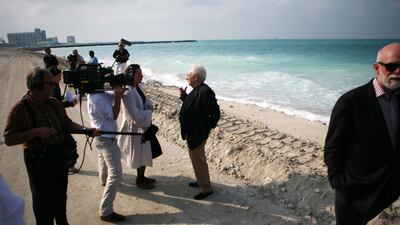
The Canadian-born architect was known for his experimental and unconventional designs. Galen Clarke/ The National -
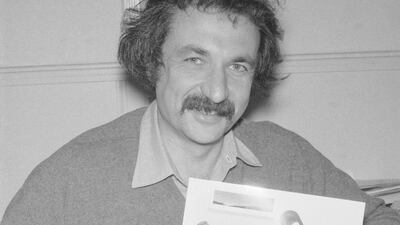
Gehry shows his furniture designs made from corrugated paperboard, in March 1972. Getty Images -

His most notable works include the highly anticipated Guggenheim Abu Dhabi. Photo: Gehry Partners -

Gehry designed The Walt Disney Concert Hall in Los Angeles. EPA -

Gehry with his wife Berta at the launch of his eponymous collection with Tiffany & Co in Beverly Hills, 2006. Reuters -

Mohamed Khalifa Al Mubarak, chairman of the Department of Culture and Tourism – Abu Dhabi, in conversation with Frank Gehry. Victor Besa / The National -
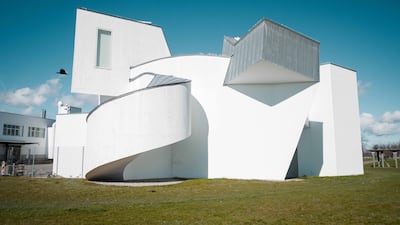
The Gehry-designed Vitra Design Museum in Weil am Rhein, Germany. Grischa / Unsplash -
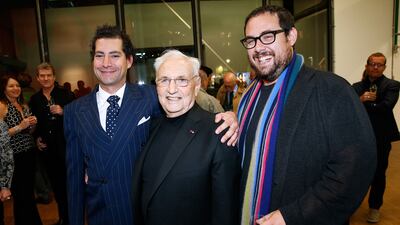
Frank Gehry with his sons Alejandro and Samuel. Getty Images -
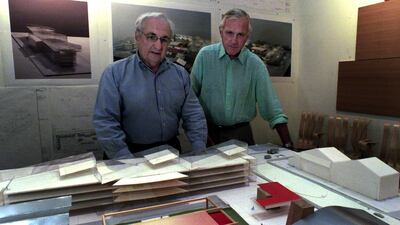
Gehry and Los Angeles developer Rob Maguire stand behind a model of the campus at the giant Playa Vista project in LA. Getty Images -

Gehry's Binoculars Building in Venice, Los Angeles, is home to Google. Reuters -

Gehry receives the French Legion of Honor from culture minister Renaud Donnedieu de Vabres in Paris in 2006. Reuters -
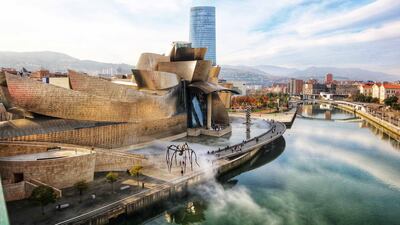
The Guggenheim Museum Bilbao in Spain was also designed by Frank Gehry. Unsplash -
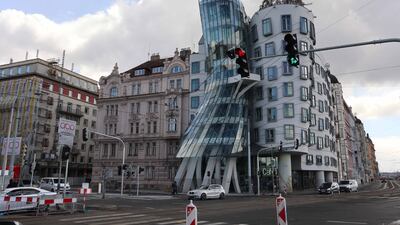
The Dancing House in Prague is a famous Gehry project. Te Lun Ou Yang / Unsplash -
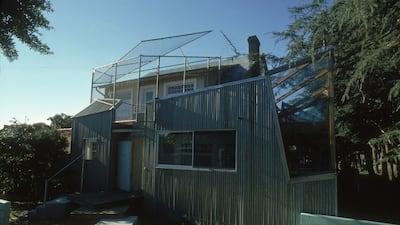
Gehry's Santa Monica house showcases some of his favourite materials. Getty Images -

Gehry in Abu Dhabi in 2021, meeting Sheikh Khaled bin Mohamed, at the time Member of Abu Dhabi Executive Council and Chairman of the Abu Dhabi Executive Office. Wam -
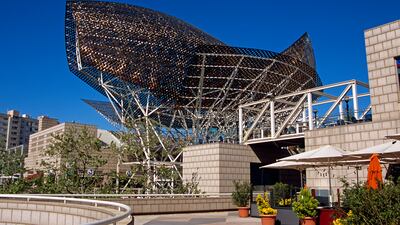
The architect designed the bronze Olympic Fish at the Olympic Park in Barcelona, Spain. Getty Images -

New York by Gehry, the architect's 76-storey, luxury residential tower in New York's Lower Manhattan. Reuters -

Gehry's Barclays Centre in Brooklyn, New York - home to the NBA's Brooklyn Nets - opened on September 21, 2012. Reuters -

The Fondation Louis Vuitton art museum in Bois de Boulogne, Paris, was designed by Gehry. Reuters. -

Gehry attends the groundbreaking ceremony of his project, The Grand, a mixed-use development in downtown Los Angeles, in 2019. Reuters


Born on February 28, 1929, in Toronto, Canada to Sadie Thelma and Irving Goldberg, according to author Laurence Chollet in his book The Essential Frank O. Gehry he showed a flair for construction and design at an early age.
Encouraged by his grandmother, he would build cities from pieces of wood from his grandfather’s hardware store on the living room floor.
“The creative genes were there”, he would later tell Time. “But my father thought I was a dreamer, I wasn't gonna amount to anything. It was my mother who thought I was just reticent to do things. She would push me.”
In 1947 the family emigrated to the United States and settled in California. Gehry studied at Los Angeles City College before going on to the University of Southern California's School of Architecture, working as a delivery driver after classes and on weekends to make ends meet.
In 1952, he married his first wife, Anita Snyder, and they had two daughters, Leslie and Brina.

After graduating from USC in 1954, Gehry moved away from architecture, enrolling in the US army for a couple of years, before 1956 found him drawn back to design to study city planning at the Harvard Graduate School of Design in Cambridge, Massachusetts.
He and Snyder divorced, and in 1975, Gehry married Panamanian Berta Aguilera, with the pair welcoming two sons, Samuel and Alejandro.
Gehry left Harvard without finishing the programme, saying he was “underwhelmed” that his ideas about social responsibility in relation to architecture were not taken seriously.
Moving back to LA, Gehry worked for Victor Gruen Associates and at the age of 28 was tasked with designing his first private residence in Idyllwild, California. Built for a man called Melvin David, the 2,000sq ft project was dubbed “David’s Cabin” and was an early showcase for many Gehry signatures, including exposed ceiling beams and vertical-grain Douglas fir detail.
Following a year in Paris, in 1962 Gehry established a practice in LA, which would become Frank Gehry and Associates, and later Gehry Partners.
Gehry’s work would remain confined to the US for the next two decades, with notable buildings including the California Aerospace Museum, California Museum of Science and Industry, Loyola Law School and the Concord Pavilion, all in California.
-
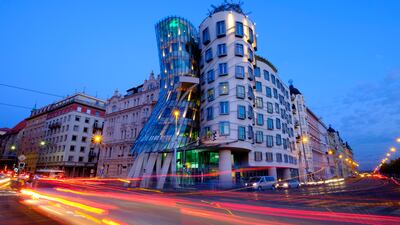
The Dancing House, also called 'Fred and Ginger', by architects Vlado Milunic and Frank Gehry, in Prague, Czech Republic. All Photos: Alamy Stock Photo -
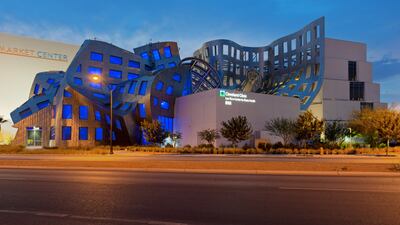
Frank Gehry's Cleveland Clinic Lou Ruvo Centre for Brain Health, in Las Vegas, Nevada, USA -
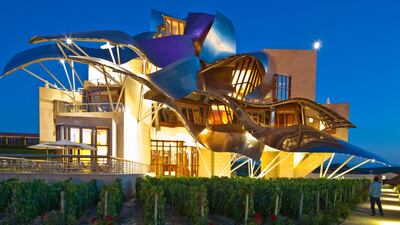
Hotel Marques de Riscal, designed by architects Frank Owen and Frank Gehry, in Elciego, Alava, Basque Country, Spain -
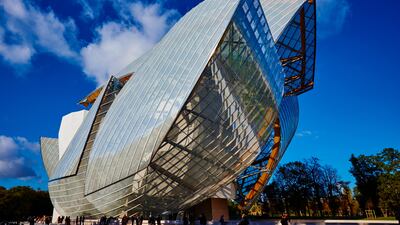
Louis Vuitton Foundation art museum and cultural centre, designed by Frank Gehry, in Paris, France -
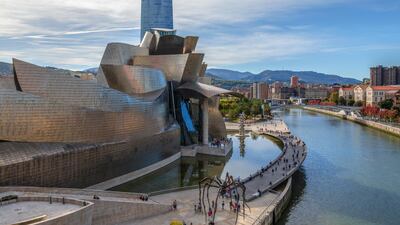
Guggenheim Museum in Bilbao, Basque Country, Spain -

Walt Disney Concert Hall in Los Angeles, California -
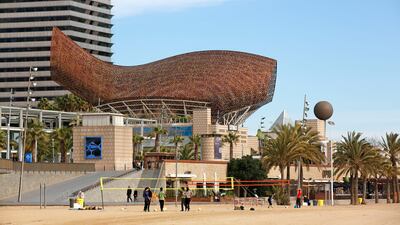
Sculpture Peix D'or, Hotel Arts Barcelona, Mapfre Tower, in Barcelona, Spain


In 1989, Gehry took his talents to a global audience with the unveiling of the Vitra Design Museum in Weil am Rhein, Germany.
Gehry’s first building in Europe quickly gained notoriety thanks to its sculptural deconstructivist style that used white plaster and a titanium–zinc alloy to create what architecture critic Paul Heyer called “a dynamically powerful interplay”.
Afterwards, Gehry would work frequently in Europe, creating the Disney Village at Disneyland Paris, France and the Olympic Fish at the Olympic Park in Barcelona, Spain, both in 1992. The Vitra International Headquarters in Basel, Switzerland followed in 1994, along with Frankfurt’s Siedlung Goldstein and the Dancing House in Prague in 1996.
Among his most acclaimed creations remains the Guggenheim Museum Bilbao in Bilbao, Spain. Completed in 1997, postmodern architect Philip Johnson called it “the greatest building of our generation” and it turned Gehry into a household name.
“I am interested in having some kind of emotion in the building,” Gehry said in an interview. “There’s some feeling. To get passion through the process of building… to come out the other end with a building that exudes some passion, that’s what I’m interested in.”
Flagship stores, museums, law and health centres, banks and concert halls followed, including more niche work, such as designing the cafeteria at the Conde Nast Publishing Headquarters in New York.
The Walt Disney Concert Hall in Los Angeles became another cultural flashpoint upon its unveiling in 2003. Calling his association with Disney “the least likely thing that I thought would ever happen to me in my life”, Gehry delivered a symmetry-defying building, but had to forgo his planned stone exterior for stainless steel after donors became enamoured with the Guggenheim Museum Bilbao.
Denmark, Hong Kong, Canada, Panama, Australia and South Korea would all come to boast their own Gehrys throughout his storied career. As would Abu Dhabi, where the Gehry-designed art museum Guggenheim Abu Dhabi on Saadiyat Island is the largest of the Guggenheim museums around the world.
The architect’s own home, the Gehry Residence in Santa Monica, California remains a career apotheosis for architecture afficionados, as well as for the man himself.
An experimental home for many of the processes and materials he would later use for some of his most famous projects, the 1920s bungalow has remained a design attraction since he bought it in 1977, thanks to the use of metal, plywood, chain link fencing, and wood framing, as well as the wraparound exterior.
Holding honorary doctorates from Harvard, Yale, Princeton, Julliard and Oxford, among others, Gehry's Pritzker Architecture Prize remained a highlight in a career filled with honours and awards.
“Always open to experimentation, he has as well a sureness and maturity that resists, in the same way that Picasso did, being bound either by critical acceptance or his successes,” said the foundation. “His buildings are juxtaposed collages of spaces and materials that make users appreciative of both the theatre and the back-stage, simultaneously revealed.”

