

The geometric designs in Cartier jewellery have long alluded to patterns prominent in Islamic art. That relationship, however, has been a nebulous one.
Now, an exhibition at Louvre Abu Dhabi delves into its origins. Cartier, Islamic Inspiration and Modern Design traces the connection to the early 20th century, showing how it continues to inform and develop the brand’s designs.
Contemporaries at Cartier recognised the correlation, but there was no clear connection of how art forms from the region, extending to India, inspired some of the West’s most coveted and exclusive pieces of jewellery.
That is until a few years ago, when researchers began delving deep into Cartier’s archives, perusing through the library and notebooks of Louis Cartier, the grandson of the luxury brand’s founder. Almost a fourth of his library, researchers found, was dedicated to books about Islamic art. His sketches had clear references to designs found on chests, pen holders and vessels from the Islamic world.
-
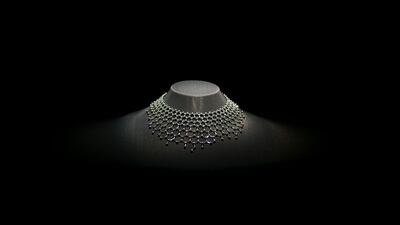
Cartier, Islamic Inspiration and Modern Design exhibition has opened at Louvre Abu Dhabi. All Photos: Khushnum Bhandari / The National -

The exhibition is replete with documentation and sketches that highlight the Islamic inspiration on Cartier's jewellery -
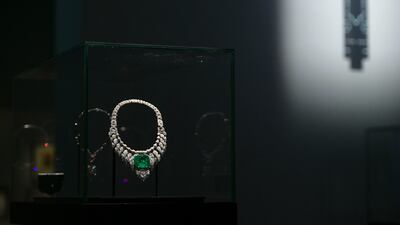
Necklace, Cartier London, 1932. Platinum, diamond and emerald -
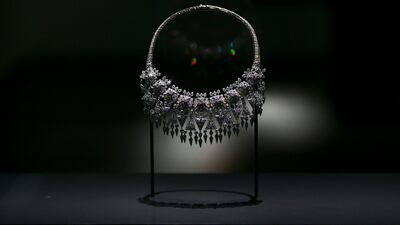
Necklace, Cartier Paris, 1948. Platinum, gold and diamond -

Sautoir, Cartier Paris, 1907-1908. Platinum, natural pearl and diamond -

A brooch dating back to 1904 is one of the earliest examples of Cartier utilising geometric designs alluding to Islamic art -

A Cartier necklace with clear Amazigh influences -

The geometric Cartier pieces developed in parallel with the brand's famous garland style -

Top, a pen box that dates to the early 17th century in Deccan, India, which was crafted in the name of Shah Abbas, the fifth ruler of Safavid Iran -
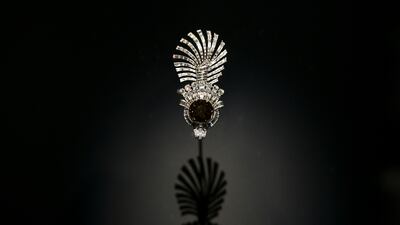
Tiger's Eye turban ornament, Cartier London, 1937. Platinum and diamond -
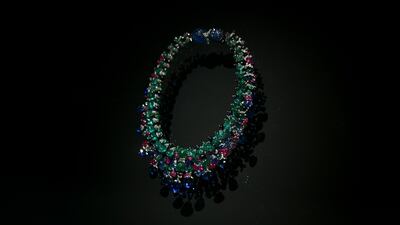
Hindu necklace, Cartier Paris, 1936, altered in 1963. Platinum, gold, diamond, sapphire, emerald and ruby -
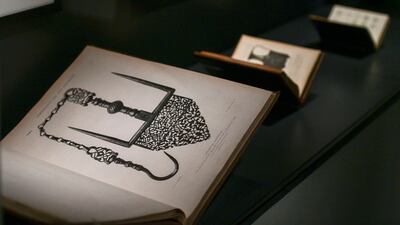
Books that highlight Louis Cartier's interest in Islamic art and design -
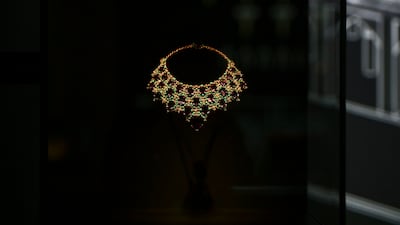
Bib necklace of the Duchess of Windsor, Cartier Paris, 1947. Gold, platinum, diamond, amethyst and turquoise -
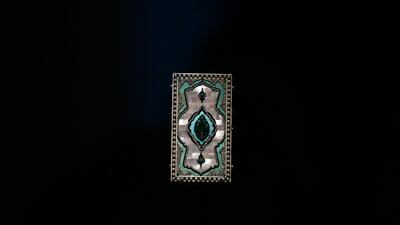
A vanity case bearing clear references to Islamic art and geometry -

Jewellery pieces with emerald stones, cut versions of which were frequently brought in from India


The exhibition is co-organised with the Musee des Arts Decoratifs, Paris's Louvre Museum and France Museums, along with the support of Cartier. It had previous iterations in Paris and Dallas, but as the research is ongoing and new connections come to light, the show at the Louvre Abu Dhabi is the most sprawling and detailed yet.
The exhibition opens by setting the cultural foundations of Cartier’s interest in Islamic designs.
“At the beginning of the 20th century, there was the massive arrival of Islamic pieces, mostly paintings and manuscripts,” says Judith Henon-Raynaud, a chief curator and deputy director at Paris's Louvre.
“These new shapes created a phenomenon in [French] society."
She adds how, in the magazines of the times, fashion and decorative arts were inspired by the style.

Within a few years, the designs began prompting novel approaches in Parisian fashion and interior design. Patterns on silk textiles from Turkey, as the exhibition highlights, were fashioned as wallpaper. Arabian ornamentation was applied on French earthenware, whereas jackets were woven with designs featuring gazelles and floral ornamentation.
With a studious zest, Louis also began sifting through Islamic works that gripped Paris in the early 20th century, to craft exquisite jewellery that would mark the pinnacle of luxury in Europe and the US.
“Cartier was a man of his time. He was looking for something new,” says Henon-Raynaud, who is co-curator of the Louvre Abu Dhabi exhibition.
“Islamic art was not the only inspiration. They were also looking at Japanese and Chinese pieces. What is interesting about the Islamic inspiration is that I think it is the most structured for the Cartier style.”
The foremost pieces by Cartier to bear this inspiration appeared at the “very beginning of the 20th century”, says Evelyne Posseme, a former chief curator at the Musee des Arts Decoratifs.
“The first one is with the losange [diamond] that is dated 1904,” she adds. This early example is present in the exhibition. A rhombus-shaped brooch made of platinum, gold, diamonds and rubies; the work marks the beginning of a fevered fascination of Islamic motifs by Cartier.

The museums of Paris, as much as his library, had an impact on Louis’s approach to design. Other designers at Maison Cartier also followed suit, visiting the Cluny Museum, with its rich collection of Iznik ceramics, as well as Paris's Louvre and the Musee des Arts Decoratifs.
Among the 400 pieces on display at Louvre Abu Dhabi is a selection of artefacts that were believed to have influenced Cartier designers, with examples of jewellery that bear noticeable similarities in motif and design, but materials as well. These include a 1924 vanity case made of gold and platinum as well as emeralds, pearls and mother of pearl inlays. The cover of one case has a particularly striking resemblance to a wooden chest that dates back to 19th century Iran, complete with its central medallion and finials.
An exceptional component of the exhibition is a pen box that dates to the early 17th century in Deccan, India, which was crafted in the name of Shah Abbas, the fifth ruler of Safavid Iran. The underside of the pen box, revealed in the exhibition through mirrors, bears floral motifs that are found in the sketches of Charles Jacqueau, one of the most renowned designers at Cartier. The sketches are displayed in between the pen box and a 1923 vanity case by Cartier that bears the motifs.
What makes the pen box particularly significant is that it was one of the first material clues to Cartier’s referencing of the Islamic world that researchers discovered. Henon-Raynaud received the pen box while working at Paris's Louvre and discovered a label in it with the name Cartier.
“We discovered that it was a piece that was part of the Cartier collection,” she says. “Louis Cartier lent this piece for the 1931 exhibition in London and this label comes from that exhibition. It was fortunately kept, by chance. If it wasn't for this label, we never would've found that this piece comes from the Cartier collection, because it was an unknown collection completely.”

The find prompted years-long research to identify pieces from Cartier’s collection, which had been disseminated across several museums.
“I was just discovering that Louis Cartier had a personal collection that had been dispersed, and I was working on this question when Evelyn came and told me she had an exhibition about Cartier and Islamic art," says Henon-Raynaud.
The interest in the Islamic world did not end with Louis. His younger brother, Jacques, who ran the London studio, was known for his keenness for finding exceptional, lustrous stones.
He’d travel the region to find the best pearls. From India, he brought back gems that had been carved, ribbed, polished or pieces that were cut in the shape of flora. He also sourced sophisticated jewellery from maharajahs, bringing them back to the Cartier studio in London to refashion them in new designs.
There are plenty of works within the exhibition that reflect this process. These include a necklace crafted from two pieces from India. The piece is an assembly of precious materials, including gold, diamond, ruby, emerald, natural pearl, jade, enamel and silk. Cartier would also create work for maharajahs. A turban tiger’s eye showcases this relationship. A 1937 piece, the ornament is made from platinum, diamond and a brown-hued diamond.
Jeanne Toussaint, a jeweller who had a considerable impact on Cartier’s designs, was also an avid collector of Indian jewellery herself. She also advocated for the reassembly of Indian pieces, which ended up being worn by the celebrities of her time, including Mexican actress Maria Felix.
Several items within the exhibition are accompanied by a video element that show, in graceful graphics, how the pieces were constructed. This multimedia element begins early and continues up until the contemporary Cartier works, which show how the luxury brand's works are evolving, yet sustain the Islamic influence with geometric designs that have become more restrained and minimal in contemporary works.

“Islamic art was so important for modernity in the 20th century in western countries,” Posseme says.
Manuel Rabate, director of Louvre Abu Dhabi, says Cartier, Islamic Inspiration and Modern Design is a marked stride forward in that research. The exhibition, he adds, builds on the shows at the Musee des Arts Decoratifs and the Dallas Museum of Art.
“It is maybe the most advanced because it goes further,” he says. “The first ones were fantastic but this one is more consistent, there is a strength to the argument.”
The exhibition, he says, was reinforced by Louvre Abu Dhabi’s collection of Islamic art, which solidified Cartier’s inspirational routes further.
“The exhibition is also localised by the collection of Louvre Abu Dhabi, as well as the loans we secured from the region," he adds.
"In the West, it is a story about the fascination and explaining how important it was to Western eyes. Here, it is understanding the exchange. How it goes back and forth.”
Cartier, Islamic Inspiration and Modern Design is running at Louvre Abu Dhabi until March 24

