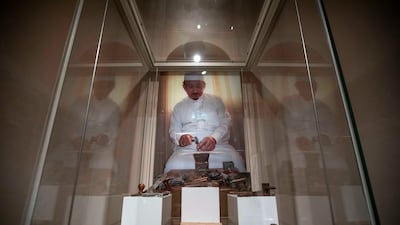
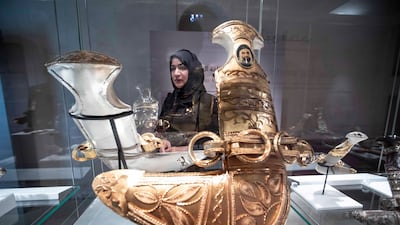
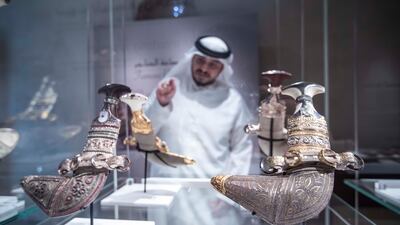
The Sharjah Heritage Museum’s current exhibition offers a fascinating look into the generations-old craft and design of the Emirati dagger, known in Arabic as a khanjar or khanyar.
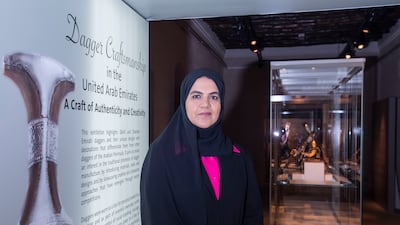
The 'Dagger Craftsmanship in the UAE — A Craft of Authenticity and Creativity' exhibition explores this manufacturing tradition through the work of one family.
The art form is an essential part of the UAE’s cultural heritage.
“My father would be astonished to see this exhibition and surprised to see his work here,” Halima Abdullah Rashid tells The National.
For generations, Rashid’s family has specialised in crafting swords and daggers. Many of the weapons and tools on display are the creations of her father and family members.
“This craft was their life, it was their routine,” she says.
“They never thought of it as something out of the ordinary, even though they were truly artists and designers.”
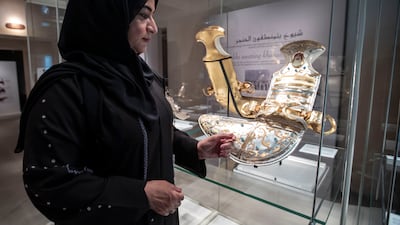
Rashid is a jewellery and dagger designer, who made two of the blades on display at the exhibition.
One is a 24-K gold plated dagger adorned with an image of UAE Founding Father, the late Sheikh Zayed bin Sultan Al Nahyan. Her design was awarded the largest dagger title by the Sea of Culture Foundation in 2018 in the Emirates National Records, under the Community Service and Love of Country category.
“The khanjar is a symbol of masculinity and courage — the idea of masculinity from a Bedouin perspective,” she says.
“There are many stories where the khanjar is always a symbol of this courage and bravery, which is important to Bedouin culture.”
Historically, daggers were carried for personal protection and hunting purposes. They were effectively part of everyday garb for many Bedouin, Emiratis and various Arab peoples from the region.
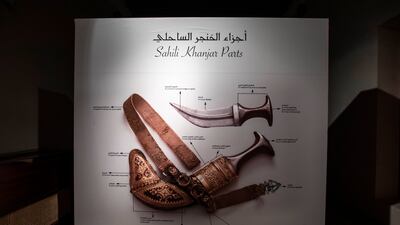
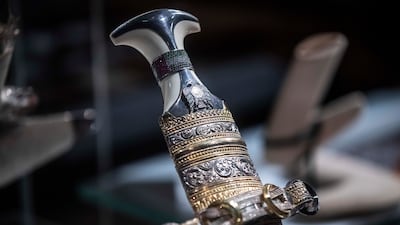
Emirati daggers consisted of a high-quality iron blade, attached to a hilt made from ivory — which has since been replaced with buffalo horn. They were completed with a curved soft leather sheath — adorned with silver and gold threads — attached to a woven belt.
Traditionally, a boy would be given his first dagger at the age of 10, symbolising his coming of age and entering adulthood.
Today, the dagger is considered an ornamental piece, worn on special occasions and for official ceremonies — often given as diplomatic gifts or awarded as a prize in competitions.
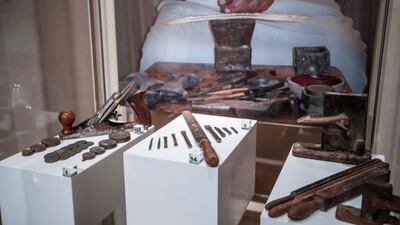
The Sharjah exhibition includes a collection of tools made by Rashid's father, Abdullah Rashid Al Naabi, who used to craft daggers and swords for more than 40 years at his home workshop in Al Rashidiya, Dubai.
Many of the items he sold across the region and the world are now on display. In particular, the exhibition focuses on the sahili and shamali daggers, distinctive by their size, shape and design.
Rashid first started researching Emirati daggers in 2003. She has since documented how her father and other members of her family laboured in their workshops, interviewing them and writing several books on the topic.
“The khanjar also has many elements of beauty, especially the Emirati khanjar,” Rashid adds.
“It has an important place, historically, artistically, in families and in society. The khanjar itself has 15 parts, and each of these parts has its own detail and history.”
The exhibition very clearly displays, through informative and approachable curation, the history and methods of creating the Emirati dagger and Rashid’s family’s connection to the history of the craft.
While educating visitors on this history, the exhibition also displays intricately designed pieces that highlight the craftsmanship, in the hope of inspiring curiosity and pride in younger generations of Emiratis.
“Visitors to the museum have come from all over and have been from many different groups and ages,” says Noura Almoughanni, curator of the exhibition.
“For children it has been something completely new and interesting. Most of them aren’t used to seeing anyone from their family owning a dagger or any of the men in their family carrying it.”
Almoughanni also says millennials and Gen Z were under the impression that the khanjar came from other countries in the region, not from the UAE.
Many of them, she noted, asked questions about the origins and influences of the Emirati dagger and were “able to learn that the dagger is an important element in the history of the country and the Emirati people".
Rashid, who is proud of her family’s contribution to the tradition, hopes that more Emiratis and Arabs can learn about the UAE's daggers and their relevance to regional culture.
“I hope that first of all people and Emiratis will learn about this period of their culture,” Rashid says.
“This is our identity," she adds. "I saw a mother with her children visiting the exhibition one day and they were all so astonished by the displays and the beauty of the designs. Children in particular are fascinated by them.”
The Dagger Craftsmanship in the UAE – A Craft of Authenticity and Creativity exhibition is running at the Sharjah History Museum until May 24

Company%20profile
%3Cp%3E%3Cstrong%3ECompany%20name%3A%20%3C%2Fstrong%3EHakbah%0D%3Cbr%3E%3Cstrong%3EStarted%3A%20%3C%2Fstrong%3E2018%0D%3Cbr%3E%3Cstrong%3EFounder%3A%20%3C%2Fstrong%3ENaif%20AbuSaida%0D%3Cbr%3E%3Cstrong%3EBased%3A%20%3C%2Fstrong%3ESaudi%20Arabia%0D%3Cbr%3E%3Cstrong%3ESector%3A%20%3C%2Fstrong%3EFinTech%0D%3Cbr%3E%3Cstrong%3ECurrent%20number%20of%20staff%3A%20%3C%2Fstrong%3E22%20%0D%3Cbr%3E%3Cstrong%3EInitial%20investment%3A%20%3C%2Fstrong%3E%24200%2C000%0D%3Cbr%3E%3Cstrong%3EInvestment%20stage%3A%20%3C%2Fstrong%3Epre-Series%20A%0D%3Cbr%3E%3Cstrong%3EInvestors%3A%20%3C%2Fstrong%3EGlobal%20Ventures%20and%20Aditum%20Investment%20Management%0D%3Cbr%3E%3Cbr%3E%3C%2Fp%3E%0A
Libya's Gold
UN Panel of Experts found regime secretly sold a fifth of the country's gold reserves.
The panel’s 2017 report followed a trail to West Africa where large sums of cash and gold were hidden by Abdullah Al Senussi, Qaddafi’s former intelligence chief, in 2011.
Cases filled with cash that was said to amount to $560m in 100 dollar notes, that was kept by a group of Libyans in Ouagadougou, Burkina Faso.
A second stash was said to have been held in Accra, Ghana, inside boxes at the local offices of an international human rights organisation based in France.
Teri%20Baaton%20Mein%20Aisa%20Uljha%20Jiya
%3Cp%3E%3Cstrong%3EDirectors%3A%3C%2Fstrong%3E%20Amit%20Joshi%20and%20Aradhana%20Sah%3C%2Fp%3E%0A%3Cp%3E%3Cstrong%3ECast%3A%3C%2Fstrong%3E%20Shahid%20Kapoor%2C%20Kriti%20Sanon%2C%20Dharmendra%2C%20Dimple%20Kapadia%2C%20Rakesh%20Bedi%3C%2Fp%3E%0A%3Cp%3E%3Cstrong%3ERating%3A%3C%2Fstrong%3E%204%2F5%3C%2Fp%3E%0A
Mercer, the investment consulting arm of US services company Marsh & McLennan, expects its wealth division to at least double its assets under management (AUM) in the Middle East as wealth in the region continues to grow despite economic headwinds, a company official said.
Mercer Wealth, which globally has $160 billion in AUM, plans to boost its AUM in the region to $2-$3bn in the next 2-3 years from the present $1bn, said Yasir AbuShaban, a Dubai-based principal with Mercer Wealth.
“Within the next two to three years, we are looking at reaching $2 to $3 billion as a conservative estimate and we do see an opportunity to do so,” said Mr AbuShaban.
Mercer does not directly make investments, but allocates clients’ money they have discretion to, to professional asset managers. They also provide advice to clients.
“We have buying power. We can negotiate on their (client’s) behalf with asset managers to provide them lower fees than they otherwise would have to get on their own,” he added.
Mercer Wealth’s clients include sovereign wealth funds, family offices, and insurance companies among others.
From its office in Dubai, Mercer also looks after Africa, India and Turkey, where they also see opportunity for growth.
Wealth creation in Middle East and Africa (MEA) grew 8.5 per cent to $8.1 trillion last year from $7.5tn in 2015, higher than last year’s global average of 6 per cent and the second-highest growth in a region after Asia-Pacific which grew 9.9 per cent, according to consultancy Boston Consulting Group (BCG). In the region, where wealth grew just 1.9 per cent in 2015 compared with 2014, a pickup in oil prices has helped in wealth generation.
BCG is forecasting MEA wealth will rise to $12tn by 2021, growing at an annual average of 8 per cent.
Drivers of wealth generation in the region will be split evenly between new wealth creation and growth of performance of existing assets, according to BCG.
Another general trend in the region is clients’ looking for a comprehensive approach to investing, according to Mr AbuShaban.
“Institutional investors or some of the families are seeing a slowdown in the available capital they have to invest and in that sense they are looking at optimizing the way they manage their portfolios and making sure they are not investing haphazardly and different parts of their investment are working together,” said Mr AbuShaban.
Some clients also have a higher appetite for risk, given the low interest-rate environment that does not provide enough yield for some institutional investors. These clients are keen to invest in illiquid assets, such as private equity and infrastructure.
“What we have seen is a desire for higher returns in what has been a low-return environment specifically in various fixed income or bonds,” he said.
“In this environment, we have seen a de facto increase in the risk that clients are taking in things like illiquid investments, private equity investments, infrastructure and private debt, those kind of investments were higher illiquidity results in incrementally higher returns.”
The Abu Dhabi Investment Authority, one of the largest sovereign wealth funds, said in its 2016 report that has gradually increased its exposure in direct private equity and private credit transactions, mainly in Asian markets and especially in China and India. The authority’s private equity department focused on structured equities owing to “their defensive characteristics.”
PROFILE OF SWVL
Started: April 2017
Founders: Mostafa Kandil, Ahmed Sabbah and Mahmoud Nouh
Based: Cairo, Egypt
Sector: transport
Size: 450 employees
Investment: approximately $80 million
Investors include: Dubai’s Beco Capital, US’s Endeavor Catalyst, China’s MSA, Egypt’s Sawari Ventures, Sweden’s Vostok New Ventures, Property Finder CEO Michael Lahyani
UAE%20athletes%20heading%20to%20Paris%202024
%3Cp%3E%3Cstrong%3EEquestrian%3C%2Fstrong%3E%3Cbr%3EAbdullah%20Humaid%20Al%20Muhairi%2C%20Abdullah%20Al%20Marri%2C%20Omar%20Al%20Marzooqi%2C%20Salem%20Al%20Suwaidi%2C%20and%20Ali%20Al%20Karbi%20(four%20to%20be%20selected).%3Cbr%3E%3Cstrong%3EJudo%3C%2Fstrong%3E%3Cbr%3EMen%3A%20Narmandakh%20Bayanmunkh%20(66kg)%2C%20Nugzari%20Tatalashvili%20(81kg)%2C%20Aram%20Grigorian%20(90kg)%2C%20Dzhafar%20Kostoev%20(100kg)%2C%20Magomedomar%20Magomedomarov%20(%2B100kg)%3B%20women's%20Khorloodoi%20Bishrelt%20(52kg).%3Cbr%3E%3Cbr%3E%3Cstrong%3ECycling%3C%2Fstrong%3E%3Cbr%3ESafia%20Al%20Sayegh%20(women's%20road%20race).%3Cbr%3E%3Cbr%3E%3Cstrong%3ESwimming%3C%2Fstrong%3E%3Cbr%3EMen%3A%20Yousef%20Rashid%20Al%20Matroushi%20(100m%20freestyle)%3B%20women%3A%20Maha%20Abdullah%20Al%20Shehi%20(200m%20freestyle).%3Cbr%3E%3Cbr%3E%3Cstrong%3EAthletics%3C%2Fstrong%3E%3Cbr%3EMaryam%20Mohammed%20Al%20Farsi%20(women's%20100%20metres).%3C%2Fp%3E%0A
More from Rashmee Roshan Lall
What is the FNC?
The Federal National Council is one of five federal authorities established by the UAE constitution. It held its first session on December 2, 1972, a year to the day after Federation.
It has 40 members, eight of whom are women. The members represent the UAE population through each of the emirates. Abu Dhabi and Dubai have eight members each, Sharjah and Ras al Khaimah six, and Ajman, Fujairah and Umm Al Quwain have four.
They bring Emirati issues to the council for debate and put those concerns to ministers summoned for questioning.
The FNC’s main functions include passing, amending or rejecting federal draft laws, discussing international treaties and agreements, and offering recommendations on general subjects raised during sessions.
Federal draft laws must first pass through the FNC for recommendations when members can amend the laws to suit the needs of citizens. The draft laws are then forwarded to the Cabinet for consideration and approval.
Since 2006, half of the members have been elected by UAE citizens to serve four-year terms and the other half are appointed by the Ruler’s Courts of the seven emirates.
In the 2015 elections, 78 of the 252 candidates were women. Women also represented 48 per cent of all voters and 67 per cent of the voters were under the age of 40.
The%20specs
%3Cp%3E%3Cstrong%3EEngine%3A%3C%2Fstrong%3E%204.0-litre%20twin-turbo%20V8%3Cbr%3E%3Cstrong%3EPower%3A%20%3C%2Fstrong%3E680hp%20at%206%2C000rpm%3Cbr%3E%3Cstrong%3ETorque%3A%20%3C%2Fstrong%3E800Nm%20at%202%2C750-6%2C000rpm%3Cbr%3E%3Cstrong%3ETransmission%3A%20%3C%2Fstrong%3ERear-mounted%20eight-speed%20auto%3Cbr%3E%3Cstrong%3EFuel%20consumption%3A%20%3C%2Fstrong%3E13.6L%2F100km%3Cbr%3E%3Cstrong%3EOn%20sale%3A%3C%2Fstrong%3E%20Orderbook%20open%3B%20deliveries%20start%20end%20of%20year%3Cbr%3E%3Cstrong%3EPrice%3A%20%3C%2Fstrong%3EFrom%20Dh970%2C000%3C%2Fp%3E%0A
The specs
Engine: 3.8-litre, twin-turbo V8
Transmission: eight-speed automatic
Power: 582bhp
Torque: 730Nm
Price: Dh649,000
On sale: now
The White Lotus: Season three
Creator: Mike White
Starring: Walton Goggins, Jason Isaacs, Natasha Rothwell
Rating: 4.5/5
Company profile
Date started: December 24, 2018
Founders: Omer Gurel, chief executive and co-founder and Edebali Sener, co-founder and chief technology officer
Based: Dubai Media City
Number of employees: 42 (34 in Dubai and a tech team of eight in Ankara, Turkey)
Sector: ConsumerTech and FinTech
Cashflow: Almost $1 million a year
Funding: Series A funding of $2.5m with Series B plans for May 2020