



Walking through the galleries of the inaugural Islamic Arts Biennale, which kicked off in Jeddah on Sunday night, visitors can expect to encounter some of the Islamic world's rarest relics, placed thoughtfully alongside striking contemporary art installations.
Saad Alrashid, curator and former deputy minister of antiquities, says the presentation of these relics is a "breakthrough" — something that will not only bring the history of the Hajj pilgrimage to life, but the timeless emotional experience of it, too.
“We want everyone to understand how Islamic civilisation grew and impacted the whole world, and how people have always gathered here from such far distances. Wherever there are Muslims, regardless of the colour of their skin or what languages they speak, even in times of catastrophe or war, they all gather and meet in Makkah.
“Historically, these people were coming to the Hajj from as near as Iraq, Syria, the Levant, Palestine and North Africa, and as far as Al Andalus and China.

“How could they bear the length of the journey, the weather conditions, climbing mountains and crossing deserts to get there? Coming to the holy site, to Makkah, to the Kaaba, and seeing people stand in rows and circle it in such a masterpiece of organisation, without any police or anyone controlling them, I can’t explain it. It really brings tears to your eyes.”
It is precisely this feeling he hopes the biennale can evoke through its galleries, and it's one that truly comes to light towards the end of the journey, as visitors arrive at a colossal ornate curtain that King Fahd bin Abdulaziz commissioned for the Kaaba in 1990. Crafted from silk and metal threads, it measures 634cm by 333cm, suspended high above the floor.
The curtain, known as the sitara in Arabic, is the most important of all the textiles that cover the Kaaba, which is the most important buildings in the Islamic world. This particular specimen was inspired by some of the earliest recorded examples, which tended to be very colourful.
Designed by the Saudi master calligrapher Abdulrahim Amin Bukhari, whose work features on the Kaaba door today, it is a true marvel. Heavily embroidered with gold and silver threads over a black silk grounding, its composition brings together scrolling decoration, with inscription panels and circular roundels enclosing verses from the Quran.

Continuing past the curtain, visitors reach the climax of the exhibition — a vast brilliant white space centred on a glistening gold door, towering to a height of almost 3.5 metres. Commissioned by King Abdulaziz bin Aldulrahman — who founded the unified Kingdom of Saudi Arabia — and crafted by “the Sheikh of the Goldsmiths” Mahmoud Yousuf Badr from 1944 to 1947, it replaced an older door that had fallen into disrepair.
The door, which was replaced in 1979 by King Khalid bin Abdulaziz, features a steel base, supported by iron bars and aluminium shutters covered with gilded silver and copper plates. It is decorated with floral and leaf motifs enclosing cartouches and roundels, filled with Quranic verses, alongside the Muslim profession of faith known as the shahadah and 11 names of God, all composed in thuluth script by Bukhari.
The door that was replaced is also on display at the biennale. Murad IV ordered its construction after floods swept through Makkah and destroyed three of the Kaaba’s walls in 1630. Makkah’s elders oversaw Egyptian craftsmen as they carefully constructed the replacement from teak, adorned with gilded silver.
Completed in about 1635, it features Quranic verses, a dedication, a prayer for Murad and information on his genealogy inscribed along the top. Composed of two teak leaves, the doors were coated in 75kg of silver and were so heavily gilded that they would have looked like they were made from solid gold at the time.

Also among the biennale’s most magnificent artefacts is one of three interior columns that were erected during the reconstruction of the Kaaba under Abdullah ibn Al-Zubayr in 683 AD. Al-Zubayr was the first child born to the Muhajirun — the first converts to Islam — as they reached Madinah, and one of the four people Caliph Uthman tasked with establishing a unified Quran text.
Rising a dizzying 8.5 metres high, the column was one of six used to support the Kaaba’s lower ceiling. Bolstering their strength, the pillars were placed on two-metre-tall stone bases and fixed to them with molten lead. They are capped with wooden crowns.
Incredibly, 1,300 years after they were forged, King Saud bin Abdulaziz included the columns in his restoration, placing a square inscribed base beneath each. In 1999, however, King Fahd finally replaced the columns with new ones. The one on show today represents the first time any have been displayed outside of Makkah.
Another of the biennale’s stunning artefacts from Makkah is a collection of tombstones from one its oldest cemeteries, Al Ma'la, which lies 1km north-east of the Haram Mosque. The Prophet Mohammed himself was said to have described it as "the finest of cemeteries", and it was where his companions, his wife Khadijah and his children were buried.
Ironically, these symbols of death offer a poignant insight into the lives of Makkah’s historic residents. Although some of the oldest examples have been damaged, about 600 dating between the 7th and 16th centuries have been preserved in museums and centres across Saudi Arabia.

While older specimens are adorned with Hijazi and Kufic calligraphic script, others feature naskh or thuluth, complete with ornate borders. These inscriptions paint vivid pictures of members of Makkah’s leading Quraish family, aristocrats, scholars, children, merchants and leaders from across the Islamic world.
Carved from local basalt, the tombstones at Al-Ma’la are distinct in that only the inscribed faces are smoothed. The epitaphs begin with the opening prayer formula, called the basmalah, with earlier graves following this with the shahada or the tasliyah, which invoke blessings on the Prophet Mohammed.
These are followed by verses from the Quran, with Ayat Al-Kursi, the throne verse, being a popular choice, as well as verses that explore death, the fleeting nature of the world and the afterlife. They also feature a trove of information on the deceased’s geographic, ethnic and tribal origins.
Curator Julian Raby, director emeritus of the National Museum of Asian Art — Smithsonian Institution, says the tombstones offer “tangible evidence of the way in which Hajj brought people from all over the place”.

“I'd shown 35 of them in Washington when I was there and I knew they have an extraordinary power. They have very, very beautiful calligraphy on one side, but unlike most tombstones, it's not dressed stone, it's a boulder, so there’s this kind of alluring power, when you look at the back, it’s just magnificent.
“But what someone was able to do was to look at the genealogies that go back to [the second Rashidun caliph] Umar ibn Khattab, so I mean it's absolutely extraordinary. But then there are also poignant stories — a seven-year-old girl dying here buried with her father and people from all sorts of different professions, so I think it reflects the diversity of Makkah in the Middle Ages."
Another two marble columns on display were once installed on the eastern side of the portico facing the Kaaba. Built during the reign of the Abbasid caliph Al-Mahdi during his expansion of the Haram Mosque, one has been dated back to 784AD. Rising 4.5m high, they are adorned with 15 lines of Kufic script, recounting the path of the Prophet Mohammed on his “farewell pilgramage” in 632 to Mas’a.
Although Al-Mahdi hauled in marble from Greater Syria and Egypt by sea to Jeddah, the carving is ascribed to “the people of Kufa”, artisans who were probably brought to Makkah. The Kufic inscriptions are of the highest skill, set alongside a border of vine scrolls, which recall 7th and 8th-century jewellery ornamentation.

The biennale also features some of the world’s oldest surviving Quranic manuscripts, dating back to the first century of the Hijrah. Some of these parchments were written within one or two generations of the Prophet Mohammed’s death. They are composed in Hijazi script, recognisable for the distinct way its tall upright letters slant backwards.
Raby points to a single-volume, monumental Quran, produced in either Herat or Shiraz in about 1420, as an “absolute triumph of calligraphy”. Embellished with brilliant illumination, the work features 372 leaves of paper adorned with 11 lines of thuluth script in opaque pigments and gold on each page — described as “elegant and dramatic”.
“It gives you goosebumps that these incredible manuscripts survived and in quite large numbers," Raby says. "There's this almost impetuous force of early Islam to produce so many of these giant Qurans." Christianity, he points out, took centuries to produce a single-volume Bible.
Other artefacts include keys to the Kaaba, a 16th-century silk ornate cover and padlock for the Prophet’s Tomb, 18th-century Hajj certificates and what Raby calls “one of the greatest astrolabes of all time” — among many more.
Together, Alrashid hopes that these pieces of Islamic history will leave a lasting impression. “I think it will educate people, and it will make them think — about who they are, what they are, where they belong and to whom.”
Scroll through more images of the Islamic Arts Biennale below
-

Haroon Gunn-Salie, from South Africa, expands on an existing work, Amongst Men, which is centred around the funeral procession of Imam Abdullah Haron, a Muslim community leader who was killed by apartheid police in 1969. Hareth Al Bustani / The National -

Building on the theme of belonging, Bricklab Studios has produced an architectural installation, Air Pilgrims Accommodation 1958, inspired by Jeddah’s historic Hajj housing. Hareth Al Bustani / The National -
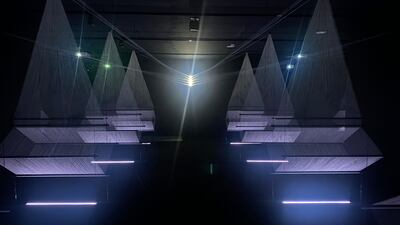
Saudi artist Muhannad Shono's Letter in Light, Lines We Write (2023) takes viewers on a spiritual journey with a stunning thread, steel and light projection installation. Hareth Al Bustani / The National -

The Islamic Arts Biennale opened on Monday night beneath the canopy of the Western Hajj Terminal. Photo: Hareth Al Bustani / The National -

A monumental single volume Quran manuscript, believed to have been made for Baysunghur Mirza bin Shah Rukh or Ibrahim Sultan bin Shah Rukh, in Herat or Sheraz 820-45AD, is on show at Jeddah's inaugural Islamic Arts Biennale. Hareth Al Bustani / The National -

The biennale includes several remarkable specimens of ancient Quran mansuscripts. Hareth Al Bustani / The National -

Saudi artist and researcher Moath Alofi's The Last Tashahud photo series captures abandoned musallas along the winding roads leading to the holy city of Madinah. Hareth Al Bustani / The National -

Saudi Arabian artist and researcher Moath Alofi's The Last Tashahud photo series captures abandoned musallas along the winding roads leading to the holy city of Madinah. Hareth Al Bustani / The National -

A former Kaaba door made by Shaikh Mahmoud Yousuf Badr for King Abdulaziz bin Abdulrahman Al Saud. Photo: Diriyah Biennale Foundation -

South African artist Igshaan Adams recreated prayer mats collected from his home in the Bonteheuwel district of Cape Town as part of a new collective tapestry, titled Salat al-jama’ah. Photo: Diriyah Biennale Foundation -
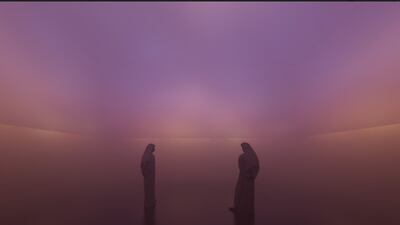
Tazaamun, an immersive multimedia by Digital Arts Lab installation that takes the audience on a journey out of mundane space and time. Photo: Diriyah Biennale Foundation -
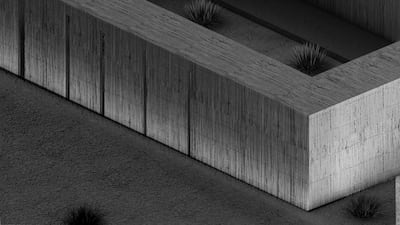
Anywhere Can Be A Place of Worship, an architectural intervention built from palm reeds, sand, plus other natural elements, by Nojoud Alsudairi and Sara Alissa of Syn Architects. Photo: Diriyah Biennale Foundation -

Key to Kabah II (2020) - one of Saudi Arabian photographer Adel Al Quraishi' Portraits of the Banu Shaibah, the family of the keepers of the Kaaba keys. Photo: Diriyah Biennale Foundation -
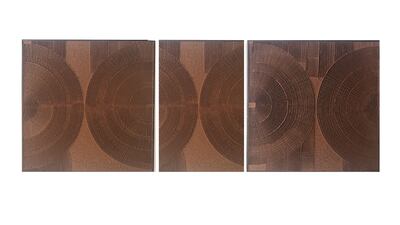
Grammar of the Earth by Moroccan artists Fatiha Zemmouri and Soukaina Aboulaoula. Photo: Diriyah Biennale Foundation -
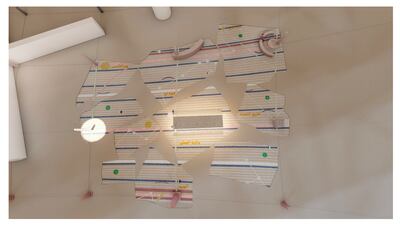
Sun Path, Rajab to Shawwal 1444 by Ali Karimi and Hamed Bukhamseen of the Bahrain's Civil Architecture. Photo: Diriyah Biennale Foundation -

Parts of an ancient Quranic manuscript with portions of the text from Surah Al-Ma’ida. Photo: Diriyah Biennale Foundation -

Adam, Eve, Others, and a Meteorite by British visual artist of Pakistani descent, Haroon Mirza. Photo: Diriyah Biennale Foundation



