• Sharjah Art Museum has paid tribute to the life and legacy of pioneering artist Ismail Khayat. An exhibition of his creations, titled Lasting Impressions, runs until November 27. Antonie Robertson / The National
    Sharjah Art Museum has paid tribute to the life and legacy of pioneering artist Ismail Khayat. An exhibition of his creations, titled Lasting Impressions, runs until November 27. Antonie Robertson / The National
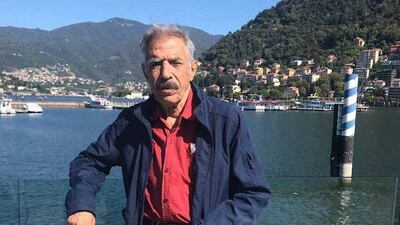
  • Khayat, who died aged 78 in October, was among the most daring, creative and influential Arab artists of the 20th century. Photo: Ismail Khayat Gallery
    Khayat, who died aged 78 in October, was among the most daring, creative and influential Arab artists of the 20th century. Photo: Ismail Khayat Gallery
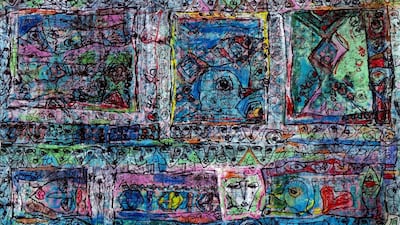
  • The exhibition features works spanning his six-decade career, as well as multiple mediums. Antonie Robertson / The National
    The exhibition features works spanning his six-decade career, as well as multiple mediums. Antonie Robertson / The National
  • Known best for his Expressionist works, Khayat was dubbed the 'grandfather of Kurdish art'. Antonie Robertson / The National
    Known best for his Expressionist works, Khayat was dubbed the 'grandfather of Kurdish art'. Antonie Robertson / The National
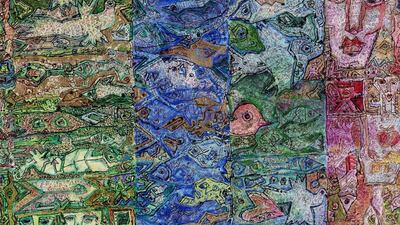
  • His works incorporated symbols, landscapes and folklore from Iraqi Kurdistan. Antonie Robertson / The National
    His works incorporated symbols, landscapes and folklore from Iraqi Kurdistan. Antonie Robertson / The National
  • The exhibition is currently on show in Sharjah. Antonie Robertson / The National
    The exhibition is currently on show in Sharjah. Antonie Robertson / The National
  • Sharjah Art Museum's exhibition includes almost 150 samples of Khayat's works, which number in the thousands.
    Sharjah Art Museum's exhibition includes almost 150 samples of Khayat's works, which number in the thousands.
  • Co-curator Alya Al Mulla says: 'He was always experimenting; with different mediums, different techniques, and different elements, coming up with his own style.' Antonie Robertson / The National
    Co-curator Alya Al Mulla says: 'He was always experimenting; with different mediums, different techniques, and different elements, coming up with his own style.' Antonie Robertson / The National
  • His son Hayas says: “He was a role model for Kurds at the time because his works were displayed alongside the great artists of Iraq's golden period of fine art." Antonie Robertson / The National
    His son Hayas says: “He was a role model for Kurds at the time because his works were displayed alongside the great artists of Iraq's golden period of fine art." Antonie Robertson / The National
  • Khayat spent much of his life in the city of Sulaymaniyah — where he taught art at public schools for 25 years, and later at the American University of Iraq.
    Khayat spent much of his life in the city of Sulaymaniyah — where he taught art at public schools for 25 years, and later at the American University of Iraq.
  • The first section of the exhibition showcases the artist's monochromatic works. Antonie Robertson / The National
    The first section of the exhibition showcases the artist's monochromatic works. Antonie Robertson / The National
  • A tour of SharjahArt Museum’s exhibition of works by Iraqi-Kurdish artist Ismail Khayat. Antonie Robertson/The National
    A tour of SharjahArt Museum’s exhibition of works by Iraqi-Kurdish artist Ismail Khayat. Antonie Robertson/The National
  • Khayat's peace stones. He began creating them during the Kurdish Civil War, which started in 1994. Antonie Robertson / The National
    Khayat's peace stones. He began creating them during the Kurdish Civil War, which started in 1994. Antonie Robertson / The National
  • Khayat even designed clothes, carrying on the legacy of his father, a notable tailor. Antonie Robertson / The National
    Khayat even designed clothes, carrying on the legacy of his father, a notable tailor. Antonie Robertson / The National

Sharjah Art Museum retrospective pays tribute to 'Picasso of Iraq' Ismail Khayat


Hareth Al Bustani
  • English
  • Arabic

Ismail Khayat, who died aged 78 last month, was among the most daring, creative and influential Middle Eastern artists of the 21st century. Dubbed the "Grandfather of Kurdish Art" and the "Picasso of Iraq", the self-taught master from Iraqi Kurdistan transcended the boundaries of form and tradition, creating new modes of expression — all the while, teaching successive generations of creatives.

Over the course of six decades, Khayat built a reputation as one of the greats of Iraqi modern artists. Demonstrating tremendous depth and range, he created a bridge between the worlds of Kurdish and Arab art, and as a mentor, helped other Kurdish artists to develop and exhibit their works across Iraq.

His dreams of creating a Kurdish art centre were sidelined by Covid-19 and an accidental fall in 2020 that left him in a coma for two years, before his death. However, Khayat’s work has finally been given the retrospective it deserves at the Sharjah Art Museum.

Ismail Khayat's son, Hayas, says that after his father fell into a coma, the family vowed to give him the exhibition he deserved. Photo: Hayas Khayat

With roughly 145 pieces spanning Khayat's vast body of work, Lasting Impressions: Ismail Khayat, on view until November 27, is the latest in a series of showcases at the museum, which aims to recognise the works of influential artists from the Middle East who are long overdue a major exhibition.

Khayat's son, Hayas, who co-curated the show with the Sharjah Art Museum’s Alya Al Mulla, recalls how it all began. "[After the accident] I never felt like my father was no longer present because everyone in the family was so preoccupied with his work that we would go to him and whisper into his ears, ‘We will open a new exhibition for you, we will take care of what you started,'" he says.

“In 2021, I promised myself that I would continue what he was doing and that I would not stop until I saw his works in the right place at the right time ... Out of nowhere, while we were dealing with his health issue, someone texted me and said ‘I'd like to speak with someone in charge of Ismail Khayat's work’. That person was Alya, like an angel from another world, who contacted me and said they want to make an exhibition for Ismail Khayat.”

Sharjah Art Museum’s Alya Al Mulla, who co-curated the exhibition with Khayat's son, Hayas. Antonie Robertson / The National

Al Mulla says: “We got in touch with his family and luckily for us, they already had a huge archive of his work. I’ve worked with many exhibitions and artists, and it's very rare to come across someone so well organised.”

However, curating a retrospective for an artist who has created more than 8,000 pieces presented a unique challenge — narrowing this down to a concise representation of his career. With such a variety of techniques, methods and mediums to work with, Hayas suggested approaching the task thematically, rather than chronologically.

Khayat was born in Khanaqin, a town in Iraqi Kurdistan near the Iranian border, in 1944, and grew up steeped in the landscapes, folklore and symbolism of the region. His father was a tailor so renowned for his craft that he adopted the surname Khayat, Kurdish for tailor.

Growing up the third of seven siblings, Khayat spent much of his time exploring Alwand river and its tributaries, among the mountains of northern Iraq. At the age of 11, he began expressing a remarkable aptitude for art; painting the walls of his houses with colourful images of birds and fish.

After secondary school, having been turned down by the Baghdad College of Fine Arts, he enrolled in the Teachers' Institute in Baqubah, before being drawn to Sulaymaniyah — renowned across Kurdistan as a city of art, beauty and liberty. There, encircled by mountains, Khayat taught art at public schools for 25 years, and later at the American University of Iraq.

Hayas says: “Sulaymaniyah changed Khayat's artistic journey because he met the love of his life in this city, his wife, Gaziza Omer.” After meeting Omer, Khayat’s work grew noticeably more vibrant and colourful; reflecting his immense love for her. During his career, he painted numerous women — and although they didn’t explicitly depict his wife and mother, they are often seen as celebrating the empowerment and strength of the women he loved.

Scroll through images of Ismail Khayat's work below:

  • Ismail Khayat died in October 2022; he had been in a coma for two years. Photo: Ismail Khayat / Facebook
    Ismail Khayat died in October 2022; he had been in a coma for two years. Photo: Ismail Khayat / Facebook
  • He was known fondly by critics and fans as 'the godfather of Kurdish art'. Photo: Ismail Khayat / Facebook
    He was known fondly by critics and fans as 'the godfather of Kurdish art'. Photo: Ismail Khayat / Facebook
  • He developed a distinctive style, inspired by Kurdish folklore and symbolism and Iraqi landscapes, infused with Kurdish issues of collective struggle and political isolation. Photo: Ismail Khayat / Facebook
    He developed a distinctive style, inspired by Kurdish folklore and symbolism and Iraqi landscapes, infused with Kurdish issues of collective struggle and political isolation. Photo: Ismail Khayat / Facebook
  • Over the course of his career, Khayat displayed his work across Iraq, the Arab region and the wider world; with shows in France, the US, Japan and others. Photo: Ismail Khayat / Facebook
    Over the course of his career, Khayat displayed his work across Iraq, the Arab region and the wider world; with shows in France, the US, Japan and others. Photo: Ismail Khayat / Facebook
  • An exhibition of Khayat's is on show at the Sharjah Art Museum until November 27. Photo: Ismail Khayat Gallery
    An exhibition of Khayat's is on show at the Sharjah Art Museum until November 27. Photo: Ismail Khayat Gallery
  • One of his artworks from 2012, an acrylic and ink piece. Photo: Ismail Khayat / Facebook
    One of his artworks from 2012, an acrylic and ink piece. Photo: Ismail Khayat / Facebook
  • Working with various mediums, he produced nearly 8,000 works over his life. Photo: Ismail Khayat Gallery
    Working with various mediums, he produced nearly 8,000 works over his life. Photo: Ismail Khayat Gallery
  • He regularly painted vibrant portraits of women inspired by his mother and wife. Photo: Ismail Khayat Gallery
    He regularly painted vibrant portraits of women inspired by his mother and wife. Photo: Ismail Khayat Gallery
  • After meeting his wife Gaziza Omer, Khayat's work became noticably more colourful. Kurdish Music, 2001. Photo: Ismail Khayat Gallery
    After meeting his wife Gaziza Omer, Khayat's work became noticably more colourful. Kurdish Music, 2001. Photo: Ismail Khayat Gallery
  • Khayat stands with a painting of peace in Pirar in 2000, no man's land during the Kurdish Civil war. Photo: Ismail Khayat Gallery
    Khayat stands with a painting of peace in Pirar in 2000, no man's land during the Kurdish Civil war. Photo: Ismail Khayat Gallery
  • Khayat produced several expressive and analytical works depicting the cityscape of Baghdad. A Balcony in Baghad, 1965, Chinese ink on paper. Photo: Ismail Khayat Gallery
    Khayat produced several expressive and analytical works depicting the cityscape of Baghdad. A Balcony in Baghad, 1965, Chinese ink on paper. Photo: Ismail Khayat Gallery
  • The 'stone man' pushed mediums to their limits. Stones in shape of Hand 2013, Acrylic on Stones. Photo: Ismail Khayat Gallery
    The 'stone man' pushed mediums to their limits. Stones in shape of Hand 2013, Acrylic on Stones. Photo: Ismail Khayat Gallery
  • Birds feature prominently in Khayat's work as symbols of peace and freedom. A Bird, oil on paper. Photo: Ismail Khayat Gallery
    Birds feature prominently in Khayat's work as symbols of peace and freedom. A Bird, oil on paper. Photo: Ismail Khayat Gallery
  • Untitled, 1980, oil color on canvas. Photo: Ismail Khayat Gallery
    Untitled, 1980, oil color on canvas. Photo: Ismail Khayat Gallery
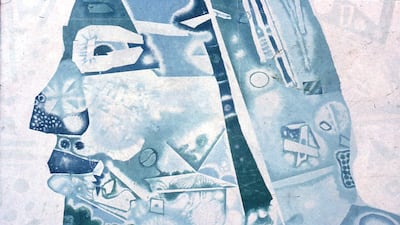
  • Khayat's work demonstrated a wide array of forms, including this piece from the Sham and Land collection, 1978. Photo: Ismail Khayat Gallery
    Khayat's work demonstrated a wide array of forms, including this piece from the Sham and Land collection, 1978. Photo: Ismail Khayat Gallery
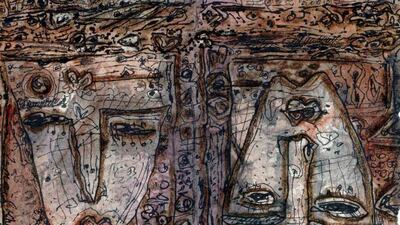
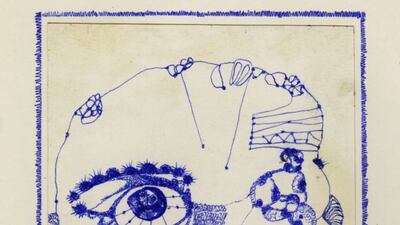
  • Masks, 2004, pen on Chinese paper. Photo: Ismail Khayat Gallery
    Masks, 2004, pen on Chinese paper. Photo: Ismail Khayat Gallery
  • The landscapes of Iraqi Kurdistan are threaded throughout Khayat's works. Near the River, 2006, watercolour and ink on paper. Photo: Ismail Khayat Gallery
    The landscapes of Iraqi Kurdistan are threaded throughout Khayat's works. Near the River, 2006, watercolour and ink on paper. Photo: Ismail Khayat Gallery
  • An installation of painted stones of peace in the Pirar Mountains, 1999. Photo: Ismail Khayat Gallery
    An installation of painted stones of peace in the Pirar Mountains, 1999. Photo: Ismail Khayat Gallery

Some of the earliest works in the exhibition include a collection of black and white drawings, through which Khayat was experimenting with ink and pencil on paper. Among these is a striking self-portrait in monochrome, which shows his distinctive brush strokes. A restless creator hungry for more tools, he often used his fingers and fingernails, giving his work a primal intensity.

Hayas says standing out among the giants of the 1960s art scene in Iraq, such as Jawad Salim and Faeq Hassan, was “extremely difficult, especially if you were from the Kurdish region of Iraq and were young”.

The exhibition features several of Khayat’s works from this period, demonstrating tremendous depth. Alongside examples of idyllic presentations of Kurdish portraiture in acrylic and pencil, and analytical depictions of the winding streets and alleyways of Baghdad, are darker expressionist pieces, including 1968’s A Face from Stone.

Ismail Khayat's 'A Face from Stone' (1968). Photo: Ismail Khayat Gallery

Hayas says: “He was a role model for Kurds at the time because his works were displayed alongside the great artists of Iraq's golden period of fine art. The Kurds were overjoyed to see one of their young artists standing alongside these amazing artists and receiving attention from Baghdad's critics and galleries."

Al Mulla adds: “He was always experimenting; with different mediums, different techniques and different elements, coming up with his own style.

“And he would recycle things,” she says, pointing to a later piece, titled Fish, which is part of the expressionist section. It features a colourful fish set over a black background — which Khayat created by flattening a cardboard box, shaping it into a fish and illustrating it in ink. “He was a very hands-on artist.”

Hayas says: “He believed that there is no waste in art. That people can turn recycled materials into art, and that great art is not about having everything, but rather about making happenings look great.”

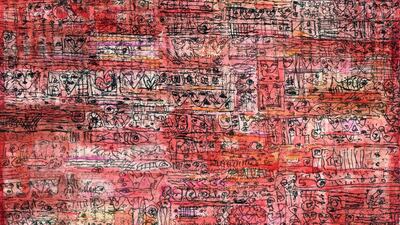
Ismail Khayat's A Flying Bird on the exhibition's poster. Photo: Ismail Khayat Gallery

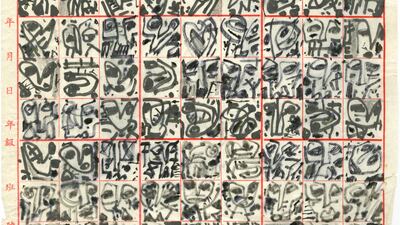
One of Khayat’s more recent works, A Flying Bird, features a circular canvas, which he created himself, with a bird illustrated on top in watercolour and ink. Between are endlessly intricate details, with numerous dramatic faces juxtaposed against one another, and tiny scribbles interlaced throughout.

Coloured in a dramatic red, the piece encapsulates Khayat’s later approach to his work, which combined natural imagery, landscapes and figurative depictions of humans. He would frequently explore the landscapes and cities of northern Iraq, soaking in inspiration and later reconfiguring the various images in his imagination.

Birds reappear frequently in Khayat’s work. His son says Khayat was deeply moved by an experience early in his life when he saw several birds that had died in “terrible circumstances”. On another level, however, he saw them as symbols of peace and of freedom. “My feeling,” says Hayas, “is that he held the view that nature and humanity are complementary, and that when we die, we return to nature and impact it in some new way.”

Among his most notable works were his Masks, which he produced over several decades. “The majority of my father's masks are, in fact, part of a series that was inspired by my mother's work in the theatre, particularly after 1989, when they were married," Hayas explains.

"But he also regarded genocide and the Anfal tragedy to be a big element of his masks.”

Khayat's masks were inspired by his wife's success in theatre, as well as the persecution of Iraqi Kurds. Antonie Robertson / The National

During this period, Khayat’s works became more intertwined in the social and political issues of his time. Spanning a broad range of mediums — such as collage paper crafted with his hands, sewed together and brought to life with ink — they depict the physical embodiment of anguish, horror and terror.

In the 1990s, during the height of the Kurdish civil war, Khayat placed himself in danger to paint the boulders and mountains of Pirar, the region between the warring sides. Hayas says: “His goal was to inform Kurds, Arabs, and the rest of the world that Kurds are fighting for peace. This project is still ongoing and has been renewed for many years to focus on the Kurds' message to everyone.”

Continuing the project, Khayat painted thousands of stones and boulders, adorned with messages and images of peace, importing and exporting hundreds of kilograms of stones across the world.

For these works, he also earned the nickname "The Stone Man". Yet, despite his powerful artistic statements, he always remained quiet. When he was sad, he painted, says Hayas. Although he was a "loner" who sacrificed making friends in order to work, Hayas says he was a proud teacher and father, who "never got angry" and "always encouraged everyone to create art and do better".

Khayat was celebrated not only as a great artist, but also a teacher who devoted his life to education. Photo: Ismail Khayat Gallery

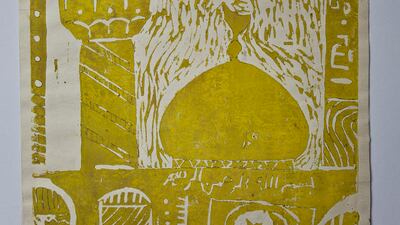
After a lengthy career teaching, Khayat served as the director of plastic arts in Kurdistan’s Ministry of Culture. He continued to experiment, working not only with paper and cardboard, but also carpets, ceramics and wood — and even designing clothing, in a tribute to his father’s legacy.

Hayas visited Sharjah with his mother for the opening of the exhibition, but three days after his return home, his father died. “When we knew the 40th day after his death would be the last day of his exhibition. It was quite difficult and tragic for us, but we are glad to see that his name is always alive.

"Age was never an issue for him; he was always saying, 'I will work until I die,' which is why I am carrying on his legacy and will not stop until the day I die, because we can overcome anything and art has no ending point. These messages should be communicated to the world."

Lasting Impressions: Ismail Khayat runs until November 27 at the Sharjah Art Museum. More information is available at sharjahmuseums.ae


Our legal consultants

Name: Hassan Mohsen Elhais

Position: legal consultant with Al Rowaad Advocates and Legal Consultants.

Mercer, the investment consulting arm of US services company Marsh & McLennan, expects its wealth division to at least double its assets under management (AUM) in the Middle East as wealth in the region continues to grow despite economic headwinds, a company official said.

Mercer Wealth, which globally has $160 billion in AUM, plans to boost its AUM in the region to $2-$3bn in the next 2-3 years from the present $1bn, said Yasir AbuShaban, a Dubai-based principal with Mercer Wealth.

Within the next two to three years, we are looking at reaching $2 to $3 billion as a conservative estimate and we do see an opportunity to do so,” said Mr AbuShaban.

Mercer does not directly make investments, but allocates clients’ money they have discretion to, to professional asset managers. They also provide advice to clients.

“We have buying power. We can negotiate on their (client’s) behalf with asset managers to provide them lower fees than they otherwise would have to get on their own,” he added.

Mercer Wealth’s clients include sovereign wealth funds, family offices, and insurance companies among others.

From its office in Dubai, Mercer also looks after Africa, India and Turkey, where they also see opportunity for growth.

Wealth creation in Middle East and Africa (MEA) grew 8.5 per cent to $8.1 trillion last year from $7.5tn in 2015, higher than last year’s global average of 6 per cent and the second-highest growth in a region after Asia-Pacific which grew 9.9 per cent, according to consultancy Boston Consulting Group (BCG). In the region, where wealth grew just 1.9 per cent in 2015 compared with 2014, a pickup in oil prices has helped in wealth generation.

BCG is forecasting MEA wealth will rise to $12tn by 2021, growing at an annual average of 8 per cent.

Drivers of wealth generation in the region will be split evenly between new wealth creation and growth of performance of existing assets, according to BCG.

Another general trend in the region is clients’ looking for a comprehensive approach to investing, according to Mr AbuShaban.

“Institutional investors or some of the families are seeing a slowdown in the available capital they have to invest and in that sense they are looking at optimizing the way they manage their portfolios and making sure they are not investing haphazardly and different parts of their investment are working together,” said Mr AbuShaban.

Some clients also have a higher appetite for risk, given the low interest-rate environment that does not provide enough yield for some institutional investors. These clients are keen to invest in illiquid assets, such as private equity and infrastructure.

“What we have seen is a desire for higher returns in what has been a low-return environment specifically in various fixed income or bonds,” he said.

“In this environment, we have seen a de facto increase in the risk that clients are taking in things like illiquid investments, private equity investments, infrastructure and private debt, those kind of investments were higher illiquidity results in incrementally higher returns.”

The Abu Dhabi Investment Authority, one of the largest sovereign wealth funds, said in its 2016 report that has gradually increased its exposure in direct private equity and private credit transactions, mainly in Asian markets and especially in China and India. The authority’s private equity department focused on structured equities owing to “their defensive characteristics.”

BMW M5 specs

Engine: 4.4-litre twin-turbo V-8 petrol enging with additional electric motor

Power: 727hp

Torque: 1,000Nm

Transmission: 8-speed auto

Fuel consumption: 10.6L/100km

On sale: Now

Price: From Dh650,000

The specs

Engine: 2.0-litre four-cylinder turbo

Power: 178hp at 5,500rpm

Torque: 280Nm at 1,350-4,200rpm

Transmission: seven-speed dual-clutch auto

Price: from Dh209,000 

On sale: now

The specs

Engine: 6.2-litre V8

Transmission: ten-speed

Power: 420bhp

Torque: 624Nm

Price: Dh325,125

On sale: Now

'Unrivaled: Why America Will Remain the World’s Sole Superpower'
Michael Beckley, Cornell Press

Ten tax points to be aware of in 2026

1. Domestic VAT refund amendments: request your refund within five years

If a business does not apply for the refund on time, they lose their credit.

2. E-invoicing in the UAE

Businesses should continue preparing for the implementation of e-invoicing in the UAE, with 2026 a preparation and transition period ahead of phased mandatory adoption. 

3. More tax audits

Tax authorities are increasingly using data already available across multiple filings to identify audit risks. 

4. More beneficial VAT and excise tax penalty regime

Tax disputes are expected to become more frequent and more structured, with clearer administrative objection and appeal processes. The UAE has adopted a new penalty regime for VAT and excise disputes, which now mirrors the penalty regime for corporate tax.

5. Greater emphasis on statutory audit

There is a greater need for the accuracy of financial statements. The International Financial Reporting Standards standards need to be strictly adhered to and, as a result, the quality of the audits will need to increase.

6. Further transfer pricing enforcement

Transfer pricing enforcement, which refers to the practice of establishing prices for internal transactions between related entities, is expected to broaden in scope. The UAE will shortly open the possibility to negotiate advance pricing agreements, or essentially rulings for transfer pricing purposes. 

7. Limited time periods for audits

Recent amendments also introduce a default five-year limitation period for tax audits and assessments, subject to specific statutory exceptions. While the standard audit and assessment period is five years, this may be extended to up to 15 years in cases involving fraud or tax evasion. 

8. Pillar 2 implementation 

Many multinational groups will begin to feel the practical effect of the Domestic Minimum Top-Up Tax (DMTT), the UAE's implementation of the OECD’s global minimum tax under Pillar 2. While the rules apply for financial years starting on or after January 1, 2025, it is 2026 that marks the transition to an operational phase.

9. Reduced compliance obligations for imported goods and services

Businesses that apply the reverse-charge mechanism for VAT purposes in the UAE may benefit from reduced compliance obligations. 

10. Substance and CbC reporting focus

Tax authorities are expected to continue strengthening the enforcement of economic substance and Country-by-Country (CbC) reporting frameworks. In the UAE, these regimes are increasingly being used as risk-assessment tools, providing tax authorities with a comprehensive view of multinational groups’ global footprints and enabling them to assess whether profits are aligned with real economic activity. 

Contributed by Thomas Vanhee and Hend Rashwan, Aurifer

Key findings of Jenkins report
  • Founder of the Muslim Brotherhood, Hassan al Banna, "accepted the political utility of violence"
  • Views of key Muslim Brotherhood ideologue, Sayyid Qutb, have “consistently been understood” as permitting “the use of extreme violence in the pursuit of the perfect Islamic society” and “never been institutionally disowned” by the movement.
  • Muslim Brotherhood at all levels has repeatedly defended Hamas attacks against Israel, including the use of suicide bombers and the killing of civilians.
  • Laying out the report in the House of Commons, David Cameron told MPs: "The main findings of the review support the conclusion that membership of, association with, or influence by the Muslim Brotherhood should be considered as a possible indicator of extremism."
The specs: Fenyr SuperSport

Price, base: Dh5.1 million

Engine: 3.8-litre twin-turbo flat-six

Transmission: Seven-speed automatic

Power: 800hp @ 7,100pm

Torque: 980Nm @ 4,000rpm

Fuel economy, combined: 13.5L / 100km

%3Cp%3E%3Cstrong%3EDirector%3A%3C%2Fstrong%3E%20Nag%20Ashwin%3C%2Fp%3E%0A%3Cp%3E%3Cstrong%3EStarring%3A%20%3C%2Fstrong%3EPrabhas%2C%20Saswata%20Chatterjee%2C%20Deepika%20Padukone%2C%20Amitabh%20Bachchan%2C%20Shobhana%3C%2Fp%3E%0A%3Cp%3E%3Cstrong%3ERating%3A%20%3C%2Fstrong%3E%E2%98%85%E2%98%85%E2%98%85%E2%98%85%3C%2Fp%3E%0A
Updated: November 21, 2022, 10:18 AM