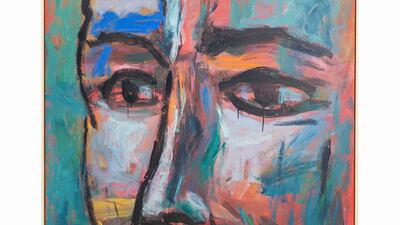
A new painting by Samia Halaby will be among the works featured in an exhibition in Venice dedicated to art from Palestine.
Organised by Palestine Museum US, the exhibition will open on Saturday at the Palazzo Mora within the European Cultural Centre. It will run until November 24, coinciding with the Venice Biennale.
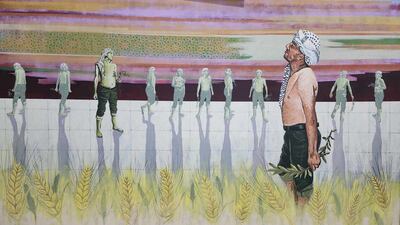
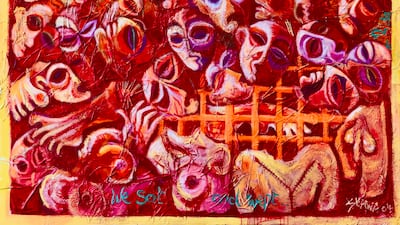
The title of the exhibition – Foreigners in their Homeland: Occupation, Apartheid, Genocide – is a response to the biennial's theme Foreigners Everywhere. It aims to underscore the plight of Palestinians living under Israeli occupation. The exhibition brings together works by 26 Palestinian artists, two of whom are from Gaza and are currently sheltering in tents in Rafah.
The exhibited works will address various aspects of the Palestinian identity, from the vibrancy of its culture to the struggles of life and the current fight to withstand Israel’s onslaught.
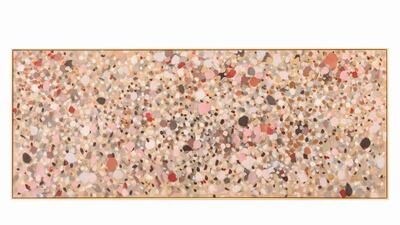
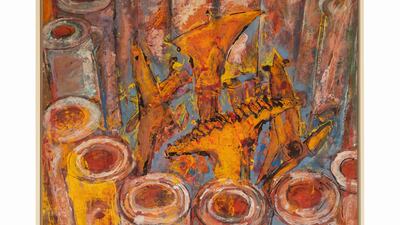
Halaby’s work, for instance, sprawls across more than three metres and has been composed with the dynamic abstraction that the Palestinian artist has become renowned for. While Halaby has shown the painting on her social media, Foreigners in their Homeland marks the first time the work will be officially displayed to the public.
Entitled Massacre of the Innocents in Gaza, the painting brings to attention the continuing war in Gaza, where more than 33,000 Palestinians have been killed as a result of Israel’s brutal onslaught since October 7. With ochre, grey, black, red and pink brushstrokes, the painting is wrought with anxiety as it touches upon the many tragedies rippling across the Palestinian enclave.
“The inclusion of Samia Halaby in this exhibition adds immense value, given her global recognition for her distinctive abstract artistic style and vibrant use of colours,” said Faisal Saleh, executive director of Palestine Museum US and the exhibition’s curator.
While Halaby’s participation in the exhibition is noteworthy, Saleh also adds that each of the exhibiting artists uniquely captures the Palestinian experience.
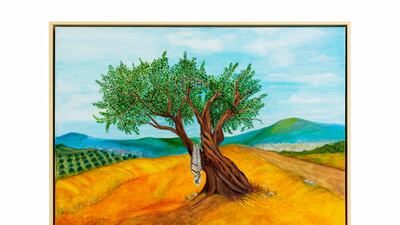
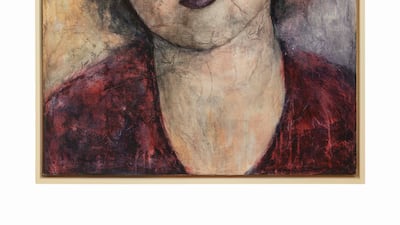
In Returning, Zeinab Shaath depicts a vibrant, almost dreamy hillside, with an olive tree standing in the foreground and a keffiyeh draped over one of its branches. Portraits by Mohamed Khalil and Khair Alah Salim are, meanwhile, composed with a touch of melancholy and pensiveness – but with widely disparate visual sensibilities.
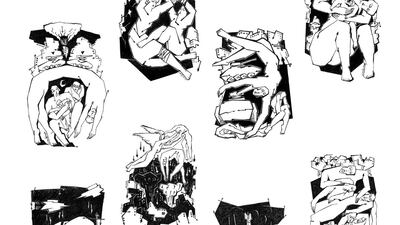
The harrowing aspects of living under Israeli occupation are also captured, such as in Democracy in Red by Laila Shawa, which was produced using acrylic, paper mache, gauze and nails; and in I'm Still Alive by Maisara Baroud, which features scenes that evidently draw from the events in Gaza. Baroud is among the exhibiting artists who come from the Palestinian enclave.
Foreigners in their Homeland: Occupation, Apartheid, Genocide will be running at the Palazzo Mora from Saturday to November 24

Essentials
The flights
Etihad and Emirates fly direct from the UAE to Delhi from about Dh950 return including taxes.
The hotels
Double rooms at Tijara Fort-Palace cost from 6,670 rupees (Dh377), including breakfast.
Doubles at Fort Bishangarh cost from 29,030 rupees (Dh1,641), including breakfast. Doubles at Narendra Bhawan cost from 15,360 rupees (Dh869). Doubles at Chanoud Garh cost from 19,840 rupees (Dh1,122), full board. Doubles at Fort Begu cost from 10,000 rupees (Dh565), including breakfast.
The tours
Amar Grover travelled with Wild Frontiers. A tailor-made, nine-day itinerary via New Delhi, with one night in Tijara and two nights in each of the remaining properties, including car/driver, costs from £1,445 (Dh6,968) per person.
Museum of the Future in numbers
- 78 metres is the height of the museum
- 30,000 square metres is its total area
- 17,000 square metres is the length of the stainless steel facade
- 14 kilometres is the length of LED lights used on the facade
- 1,024 individual pieces make up the exterior
- 7 floors in all, with one for administrative offices
- 2,400 diagonally intersecting steel members frame the torus shape
- 100 species of trees and plants dot the gardens
- Dh145 is the price of a ticket
Nancy 9 (Hassa Beek)
Nancy Ajram
(In2Musica)
Ten tax points to be aware of in 2026
1. Domestic VAT refund amendments: request your refund within five years
If a business does not apply for the refund on time, they lose their credit.
2. E-invoicing in the UAE
Businesses should continue preparing for the implementation of e-invoicing in the UAE, with 2026 a preparation and transition period ahead of phased mandatory adoption.
3. More tax audits
Tax authorities are increasingly using data already available across multiple filings to identify audit risks.
4. More beneficial VAT and excise tax penalty regime
Tax disputes are expected to become more frequent and more structured, with clearer administrative objection and appeal processes. The UAE has adopted a new penalty regime for VAT and excise disputes, which now mirrors the penalty regime for corporate tax.
5. Greater emphasis on statutory audit
There is a greater need for the accuracy of financial statements. The International Financial Reporting Standards standards need to be strictly adhered to and, as a result, the quality of the audits will need to increase.
6. Further transfer pricing enforcement
Transfer pricing enforcement, which refers to the practice of establishing prices for internal transactions between related entities, is expected to broaden in scope. The UAE will shortly open the possibility to negotiate advance pricing agreements, or essentially rulings for transfer pricing purposes.
7. Limited time periods for audits
Recent amendments also introduce a default five-year limitation period for tax audits and assessments, subject to specific statutory exceptions. While the standard audit and assessment period is five years, this may be extended to up to 15 years in cases involving fraud or tax evasion.
8. Pillar 2 implementation
Many multinational groups will begin to feel the practical effect of the Domestic Minimum Top-Up Tax (DMTT), the UAE's implementation of the OECD’s global minimum tax under Pillar 2. While the rules apply for financial years starting on or after January 1, 2025, it is 2026 that marks the transition to an operational phase.
9. Reduced compliance obligations for imported goods and services
Businesses that apply the reverse-charge mechanism for VAT purposes in the UAE may benefit from reduced compliance obligations.
10. Substance and CbC reporting focus
Tax authorities are expected to continue strengthening the enforcement of economic substance and Country-by-Country (CbC) reporting frameworks. In the UAE, these regimes are increasingly being used as risk-assessment tools, providing tax authorities with a comprehensive view of multinational groups’ global footprints and enabling them to assess whether profits are aligned with real economic activity.
Contributed by Thomas Vanhee and Hend Rashwan, Aurifer
The specs
Engine: 3.0-litre six-cylinder turbo
Power: 398hp from 5,250rpm
Torque: 580Nm at 1,900-4,800rpm
Transmission: Eight-speed auto
Fuel economy, combined: 6.5L/100km
On sale: December
Price: From Dh330,000 (estimate)
The Breadwinner
Director: Nora Twomey
Starring: Saara Chaudry, Soma Chhaya, Laara Sadiq
Three stars
Roll of honour 2019-2020
Dubai Rugby Sevens
Winners: Dubai Hurricanes
Runners up: Bahrain
West Asia Premiership
Winners: Bahrain
Runners up: UAE Premiership
UAE Premiership
Winners: Dubai Exiles
Runners up: Dubai Hurricanes
UAE Division One
Winners: Abu Dhabi Saracens
Runners up: Dubai Hurricanes II
UAE Division Two
Winners: Barrelhouse
Runners up: RAK Rugby
The%20specs
%3Cp%3E%3Cstrong%3EEngine%3A%3C%2Fstrong%3E%204.0-litre%20twin-turbo%20V8%3Cbr%3E%3Cstrong%3EPower%3A%20%3C%2Fstrong%3E680hp%20at%206%2C000rpm%3Cbr%3E%3Cstrong%3ETorque%3A%20%3C%2Fstrong%3E800Nm%20at%202%2C750-6%2C000rpm%3Cbr%3E%3Cstrong%3ETransmission%3A%20%3C%2Fstrong%3ERear-mounted%20eight-speed%20auto%3Cbr%3E%3Cstrong%3EFuel%20consumption%3A%20%3C%2Fstrong%3E13.6L%2F100km%3Cbr%3E%3Cstrong%3EOn%20sale%3A%3C%2Fstrong%3E%20Orderbook%20open%3B%20deliveries%20start%20end%20of%20year%3Cbr%3E%3Cstrong%3EPrice%3A%20%3C%2Fstrong%3EFrom%20Dh970%2C000%3C%2Fp%3E%0A
Sinopharm vaccine explained
The Sinopharm vaccine was created using techniques that have been around for decades.
“This is an inactivated vaccine. Simply what it means is that the virus is taken, cultured and inactivated," said Dr Nawal Al Kaabi, chair of the UAE's National Covid-19 Clinical Management Committee.
"What is left is a skeleton of the virus so it looks like a virus, but it is not live."
This is then injected into the body.
"The body will recognise it and form antibodies but because it is inactive, we will need more than one dose. The body will not develop immunity with one dose," she said.
"You have to be exposed more than one time to what we call the antigen."
The vaccine should offer protection for at least months, but no one knows how long beyond that.
Dr Al Kaabi said early vaccine volunteers in China were given shots last spring and still have antibodies today.
“Since it is inactivated, it will not last forever," she said.