


Two festivals held annually to commemorate the journey of Jesus, Joseph and Mary from Bethlehem to Egypt while fleeing King Herod have been added to Unesco’s Intangible Cultural Heritage list, the UN agency said on Wednesday.
The first is the Festival of the Advent of the Holy Family in Egypt, a one-day event held at the beginning of June annually. The second, the Nativity of the Virgin, is a feast celebrated between May and August of each year in several localities in Cairo as well as in various provinces.
Egyptian Christians, the majority of whom are Coptic Orthodox, are joined by their Muslim counterparts each year to celebrate both festivals, a fact Unesco highlighted as an important reason for their inscription, because they promote unity between the country’s two largest religious groups.
“The festivities are replete with social functions and cultural meanings, including the unified social and cultural fabric between Coptic Christians and Muslims evidenced during the preparations and festivities. The events are also associated with the provision of voluntary services to visitors by local residents and the exchange of gifts,” it said.

The festivities include singing, traditional games, body painting, re-enactments of the journey, religious processions, artistic performances and the sharing of traditional foods.
Though it is known for its preservation of physical monuments all over the world, Unesco also does a lot of work to preserve traditions and ways of living that are at threat of being erased amid increasing levels of globalisation.
The agency considers “oral traditions, performing arts, social practices, rituals, festive events, knowledge and practices concerning nature and the universe” as intangible heritage that it seeks to preserve.
As opposed to physical monuments, intangible heritage is not merely important as a cultural manifestation, but rather because it constitutes essential knowledge, skills or ethics transmitted from one generation to the next.
The inscription was announced amid the 17th session of the Intergovernmental Committee for the Safeguarding of the Intangible Cultural Heritage, which this year is being held in Rabat, Morocco until Thursday.
UAE's 12 traditions on Unesco's lists of intangible cultural heritage — in pictures
-

Arabic calligraphy is the latest addition from the UAE, among other countries, to Unesco's intangible cultural heritage lists. AFP -
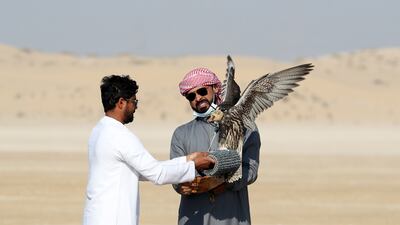
Falconry has been practised in the Arab region for 4,000 years, mainly by desert-dwelling Bedouins as an important form of hunting and fishing in a land with scarce natural resources. Pawan Singh / The National -

Learn more about al aflaj system in Al Ain in 'Emirates from Above', a National Geographic film. The traditional irrigation network system in the UAE has been added to Unesco's list. -
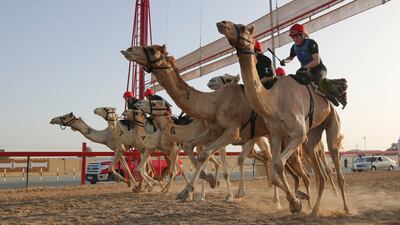
Camel racing, an age-old tradition in the region, is still as popular today. EPA -
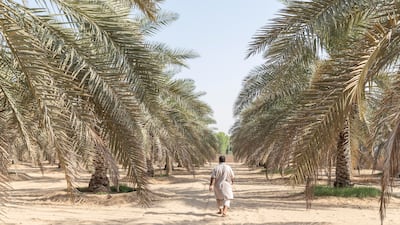
Date palms have been used for centuries for myriad purposes around the Gulf, including the UAE. It was added by Unesco in 2019. Antonie Robertson / The National -
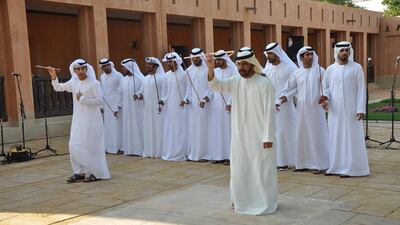
Al azi poetry has been offered protected status by Unesco to develop a clear national identity in the UAE. -
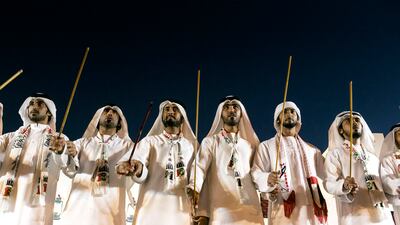
Al rafza is a traditional art form performed by men during special occasions, from weddings to national festivals. Reem Mohammed / The National -

The serving of Arabian coffee is a vital part of hospitality in the region and 'considered a ceremonial act of generosity', says the Unesco inscription. Khushnum Bhandari / The National -
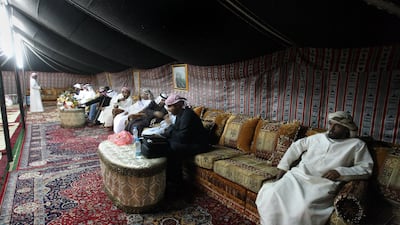
The majlis, a cultural and social space prevalent throughout the region, was added in 2015 on behalf of the UAE, Saudi Arabia, Oman and Qatar. Jaime Puebla / The National -
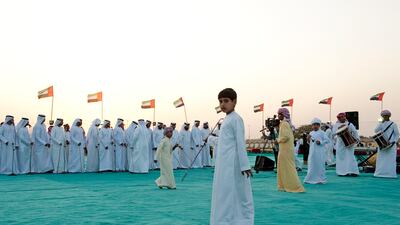
Al ayyala is a cultural performance practised in north-western Oman and throughout the UAE. It was added in 2014. -
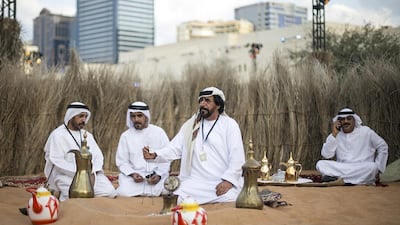
Al taghrooda, traditional Bedouin chanted poetry, was added in 2012. Mona Al Marzooqi / The National -
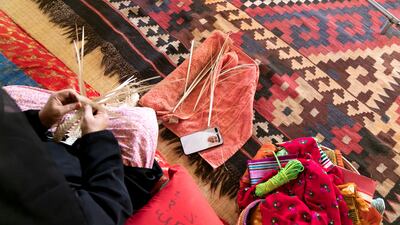
Sadu, a traditional weaving technique, is on the list twice, once for the UAE and once for Saudi Arabia and Kuwait. It was added for the UAE in 2011. Reem Mohammed / The National



