This Faeq Hassan painting of a Kurdish sheikh, looted in 2003, has been returned to the Baghdad Museum of Modern Art. Photo: Ministry of Culture, Tourism and Antiquities – Iraq

Iraq recovers Faeq Hassan painting looted during 2003 invasion


Melissa Gronlund
  • English
  • Arabic

Iraq's Ministry of Culture Tourism and Antiquities has recovered a painting by the late artist Faeq Hassan, a luminary of the Golden Age of Iraqi art in the 1950s and '60s. It depicts a Kurdish sheikh resting casually with a rifle between his legs.

The painting was among those looted from the Saddam Centre for the Arts during the US invasion of 2003 and was found in the Ibrahimi Collection of Fine Art in Amman. As soon as the collector, Hassanein Al Ibrahimi, discovered the work's origins, he returned it to Iraq, says Hasanein Sadik Ayeed, director of the National Museum of Modern Art in Baghdad.

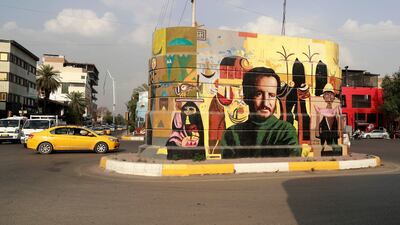
A man sits in front of a Faeq Hassan mural titled 'Women and Birds', in central Baghdad. Photo: AFP

"This work was among the assets of the National Museum of Modern Art in the past, and it bears a catalogue number and the department's name.

"After 2003, all of these museum works were lost and sent abroad. Artists and connoisseurs bought and acquired most of them and hung them in their homes, workplaces, circles and art institutions — particularly members of the Iraqi community residing outside the country, and expatriates."

For the ministry and other bodies that have since been searching for these artworks, the return of a Hassan is a significant accomplishment. The painting will be shown as part of the museum's Faeq Hassan Art Gallery.

Faeq Hassan's Cubism-inspired 'El-Allabat' (The Curd Sellers), painted in the early 1950s. Photo: Bonhams

"Pioneering artists' works, especially 50 to 75-year-old works, will be featured here in the museum. They're considered civilisational and cultural heritage of high artistic value," says Sadik Ayeed.

"Most of the Iraqi artists participated in the initial stages of Iraq's establishment and presented their distinguished works as a record of the events, people, places and personalities that are still remembered today."

Hassan created the painting in the northern Iraqi city of Zakho as one of six portraits of the Kurdish sheikh Bazi Al Kurdi Al Badnani.

Produced in the early 1940s, it bears the more naturalist style that Hassan later broke from as he moved to more expressionist and cubist styles. In it, Al Kurdi Al Badnani sits bowlegged in baggy trousers. One arm rests on a table behind him and the other clutches a wooden rifle, the browns and black matching the sheikh’s attire.

At the time, Hassan had returned from the Ecole des Beaux-Arts in Paris and was director of the painting and sculpture department at Baghdad's Institute of Fine Art, where he pursued an important and influential career as an educator.

Visitors explore works by Faeq Hassan at Iraq's Ministry of Culture in Baghdad. Photo: AFP

Artistically, he was moving away from the traditional, academic styles that he learnt in Paris, and was instead intent on picturing everyday scenes of Iraqi life.

He travelled across the country to capture its people, as his time in Zakho suggests. He also organised summer camping trips in rural Iraq with Al Ruwwad, or the Societe Primitive — the group he began leading organically in the 1940s and which he officially founded in 1950.

The painting of the Kurdish sheikh is emblematic of this impulse to depict Iraqis, illustrating the young man with a direct, calm and peaceful expression on his face. It's return marks a major milestone for the country's artistic community.

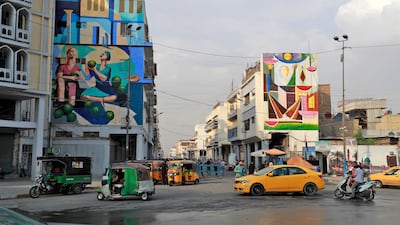
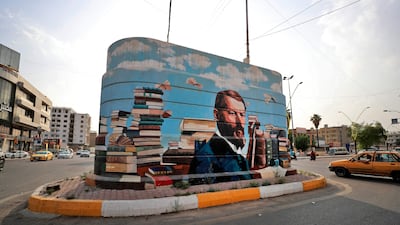
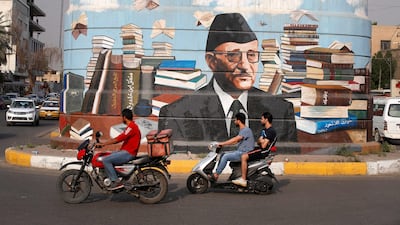
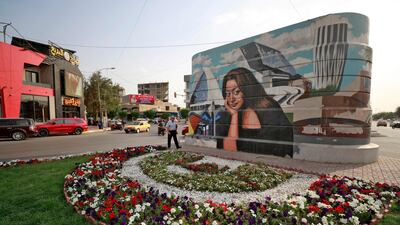
Scroll through the images below to see Iraq's streets transformed by murals of celebrated figures

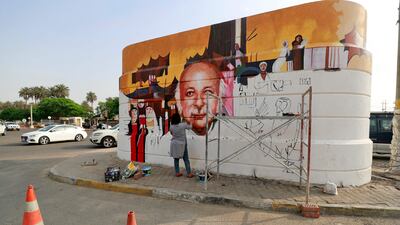
  • Iraqi artist Wijdan Al Majed draws a mural depicting Iraqi poet Muzzafar Al Nawab on a concrete structure in the capital Baghdad. All photos: AFP
    Iraqi artist Wijdan Al Majed draws a mural depicting Iraqi poet Muzzafar Al Nawab on a concrete structure in the capital Baghdad. All photos: AFP
  • Iraqi artist Wijdan Al Majed is transforming Baghdad's concrete jungle into a colour-filled city with murals depicting well-known figures from the war-scarred country and abroad.
    Iraqi artist Wijdan Al Majed is transforming Baghdad's concrete jungle into a colour-filled city with murals depicting well-known figures from the war-scarred country and abroad.
  • The 49-year-old artist and instructor at the Baghdad College of Fine Arts is adding the final touches to a mural dedicated to celebrated Iraqi poet Muzzafar Al Nawab.
    The 49-year-old artist and instructor at the Baghdad College of Fine Arts is adding the final touches to a mural dedicated to celebrated Iraqi poet Muzzafar Al Nawab.
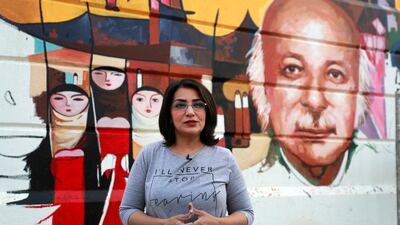
  • Majed, an artist more accustomed to exhibiting her work in the cosy and reflective settings of galleries, at first had helpers to create the street art. But she has turned to working alone, undaunted by the "huge challenges" she faces as a woman in a largely conservative, male-dominated society.
    Majed, an artist more accustomed to exhibiting her work in the cosy and reflective settings of galleries, at first had helpers to create the street art. But she has turned to working alone, undaunted by the "huge challenges" she faces as a woman in a largely conservative, male-dominated society.
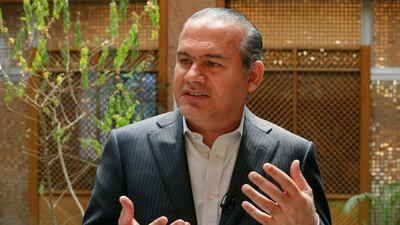
  • The former mayor of Baghdad, Alaa Maan, launched an initiative nine months ago to "bring beauty to the city and move art to the streets in order to get rid of the grey and dusty colours" that hang over it.
    The former mayor of Baghdad, Alaa Maan, launched an initiative nine months ago to "bring beauty to the city and move art to the streets in order to get rid of the grey and dusty colours" that hang over it.
  • A mural of German sociologist Max Weber on a concrete structure in Baghdad.
    A mural of German sociologist Max Weber on a concrete structure in Baghdad.
  • A mural of Iraqi painter Jawad Saleem, considered the father of Iraqi modern art and a celebrated sculptor.
    A mural of Iraqi painter Jawad Saleem, considered the father of Iraqi modern art and a celebrated sculptor.
  • A mural of Iraqi author Ali Al Ward.
    A mural of Iraqi author Ali Al Ward.
  • A mural of Iraqi architect Zaha Hadid.
    A mural of Iraqi architect Zaha Hadid.
  • A mural of Iraqi painter Jawad Saleem, left, and Iraqi poet Muhammad Mahdi Al Jawahiri.
    A mural of Iraqi painter Jawad Saleem, left, and Iraqi poet Muhammad Mahdi Al Jawahiri.
Real estate tokenisation project

Dubai launched the pilot phase of its real estate tokenisation project last month.

The initiative focuses on converting real estate assets into digital tokens recorded on blockchain technology and helps in streamlining the process of buying, selling and investing, the Dubai Land Department said.

Dubai’s real estate tokenisation market is projected to reach Dh60 billion ($16.33 billion) by 2033, representing 7 per cent of the emirate’s total property transactions, according to the DLD.

Skewed figures

In the village of Mevagissey in southwest England the housing stock has doubled in the last century while the number of residents is half the historic high. The village's Neighbourhood Development Plan states that 26% of homes are holiday retreats. Prices are high, averaging around £300,000, £50,000 more than the Cornish average of £250,000. The local average wage is £15,458. 

Jetour T1 specs

Engine: 2-litre turbocharged

Power: 254hp

Torque: 390Nm

Price: From Dh126,000

Available: Now

Hurricanes 31-31 Lions

Wellington Hurricanes: 
Tries: Gibbins, Laumape, Goosen, Fifita tries, Barrett
Conversions: Barrett (4)
Penalties: Barrett

British & Irish Lions:
Tries: Seymour (2), North
Conversions: Biggar (2)
Penalties: Biggar (4)

TOUCH RULES

Touch is derived from rugby league. Teams consist of up to 14 players with a maximum of six on the field at any time.

Teams can make as many substitutions as they want during the 40 minute matches.

Similar to rugby league, the attacking team has six attempts - or touches - before possession changes over.

A touch is any contact between the player with the ball and a defender, and must be with minimum force.

After a touch the player performs a “roll-ball” - similar to the play-the-ball in league - stepping over or rolling the ball between the feet.

At the roll-ball, the defenders have to retreat a minimum of five metres.

A touchdown is scored when an attacking player places the ball on or over the score-line.

What is the definition of an SME?

SMEs in the UAE are defined by the number of employees, annual turnover and sector. For example, a “small company” in the services industry has six to 50 employees with a turnover of more than Dh2 million up to Dh20m, while in the manufacturing industry the requirements are 10 to 100 employees with a turnover of more than Dh3m up to Dh50m, according to Dubai SME, an agency of the Department of Economic Development.

A “medium-sized company” can either have staff of 51 to 200 employees or 101 to 250 employees, and a turnover less than or equal to Dh200m or Dh250m, again depending on whether the business is in the trading, manufacturing or services sectors. 

Labour dispute

The insured employee may still file an ILOE claim even if a labour dispute is ongoing post termination, but the insurer may suspend or reject payment, until the courts resolve the dispute, especially if the reason for termination is contested. The outcome of the labour court proceedings can directly affect eligibility.


- Abdullah Ishnaneh, Partner, BSA Law 

How to join and use Abu Dhabi’s public libraries

• There are six libraries in Abu Dhabi emirate run by the Department of Culture and Tourism, including one in Al Ain and Al Dhafra.

• Libraries are free to visit and visitors can consult books, use online resources and study there. Most are open from 8am to 8pm on weekdays, closed on Fridays and have variable hours on Saturdays, except for Qasr Al Watan which is open from 10am to 8pm every day.

• In order to borrow books, visitors must join the service by providing a passport photograph, Emirates ID and a refundable deposit of Dh400. Members can borrow five books for three weeks, all of which are renewable up to two times online.

• If users do not wish to pay the fee, they can still use the library’s electronic resources for free by simply registering on the website. Once registered, a username and password is provided, allowing remote access.

• For more information visit the library network's website.

Ten tax points to be aware of in 2026

1. Domestic VAT refund amendments: request your refund within five years

If a business does not apply for the refund on time, they lose their credit.

2. E-invoicing in the UAE

Businesses should continue preparing for the implementation of e-invoicing in the UAE, with 2026 a preparation and transition period ahead of phased mandatory adoption. 

3. More tax audits

Tax authorities are increasingly using data already available across multiple filings to identify audit risks. 

4. More beneficial VAT and excise tax penalty regime

Tax disputes are expected to become more frequent and more structured, with clearer administrative objection and appeal processes. The UAE has adopted a new penalty regime for VAT and excise disputes, which now mirrors the penalty regime for corporate tax.

5. Greater emphasis on statutory audit

There is a greater need for the accuracy of financial statements. The International Financial Reporting Standards standards need to be strictly adhered to and, as a result, the quality of the audits will need to increase.

6. Further transfer pricing enforcement

Transfer pricing enforcement, which refers to the practice of establishing prices for internal transactions between related entities, is expected to broaden in scope. The UAE will shortly open the possibility to negotiate advance pricing agreements, or essentially rulings for transfer pricing purposes. 

7. Limited time periods for audits

Recent amendments also introduce a default five-year limitation period for tax audits and assessments, subject to specific statutory exceptions. While the standard audit and assessment period is five years, this may be extended to up to 15 years in cases involving fraud or tax evasion. 

8. Pillar 2 implementation 

Many multinational groups will begin to feel the practical effect of the Domestic Minimum Top-Up Tax (DMTT), the UAE's implementation of the OECD’s global minimum tax under Pillar 2. While the rules apply for financial years starting on or after January 1, 2025, it is 2026 that marks the transition to an operational phase.

9. Reduced compliance obligations for imported goods and services

Businesses that apply the reverse-charge mechanism for VAT purposes in the UAE may benefit from reduced compliance obligations. 

10. Substance and CbC reporting focus

Tax authorities are expected to continue strengthening the enforcement of economic substance and Country-by-Country (CbC) reporting frameworks. In the UAE, these regimes are increasingly being used as risk-assessment tools, providing tax authorities with a comprehensive view of multinational groups’ global footprints and enabling them to assess whether profits are aligned with real economic activity. 

Contributed by Thomas Vanhee and Hend Rashwan, Aurifer

Our family matters legal consultant

Name: Hassan Mohsen Elhais

Position: legal consultant with Al Rowaad Advocates and Legal Consultants.

The five pillars of Islam

1. Fasting

2. Prayer

3. Hajj

4. Shahada

5. Zakat 

Islamophobia definition

A widely accepted definition was made by the All Party Parliamentary Group on British Muslims in 2019: “Islamophobia is rooted in racism and is a type of racism that targets expressions of Muslimness or perceived Muslimness.” It further defines it as “inciting hatred or violence against Muslims”.

Moon Music

Artist: Coldplay

Label: Parlophone/Atlantic

Number of tracks: 10

Rating: 3/5

Emergency

Director: Kangana Ranaut

Stars: Kangana Ranaut, Anupam Kher, Shreyas Talpade, Milind Soman, Mahima Chaudhry 

Rating: 2/5

COMPANY%20PROFILE
%3Cp%3E%3Cstrong%3EName%3A%3C%2Fstrong%3E%20Carzaty%2C%20now%20Kavak%3Cbr%3E%3Cstrong%3EBased%3A%3C%2Fstrong%3E%20Dubai%3Cbr%3E%3Cstrong%3ELaunch%20year%3A%20%3C%2Fstrong%3ECarzaty%20launched%20in%202018%2C%20Kavak%20in%20the%20GCC%20launched%20in%202022%3Cbr%3E%3Cstrong%3ENumber%20of%20employees%3A%3C%2Fstrong%3E%20140%3Cbr%3E%3Cstrong%3ESector%3A%3C%2Fstrong%3E%20Automotive%3Cbr%3E%3Cstrong%3EFunding%3A%20%3C%2Fstrong%3ECarzaty%20raised%20%246m%20in%20equity%20and%20%244m%20in%20debt%3B%20Kavak%20plans%20%24130m%20investment%20in%20the%20GCC%3C%2Fp%3E%0A
What is a black hole?

1. Black holes are objects whose gravity is so strong not even light can escape their pull

2. They can be created when massive stars collapse under their own weight

3. Large black holes can also be formed when smaller ones collide and merge

4. The biggest black holes lurk at the centre of many galaxies, including our own

5. Astronomers believe that when the universe was very young, black holes affected how galaxies formed

Updated: August 30, 2022, 4:46 AM