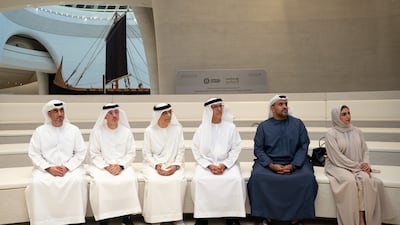
When the Mother of the Nation Endowment for Orphans recently earned a Guinness World Records title for raising Dh3.3 billion in a month, the focus was naturally on the scale of the achievement. Yet the real significance of this milestone was not the amount raised, but what it represented.
For generations, charitable giving has been measured by how much is donated and how quickly support reaches those in need. While this model remains essential during emergencies, many of society's greatest challenges cannot be solved through one-time contributions alone. They require reliable, long-term solutions capable of supporting people not just today, but for years and even generations to come.
This is where endowments, or waqf, offer a fundamentally different approach.

Unlike traditional charitable donations which are spent once, endowments preserve the original contribution while investing it to generate sustainable returns. Those returns then finance programmes year after year, creating a continuous cycle of giving without depleting the original capital.
Shedding light on how philanthropy works differently in the UAE, Fahad Abdulqader Al Qassim, director general of the Endowments and Minors' Funds Authority – Awqaf Abu Dhabi, said: “A child who loses a parent does not require support for a single month or a single school year. Their needs evolve, from education and health care to daily living expenses, emotional well-being and opportunities that enable them to become active, independent members of society. Sustainable care, therefore, requires sustainable funding.
“The real measure of success is not the amount we raise today, but the impact we continue to create for years to come. Every contribution becomes part of an enduring framework that continues supporting education, health care and quality of life for orphans through sustainable investment.
"In many ways, this transforms philanthropy from an act of generosity into an investment in society's future,” he added.
For Awqaf Abu Dhabi, the campaign was also about changing public perceptions.
"People often think of giving as something that happens once. What we're seeing now is a growing understanding that philanthropy can be designed to create value for generations. Every contribution becomes part of something much bigger than a single donation," said Al Qassim.
Coming during the UAE's Year of the Family, the campaign tapped into a broader national conversation around strengthening communities. The UAE has long demonstrated global leadership in humanitarian work, guided by values established by the Founding Father, the late Sheikh Zayed bin Sultan Al Nahyan, and continuously strengthened under the country's leadership. Today, that legacy is evolving further through initiatives that seek to maximise not only the volume of giving, but also its longevity and effectiveness.

For many contributors, supporting orphans was seen not simply as an act of generosity, but as a shared responsibility.
This philosophy also reflected a broader evolution taking place across humanitarian work worldwide.
Governments, foundations and philanthropic organisations are increasingly recognising that resilience depends not only on responding to immediate needs, but also on building permanent financial mechanisms capable of supporting communities through changing economic and social circumstances.
The campaign's success during Ramadan showed that individuals, families, philanthropists, private companies and government institutions all share a willingness to invest in solutions that extend well beyond immediate relief.
Importantly, the significance of the recent Guinness World Records recognition extends beyond international recognition itself.
It signals growing public confidence in endowment as a modern development tool capable of addressing complex social challenges through structured, transparent and professionally governed models. As philanthropic expectations continue to evolve, accountability, governance and measurable long-term impact become increasingly important alongside generosity itself.
"The success of this initiative demonstrates that people want their contributions to create lasting value. Every contribution, regardless of its size, played a role in achieving this milestone because every contribution becomes part of a sustainable system that continues serving future generations, said Al Qassim.
Perhaps this represents the most important lesson from this achievement.
The future of humanitarian work will not be defined solely by how much societies are willing to give, but by how effectively those contributions are preserved, managed and transformed into lasting opportunities for those who need them most.
Records may eventually be broken, but a sustainable endowment has the potential to continue changing lives long after headlines have faded.