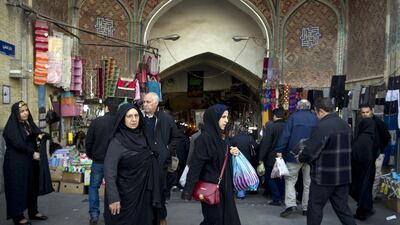
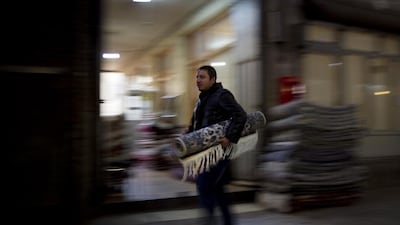
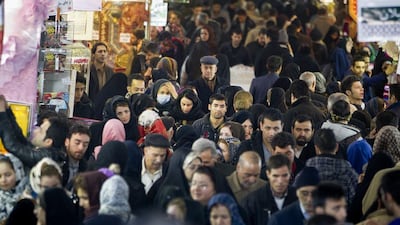
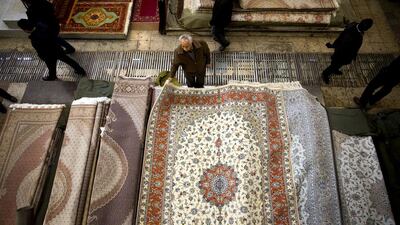
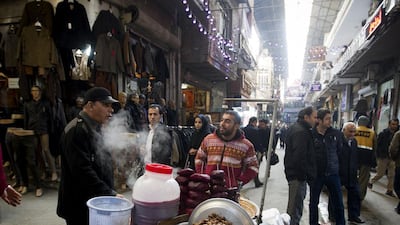
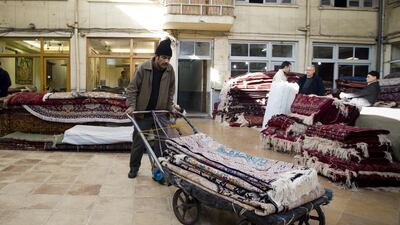
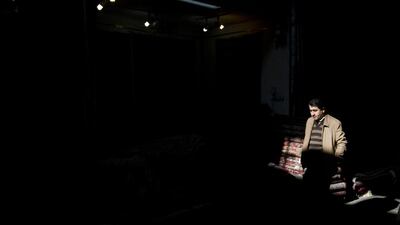
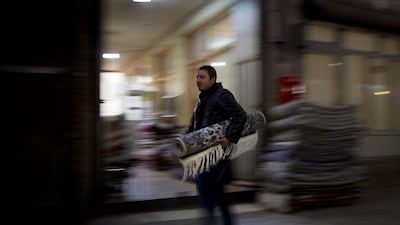
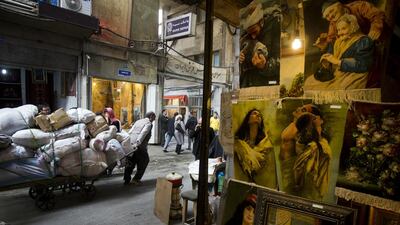
• Iranians walk pass by the main entrance. Amid the bustle of preparation for the two-week holiday, known in Persian as Nowruz, many are fearful of their financial future as they struggle with the country’s deepening economic woes.
    Iranians walk pass by the main entrance. Amid the bustle of preparation for the two-week holiday, known in Persian as Nowruz, many are fearful of their financial future as they struggle with the country’s deepening economic woes.
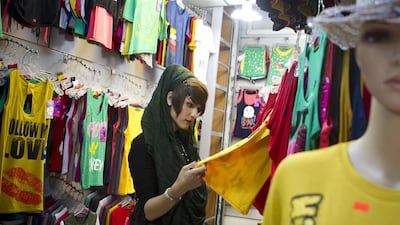
  • An Iranian woman looks at T-shirts inside a shop. High prices for basic products have given the traditional optimism surrounding Nowruz, which falls on March 20, a tinge of anxiety.
    An Iranian woman looks at T-shirts inside a shop. High prices for basic products have given the traditional optimism surrounding Nowruz, which falls on March 20, a tinge of anxiety.
  • The economic difficulties have been caused by sanctions imposed by the international community over Iran’s controversial nuclear programme.
    The economic difficulties have been caused by sanctions imposed by the international community over Iran’s controversial nuclear programme.
  • While the election of president Hassan Rouhani may have brought about a less hostile political climate, it is the state of the economy that is the most important issue for Iranians.
    While the election of president Hassan Rouhani may have brought about a less hostile political climate, it is the state of the economy that is the most important issue for Iranians.
  • Despite the current negotiations between Iran and world powers to reach a final deal on the programme, the national currency, the rial, has lost 50 per cent of its value since 2012.
    Despite the current negotiations between Iran and world powers to reach a final deal on the programme, the national currency, the rial, has lost 50 per cent of its value since 2012.
  • A weak rial has been hurting Iranians’ ability to buy basic products.
    A weak rial has been hurting Iranians’ ability to buy basic products.
  • Iran’s official rate of inflation stands at 37 per cent. But experts in Tehran believe it is much higher perhaps as much as 40 per cent.
    Iran’s official rate of inflation stands at 37 per cent. But experts in Tehran believe it is much higher perhaps as much as 40 per cent.
  • To offset some of the economic pressure and help families prepare for the New Year, Mr Rouhani’s government organised 400 exhibitions of discounted goods currently taking place throughout the country, with four in Tehran.
    To offset some of the economic pressure and help families prepare for the New Year, Mr Rouhani’s government organised 400 exhibitions of discounted goods currently taking place throughout the country, with four in Tehran.
  • The prices of food sold at the exhibitions were lowered with the aim of controlling Iran’s rampant inflation.
    The prices of food sold at the exhibitions were lowered with the aim of controlling Iran’s rampant inflation.
  • Also available was a wide range of domestic products from home appliances and clothing at about 20 per cent less than regular prices, said Ali Fazeli, head of an umbrella group of unions and producers associations which helped organise the 10-day exhibitions in the capital.
    Also available was a wide range of domestic products from home appliances and clothing at about 20 per cent less than regular prices, said Ali Fazeli, head of an umbrella group of unions and producers associations which helped organise the 10-day exhibitions in the capital.
  • The prices of food sold at the exhibitions were lowered with the aim of controlling Iran’s rampant inflation.
    The prices of food sold at the exhibitions were lowered with the aim of controlling Iran’s rampant inflation.
  • For Ms Riazi, who was shopping at one of the exhibitions in central Tehran, the slightly reduced prices were welcome. “The prices are a bit cheaper than regular shops, not so much, but it is helpful to families,” she said. “I only came to buy new clothes for my children.”
    For Ms Riazi, who was shopping at one of the exhibitions in central Tehran, the slightly reduced prices were welcome. “The prices are a bit cheaper than regular shops, not so much, but it is helpful to families,” she said. “I only came to buy new clothes for my children.”
  • The government is ending aid to Iranians who are not considered to need the assistance, in an effort to limit spending in the coming year.
    The government is ending aid to Iranians who are not considered to need the assistance, in an effort to limit spending in the coming year.
  • The assistance began under Mr Rouhani’s predecessor, Mahmoud Ahmadinejad, who in 2010 initiated a five-year plan, phasing out energy and food subsidies and replacing them with cash payments to make up for rising costs.
    The assistance began under Mr Rouhani’s predecessor, Mahmoud Ahmadinejad, who in 2010 initiated a five-year plan, phasing out energy and food subsidies and replacing them with cash payments to make up for rising costs.
  • On Sunday, Mr Rouhani asked Iranians who do not need the monthly Dh55 per person payout not to register for the coming year.
    On Sunday, Mr Rouhani asked Iranians who do not need the monthly Dh55 per person payout not to register for the coming year.

In pictures: Iranians feel the bite of sanctions inside Tehran’s Grand Bazaar


  • English
  • Arabic

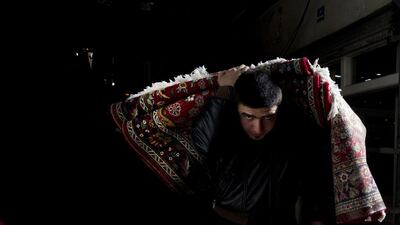
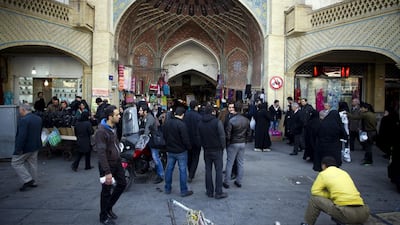
Amid the bustle of preparation for the two-week holiday, known in Persian as Nowruz, many are fearful of their financial future as they struggle with the country’s deepening economic woes. Photos by Maryam Rahmanian for The National

Turning%20waste%20into%20fuel
%3Cp%3EAverage%20amount%20of%20biofuel%20produced%20at%20DIC%20factory%20every%20month%3A%20%3Cstrong%3EApproximately%20106%2C000%20litres%3C%2Fstrong%3E%3C%2Fp%3E%0A%3Cp%3EAmount%20of%20biofuel%20produced%20from%201%20litre%20of%20used%20cooking%20oil%3A%20%3Cstrong%3E920ml%20(92%25)%3C%2Fstrong%3E%3C%2Fp%3E%0A%3Cp%3ETime%20required%20for%20one%20full%20cycle%20of%20production%20from%20used%20cooking%20oil%20to%20biofuel%3A%20%3Cstrong%3EOne%20day%3C%2Fstrong%3E%3C%2Fp%3E%0A%3Cp%3EEnergy%20requirements%20for%20one%20cycle%20of%20production%20from%201%2C000%20litres%20of%20used%20cooking%20oil%3A%3Cbr%3E%3Cstrong%3E%E2%96%AA%20Electricity%20-%201.1904%20units%3Cbr%3E%E2%96%AA%20Water-%2031%20litres%3Cbr%3E%E2%96%AA%20Diesel%20%E2%80%93%2026.275%20litres%3C%2Fstrong%3E%3C%2Fp%3E%0A
Jetour T1 specs

Engine: 2-litre turbocharged

Power: 254hp

Torque: 390Nm

Price: From Dh126,000

Available: Now

What can victims do?

Always use only regulated platforms

Stop all transactions and communication on suspicion

Save all evidence (screenshots, chat logs, transaction IDs)

Report to local authorities

Warn others to prevent further harm

Courtesy: Crystal Intelligence

The specs

Engine: 6.2-litre supercharged V8

Power: 712hp at 6,100rpm

Torque: 881Nm at 4,800rpm

Transmission: 8-speed auto

Fuel consumption: 19.6 l/100km

Price: Dh380,000

On sale: now 

Mercer, the investment consulting arm of US services company Marsh & McLennan, expects its wealth division to at least double its assets under management (AUM) in the Middle East as wealth in the region continues to grow despite economic headwinds, a company official said.

Mercer Wealth, which globally has $160 billion in AUM, plans to boost its AUM in the region to $2-$3bn in the next 2-3 years from the present $1bn, said Yasir AbuShaban, a Dubai-based principal with Mercer Wealth.

Within the next two to three years, we are looking at reaching $2 to $3 billion as a conservative estimate and we do see an opportunity to do so,” said Mr AbuShaban.

Mercer does not directly make investments, but allocates clients’ money they have discretion to, to professional asset managers. They also provide advice to clients.

“We have buying power. We can negotiate on their (client’s) behalf with asset managers to provide them lower fees than they otherwise would have to get on their own,” he added.

Mercer Wealth’s clients include sovereign wealth funds, family offices, and insurance companies among others.

From its office in Dubai, Mercer also looks after Africa, India and Turkey, where they also see opportunity for growth.

Wealth creation in Middle East and Africa (MEA) grew 8.5 per cent to $8.1 trillion last year from $7.5tn in 2015, higher than last year’s global average of 6 per cent and the second-highest growth in a region after Asia-Pacific which grew 9.9 per cent, according to consultancy Boston Consulting Group (BCG). In the region, where wealth grew just 1.9 per cent in 2015 compared with 2014, a pickup in oil prices has helped in wealth generation.

BCG is forecasting MEA wealth will rise to $12tn by 2021, growing at an annual average of 8 per cent.

Drivers of wealth generation in the region will be split evenly between new wealth creation and growth of performance of existing assets, according to BCG.

Another general trend in the region is clients’ looking for a comprehensive approach to investing, according to Mr AbuShaban.

“Institutional investors or some of the families are seeing a slowdown in the available capital they have to invest and in that sense they are looking at optimizing the way they manage their portfolios and making sure they are not investing haphazardly and different parts of their investment are working together,” said Mr AbuShaban.

Some clients also have a higher appetite for risk, given the low interest-rate environment that does not provide enough yield for some institutional investors. These clients are keen to invest in illiquid assets, such as private equity and infrastructure.

“What we have seen is a desire for higher returns in what has been a low-return environment specifically in various fixed income or bonds,” he said.

“In this environment, we have seen a de facto increase in the risk that clients are taking in things like illiquid investments, private equity investments, infrastructure and private debt, those kind of investments were higher illiquidity results in incrementally higher returns.”

The Abu Dhabi Investment Authority, one of the largest sovereign wealth funds, said in its 2016 report that has gradually increased its exposure in direct private equity and private credit transactions, mainly in Asian markets and especially in China and India. The authority’s private equity department focused on structured equities owing to “their defensive characteristics.”

RESULT

Bayern Munich 5 Eintrracht Frankfurt 2
Bayern:
 Goretzka (17'), Müller (41'), Lewandowski (46'), Davies (61'), Hinteregger (74' og)    
Frankfurt: Hinteregger (52', 55')

Match info

Uefa Champions League Group B

Tottenham Hotspur 1 (Eriksen 80')
Inter Milan 0