
The Trump administration is withholding $105 million in security aid for Lebanon, two days after Prime Minister Saad Hariri's resignation.
The State Department told Congress on Thursday that the White House budget office and National Security Council had decided to withhold the foreign military assistance, officials told Reuters.
The US has given an average of $70m annual aid to the Lebanese army and security forces, and is seeking to put pressure on the Lebanese leadership for a swift formation of a government that could enact tangible reforms.
"We will support Lebanon when it takes the decision to reform. No one is going to bail out Lebanon," a US senior official told The National on Thursday.
The popular protests that have rocked Lebanon since October 16, forcing the resignation of Mr Hariri on Tuesday, are a cause of hope and anxiety in the Trump administration.
A senior US official called the upheaval “remarkable” but voiced “a concern over stability” as protests, strikes and partial bank closures drag into a second week.
In Washington’s view, the protests that were sparked by a tax on WhatsApp calls and economic and corruption problems are a “remarkable development".
“The people are speaking up clearly and have articulated their demands in a non-sectarian peaceful way,” the senior official said.
"They have largely demonstrated national unity; that they want a clean government that is accountable, undertakes reform and ends corruption."
-

Supporters of Lebanese Prime Minister Saad al Hariri gather to show support in Tariq Al Jadideh, Beirut, Lebanon. Getty Images -

Protesters shout slogans as they block the main highway during ongoing anti-government protests near downtown in Beirut, Lebanon. EPA -

Supporters of Lebanese Prime Minister Saad al Hariri ride their scooters in a convoy to show support. Getty Images -

Protesters shout slogans as they block the main highway during ongoing anti-government protests near downtown in Beirut, Lebanon. EPA -
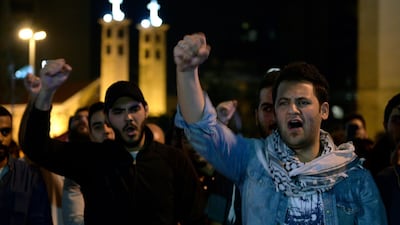
Protesters shout slogans as they block the main highway during ongoing anti-government protests near downtown in Beirut, Lebanon. EPA -

Lebanese policeman sits on his armored personal carrier, as they arrive to open a main highway which was blocked by anti-government protesters during ongoing protests against the Lebanese government, in Beirut, Lebanon. AP Photo -

People use ATM outside a closed bank, in Beirut, Lebanon. Lebanese banks have been closed for the last two weeks as the government grapples with mass demonstrations that have paralyzed the country, but an even greater crisis may set in when they reopen Friday. AP Photo -
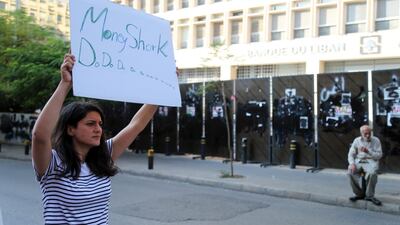
A protester holds a banner reading 'Money Shark' during a demonstration outside the Lebanese central bank, also known as Banque du Liban, in Beirut, Lebanon. Calls are mounting for Lebanon to impose formal restrictions on the movement of money to defend the country’s dollar peg and prevent a run on the banks when they open their doors on Friday after two weeks of nationwide protests. Bloomberg


As the political debate heats up in Beirut over formation of the next Cabinet, the official said the US government was “indifferent to how Lebanon gets to such government".
“This is a decision of the Lebanese people," he said.
"We are supporting the legitimate demands and the principles that whatever government comes next should be focused on accomplishing these goals to save Lebanon from an economic crisis.”
The official was sceptical about the possibility of the Lebanese militant group Hezbollah and its allies forming a one-sided government with the majority coalition they have in Parliament.
Hezbollah and its allies, among them President Michel Aoun of the Free Patriotic Movement, hold a 71-seat majority in the Lebanese Parliament.
But the US official said even if Hezbollah and the FPM decided to form such government, it would not be capable of reform.
An extended leadership void or a prolonged process is a cause of concern.
“We are concerned about stability of Lebanon but Lebanon will never be stable until there are reforms," the official said.
"The practices of the [last Hariri] government have destabilised the country."
The Trump administration has been pushing for reforms since the Cedar conference hosted by France in April 2018 pledged more than $11 billion (Dh40,4bn) in aid for Lebanon if it underwent economic, fiscal and institutional change.
“All they had to do is reform but the government couldn’t,” the senior US official said.
Now Washington is hoping the next Cabinet will be able to institute change, and is hingeing US support on tangible reforms.
“We will support Lebanon when it takes the decision to reform. No one is going to bail out Lebanon,” the official added.
Another element of instability is recent tension on the Lebanon-Israel border in the South.
Two attacks on Israeli drones on October 23 and today were reported since the protests started.
But the official did not expect a military escalation.
“No one wants a war, despite the incidents we are seeing at the border,” he said.
The US, while not wishing to intervene in the Lebanese protests, is stressing the need to protect their peaceful nature.
US Secretary of State Mike Pompeo called on the Lebanese army and security services this week “to continue to ensure the rights and safety of the protesters".

