


Live updates: Follow the latest news on Israel-Gaza
The US and its allies in the Middle East have been focused on establishing “responsible leadership” in Gaza “that could lead to the West Bank and Gaza forming a sovereign state”, the top foreign affairs senator has told The National.
Senate foreign relations committee chairman Ben Cardin this week met Qatar's Prime Minister, the Jordanian ambassador to Washington and will soon meet Israeli officials, he said, for conversations “looking at what happens after the war is over in regards to a path forward”.
“There needs to be responsible leadership for the people of Gaza that can protect their security and respects Israel's security and provides an economic future,” Mr Cardin explained.
“That seems to be the common thread I hear from all the leaders in the region, and that could lead to the West Bank and Gaza forming a sovereign state living in peace with Israel.”
He told The National at a press round-table: “We are seeing through this tragedy, that unless we want to see a repeat of this in the future, we need to have a more permanent way of solving the Palestinian issue.”
But he cautioned that “it's going to take some time”.
“The connection between the West Bank and Gaza is not easy. Security is not easy. The ability to effectively operate a government is not easy,” he added, emphasising that Hamas must be “neutralised”.
President Joe Biden's administration has continued Washington's legacy of funding Israel's military and defending its policies towards Palestinians.
That has included billions of dollars in funding and twice circumventing congressional authorisations to provide more in military sales, as Israel continues its campaign in Gaza, which officials say has killed more than 27,000 Palestinians.
Since the war began, the Biden administration and its allies in Congress have adopted rhetoric vaguely endorsing “political horizons for the Palestinians”.
Gaza protest in Washington – in pictures
-

Pro-Palestinian demonstrators take part in a protest against the continuing war in Gaza outside Union Station in Washington on February 1. EPA -
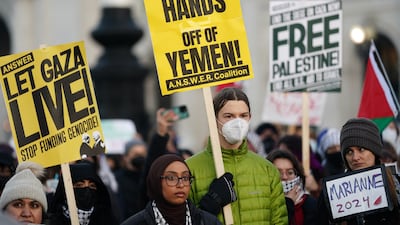
Tens of thousands of Palestinians have been killed since the militant group Hamas launched an unprecedented attack on Israel from the Gaza Strip on October 7. EPA -
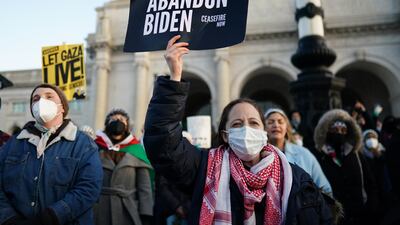
Israeli has responded with a military onslaught in the Palestinian enclave. EPA -
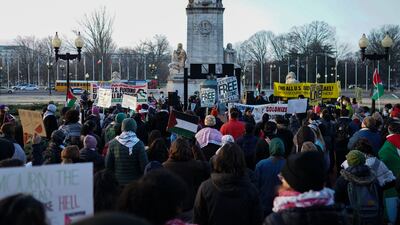
The rally in the US capital drew protesters from far and wide. EPA -

Meanwhile, US Defence Secretary Lloyd Austin has said Joe Biden's administration must do more to address the issue of the besieged Palestinian people. EPA -

Mr Austin said in regular talks with Israel he has stressed the need to protect civilian lives and provide humanitarian aid to the Palestinians. EPA -
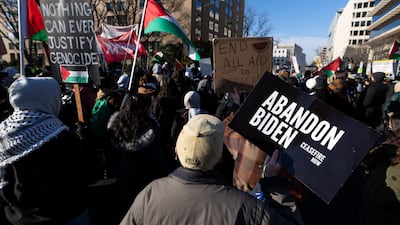
Demonstrators block a junction near the US Capitol as President Joe Biden attends the National Prayer Breakfast. Getty Images -

Protesters in Washington call for a ceasefire in Gaza. Reuters -

Pro-Palestine demonstrators shut down interstate ramps on the street on Capitol Hill, Washington. Reuters -

Gaza protests in Washington. The National -

A person participates in the protest in Washington. The National -

Metropolitan Police Department officers as members of the anti-Zionist Jews group Neturei Karta join pro-Palestinians people blocking a street close to the US Capitol in Washington DC. AFP -

Members of the anti-Zionist Jews group Neturei Karta join pro-Palestinians people blocking a street close to the US Capitol in Washington. AFP


Mr Cardin himself has been one of the Democratic Party's most ardent advocates of the US-Israel relationship over his career.
But despite rejections from Israeli Prime Minister Benjamin Netanyahu, a more concrete resolve on Palestinian statehood has in recent days appeared to gain momentum in the West.
US outlets, citing unnamed administration officials, have reported that Secretary of State Antony Blinken asked his department to review policy options on possible US and international recognition of a Palestinian state after the war in Gaza.
And in the UK, Foreign Secretary David Cameron has called for the establishment of a diplomatic campaign by “all the friends of a Palestinian state”.
“We with allies will look at the issue of recognising a Palestinian state including at the United Nations,” Lord Cameron said this week.
“This could be one of the things that helps to make this process irreversible.”
All of this hinges on an end to Israel's Gaza siege and a return of hostages taken by Hamas during its deadly October 7 attack.
During his visit to Washington this week, Mr Cardin met Qatar's Prime Minister Sheikh Mohammed bin Abdulrahman bin Jassim Al Thani and they “had a chance to go over the current hostage offers”.
News circulated this week that a hostage framework had been achieved, including the freeing of Palestinian detainees held by Israel, at a rate of three detainees for each hostage, a temporary repositioning of Israeli troops away from high-population areas of Gaza and a significant increase in humanitarian aid flowing into the enclave.
Sheikh Mohammed has said in his meetings in Washington that hostage negotiations are “in a much better place than where we were few weeks ago”.
“We've seen a lot of starts that were not successful. We hope this one will be because it will not only lead to a large number of hostages being released, but also a pathway forward,” Mr Cardin said.
The US is “thoroughly involved” in efforts together with Egypt, Qatar and Israel to put together a proposal to forward to Hamas and kick off a deal to release the hostages including a humanitarian pause, US Assistant Secretary of State for Near East Affairs Barbara Leaf told reporters.

