


President Joe Biden is this week celebrating the anniversary of his landmark Inflation Reduction Act, a highly significant piece of climate legislation for the country responsible for 15 per cent of global carbon emissions.
The IRA's investments carry the potential to accelerate the pace of the domestic energy transition and move the US closer to its target of a 50 per cent to 52 per cent emissions reduction by 2030, according to analysis from the Washington-based Atlantic Council.
“Undoubtedly, massive investments in key transition technologies within the world’s largest economy have global implications,” the analysis read.
But one year later, the effectiveness of its provisions and its global reception are still up for debate.
Ben Cahill, a senior fellow in the Energy Security and Climate Change Programme at the Washington-based Centre for Strategic and International Studies, told The National that, “in terms of international climate policy, the US is back in a serious way” and the IRA “has made incredible strides”.
For oil-producing countries in the Gulf, he says, the IRA's implications are nuanced, but ultimately “hold a lot of promise”.
“Some of the technologies and industries that are really a big focus of the IRA also feature heavily in the net-zero plans of the Gulf states and their national oil companies,” Mr Cahill said.
In the UAE, for example, Abu Dhabi National Oil Company recently brought forward its net-zero carbon emissions target by five years to 2045 in the run-up to Cop28.
At the same time, Washington's Gulf Co-operation Council partners are concerned the US is “overestimating the pace of the energy transition”.
The International Energy Agency's August report found that oil demand is “scaling record highs”.
And late last year, Washington responded with frustration after Opec announced it would slash its November output by two million barrels per day, the biggest production cut since the start of the pandemic in 2020 that led to a jump in oil prices.
“We've all been reminded of energy security and the importance of it in the last 18 months. For the Gulf states, they look at this past period as a cautionary tale. And they think we still have to continue investing in all forms of energy,” Mr Cahill added.
Analysis from the Rhodium Group suggests that the IRA’s domestic provisions will “ultimately reduce the cost curves for technologies like clean hydrogen and sustainable aviation fuels throughout the world”.
Investments in US-based clean energy have witnessed a boom in the past year.
A July report from the American Clear Power Association found that companies have invested more than $270 billion in US-based clean energy projects since the IRA became law – “equivalent to eight years’ worth of American clean energy investment … commissioned between 2015 – 2022".
And White House data shows that private companies have announced up to $503 billion in these “industries of the future”, including $231 billion in semiconductors and electronics, and $133 billion in electric vehicles and batteries.
“It shows the power of tax credits This is how we do energy policy in the United States. We make energy policy through tax credits,” said Mr Cahill.
The Rhodium Group analysis found that progress has positive implications for carbon goals outside the US, although its global impact “really picks up steam” after 2050.
“By the end of the century, the emerging climate technologies incentives (ECT) in the IRA are driving 401-847 million metric tonnes of CO2 of abatement each year on average outside the US … on a cumulative basis, the IRA ECT incentives included in this analysis reduce 2.4-2.9 tonnes of CO2 emissions outside the US for every ton they reduce within the US,” the report said.
Still, the full scope of the Biden administration's climate agenda, including the IRA and other related legislation, will only get Washington to 40 per cent of its emissions reduction target, warned Mr Cahill.
“That's a huge start, but it's obviously not enough … But because the US is such a big share of emissions and a big share of the global economy, [the IRA] really was a huge signal that these are serious investments and that a lot of capital is coming into them,” he said.
-
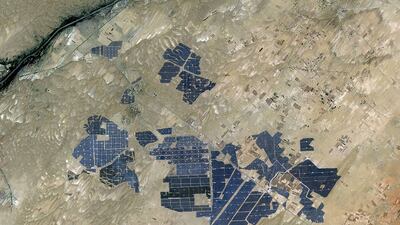
The solar park covers an area of 56 square kilometers. Photo: Alamy -

The 200 megawatt structure is the second biggest in the world. Bloomberg -
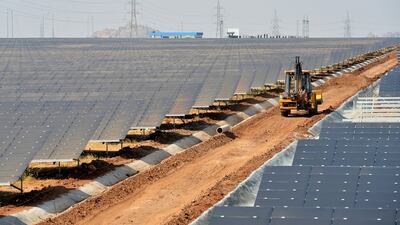
The park covers an area of 53 square kilometres. AFP -
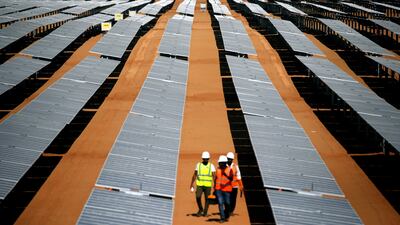
The Egyptian plant has a capacity of 1650 megawatts. Reuters. -
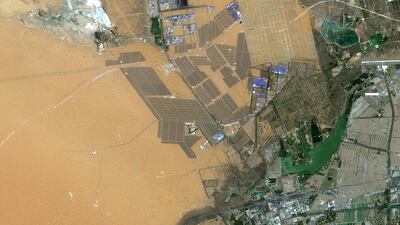
The solar farm in China is in the fourth largest desert in China. Getty



