


A former US Marine Corps sniper who was gravely injured in a suicide attack outside Kabul airport during the chaotic withdrawal from Afghanistan said on Wednesday that he and his team had a chance to shoot the bomber — but were never given permission to do so.
Sgt Tyler Vargas-Andrews, who lost a leg, an arm and a kidney in the August 26, 2021, attack at the Abbey Gate entrance to the airport, was one of several witnesses to provide harrowing details to Congress on the final days of America's longest war.
He depicted a breakdown in lines of authority that left him and his team unclear as to whether they could take out a suspected suicide bomber.
He described identifying an exact match of an intelligence warning of a suicide bomber description, sharing photo evidence with his battalion commander and asking for permission to shoot him.
“Our battalion commander said, and I quote, 'I don't know',” Sgt Vargas-Andrews said.
“Myself and my team, we asked very harshly, 'Well who does? Because this is your responsibility, sir.' He again replied he did not know … We received no update and never got our answer. Eventually the [suspect] disappeared.”
The claim was met with visible shock and anger by several congressional representatives.
A Pentagon report last year concluded that the attack was “not preventable”, that security precautions were being taken and that intelligence about potential threats circulating that day was “not specific”.
The suicide bombing killed at least 183 people: 170 Afghan civilians and 13 members of the US military.
“Plain and simple, we were ignored. Our expertise was disregarded. No one was held accountable for our safety,” Sgt Vargas-Andrews told the House Foreign Affairs Committee.
The Republican Party, which now controls the House of Representatives, is holding hearings and has opened investigations into the final weeks of the 20-year US occupation of Afghanistan.
President Joe Biden, who oversaw the pullout, had largely been shielded from intense congressional scrutiny while the Democrats controlled the chamber.
Sgt Vargas-Andrews was among dozens of US troops wounded in the Abbey Gate attack. He paused for minutes at a time to weep as he delivered his testimony, as several members of Congress struggled to maintain their composure.
“I instantly knew what had happened. I opened my eyes to marines dead or unconscious lying around me, crowd of hundreds immediately vanished in front of me. And my body was catastrophically wounded,” Sgt Vargas-Andrews recalled.

Republicans sought to characterise the Biden administration's actions as a “dereliction of duty”. Mr Biden has blamed his predecessor, Donald Trump, for cutting a deal with the Taliban that all but ensured a hasty retreat under a compressed timeline.
Committee chairman Michael McCaul painted a picture of a divided administration in the run-up to the withdrawal, with “stark” differences in assessments between the Pentagon, the State Department and the White House.
“What happened in Afghanistan was a systemic breakdown of the federal government at every level, and a stunning failure of leadership by the Biden administration,” Mr McCaul said.
“I will not rest and this committee will not rest until we determine how this happened.”
Democrats sought to highlight the broader impact of the two-decade war and push for the passing of the Afghan Adjustment Act — a bill that provides a path to permanent residency for tens of thousands of Afghans who aided the US during the war.
The Democrats' ranking member Gregory Meeks defended the Biden administration, saying the withdrawal was the “right decision,” and highlighted veterans' struggles in grappling with “forever wars”.
“I can't in good conscience imagine sending more American men and women to fight in Afghanistan,” Mr Meeks said.
Harsh partisan lines softened throughout the hours-long hearing, with powerful first-hand accounts of those deadly days in August 2021 from veterans and advocates.
The hearing began with a moment of silence, then a standing ovation, in honour of the lives lost in the Abbey Gate bombing.
Congressional leaders, witnesses and hearing attendants shed more tears as they took a moment to remember the plight of Afghan women during the hearing, which fell on International Women's Day.
Republican Ann Wagner broke down as she asked witness David Scott Mann, a retired lieutenant colonel, about the State Department's failure to evacuate Hasina Safi, Afghanistan's last minister of women's affairs and one of the Taliban's top targets.
Mr Mann founded Task Force Pineapple, which ultimately helped rescue Ms Safi and her family through an “open sewage canal”.
As of March of 2022, Washington had evacuated only 3 per cent of Afghans who had worked for the American government and applied for special visas, leaving behind an estimated 78,000 people, according to a report by non-profit Association of Wartime Allies.
Peter Lucier, who serves as the lead for strategic partnerships and allied organisations for Team America Relief, a member organisation of the Afghan Evacuation coalition, said during the hearing that Congress must be forward-looking, as need endures.
“As we examine those mistakes and look at solutions, if I leave this committee with only one thought, it's this: It's not too late. We're going to talk a lot today about all the mistakes were made leading up to that [withdrawal] but urgent action right now will save so many lives,” said Mr Lucier.
-
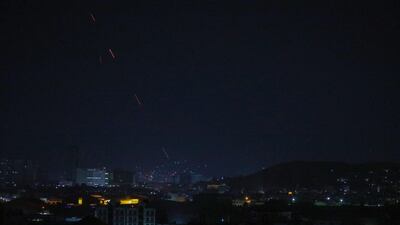
Celebratory gunfire light up part of the night sky after the last US aircraft took off from the airport in Kabul early on August 31, 2021. AFP -
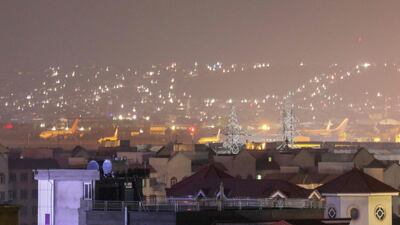
Planes are seen on the tarmac at the airport in Kabul late on August 30, 2021, hours ahead of a US deadline to complete its frenzied withdrawal from Afghanistan. AFP -
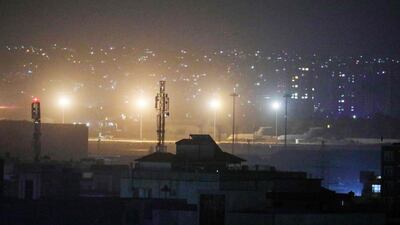
Planes are seen on the tarmac at the airport in Kabul late on August 30, 2021, hours ahead of a US deadline to complete its frenzied withdrawal from Afghanistan. AFP -
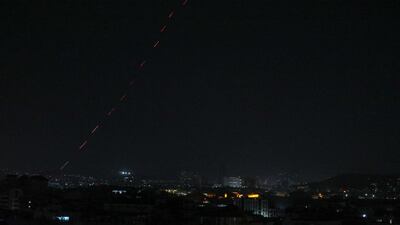
Celebratory gunfire light up part of the night sky after the last US aircraft took off from the airport in Kabul early on August 31, 2021. AFP -
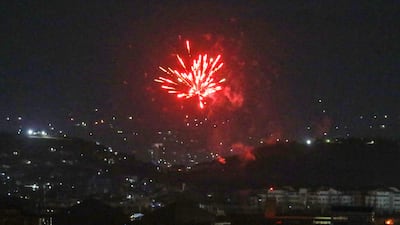
Celebratory gunfire light up part of the night sky after the last US aircraft took off from the airport in Kabul early on August 31, 2021. AFP -
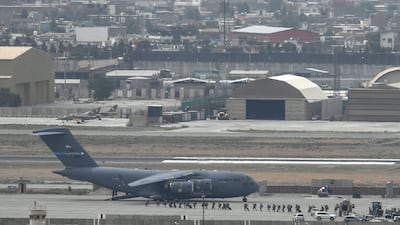
US soldiers arrive board an US Air Force aircraft at the airport in Kabul on August 30, 2021. AFP -
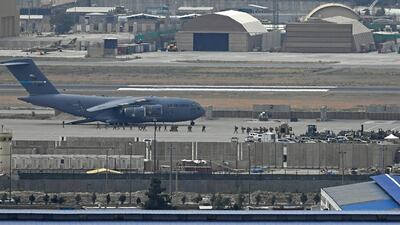
US soldiers arrive to board an US Air Force aircraft at the airport in Kabul on August 30, 2021. AFP -
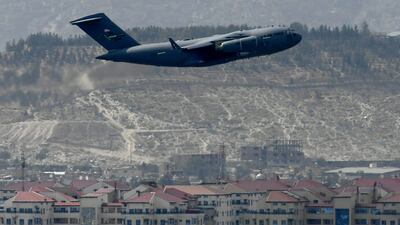
An US Air Force aircraft takes off from the airport in Kabul on August 30, 2021. AFP -

An US Air Force aircraft takes off from the airport in Kabul on August 30, 2021. AFP



