
Actor Alec Baldwin will be charged with involuntary manslaughter in the fatal shooting of cinematographer Halyna Hutchins on the New Mexico set of Rust, prosecutors announced on Thursday.
“After a thorough review of the evidence and the laws of the state of New Mexico, I have determined that there is sufficient evidence to file criminal charges against Alec Baldwin and other members of the Rust film crew,” District Attorney Mary Carmack-Altwies said in a statement.
“On my watch, no one is above the law, and everyone deserves justice.”
Ms Carmack-Altwies has also brought involuntary manslaughter charges against Hannah Gutierrez Reed, the on-set armourer who was in charge of weapons.

The film’s first assistant director, David Halls, has agreed to plead guilty to negligent use of a deadly weapon.
Ms Hutchins was killed and director Joel Souza was wounded when a gun Baldwin was holding during a rehearsal in October 2021 fired a live bullet.
The moment Alec Baldwin learnt of Halyna Hutchins death
The 30 Rock and Working Girl actor, who was also a producer on Rust, has denied responsibility for the shooting.
Baldwin has said he was told the gun was “cold” — an industry term meaning it is safe to use — and that he did not pull the trigger. He has sued crew members for negligence.
An FBI forensic test of the single-action revolver found it “functioned normally” and would not fire without the trigger being pulled.
New Mexico's Medical Investigator Office has ruled the shooting an accident, saying the gun did not appear to have been deliberately loaded with a live round.
Authorities have been trying to determine how a real bullet made its way to the movie set.
Ms Hutchins's family settled a wrongful death lawsuit against Baldwin and other producers last year.
Under the agreement, filming on the low-budget movie is set to resume this month, with Ms Hutchins's husband as an executive producer.
-
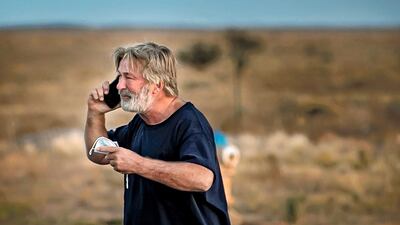
Alec Baldwin outside the Santa Fe County Sheriff's Office in New Mexico, after he was questioned about a shooting on the set of the film 'Rust', which killed cinematographer Halyna Hutchins and wounded director Joel Souza. AP -
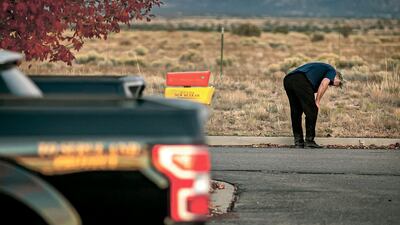
A distraught Alec Baldwin lingers in the car park outside the Santa Fe County Sheriff's Office. AP -
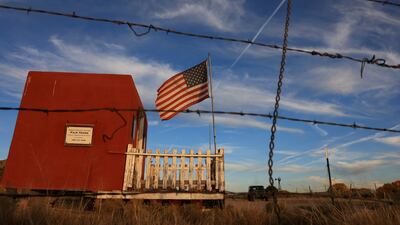
The entrance to the film set of 'Rust'. Reuters -
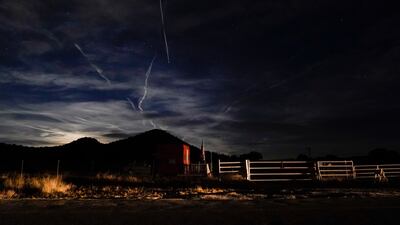
The entrance to the Bonanza Creek Ranch used for film shoots. AP -
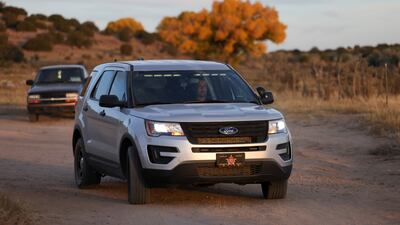
A vehicle from the Santa Fe County Sheriff's Office exiting the set of 'Rust'. Reuters -
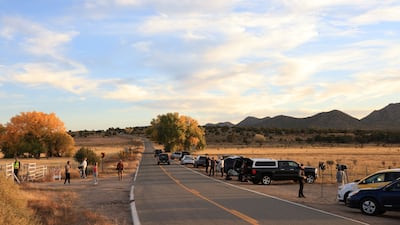
Media crews outside the gate of the film set of 'Rust'. Reuters -
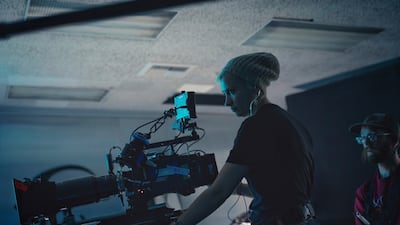
Director of photography Halyna Hutchins was fatally shot by Alec Baldwin on the set of 'Rust'. AP -
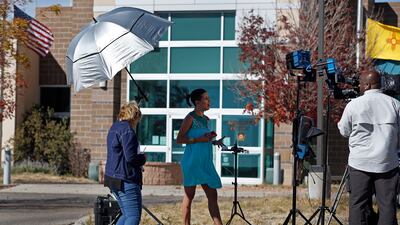
Journalists outside the Santa Fe County Sheriff's Office in New Mexico. AP -

Security guards block the Bonanza Creek Ranch. AP -
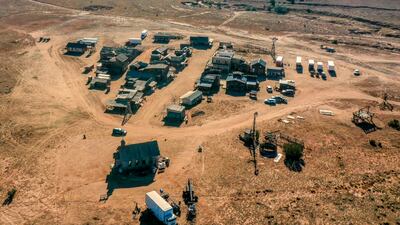
The Bonanza Creek Ranch where 'Rust' was being filmed, one day after the incident. Photo: Roberto E Rosales / Albuquerque Journal -
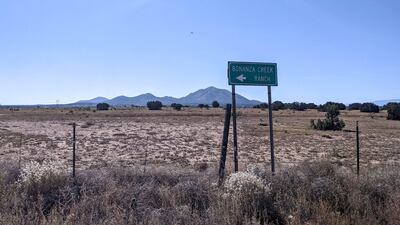
A sign points to the Bonanza Creek Ranch in Santa Fe. AFP -
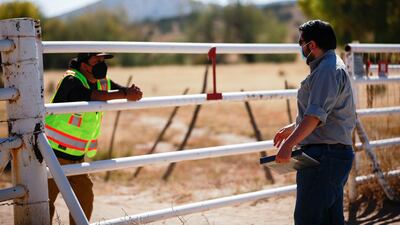
A security guard speaks with a compliance officer from the State of New Mexico at the Bonanza Creek Ranch where 'Rust' was being filmed. AFP -
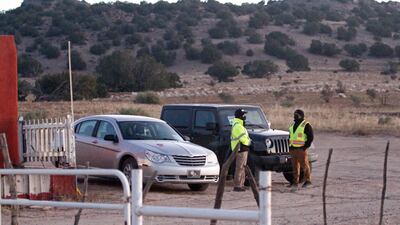
Security guards at the entrance of the 'Rust' film set. AP -
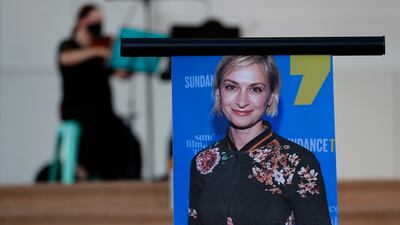
A vigil in Albuquerque, New Mexico, held in the honour of cinematographer Halyna Hutchins. AP -
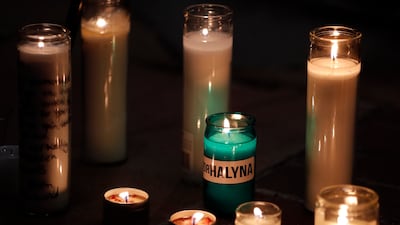
A candle bearing Halyna Hutchins's name is placed among others during a vigil in her honour. AP -
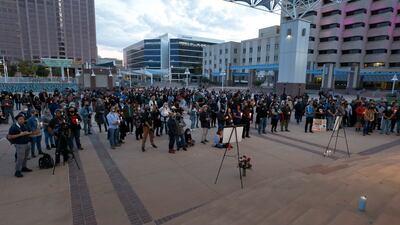
A large crowd of movie industry workers and New Mexico residents attend the candlelight vigil. AP -
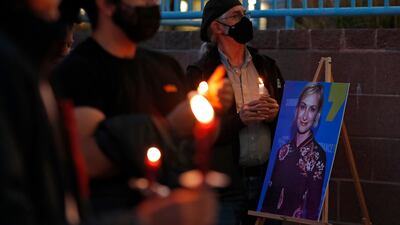
New Mexico residents at the vigil. AP -

Members of the local film community mourn the loss of Halyna Hutchins. Reuters -

Film industry worker Jake Extine pays his respects. AP -
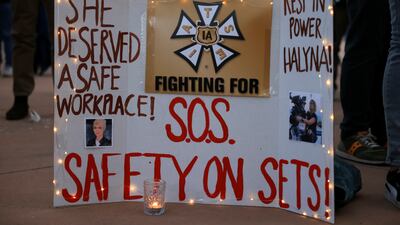
A sign calling for workplace safety at the vigil. Reuters -
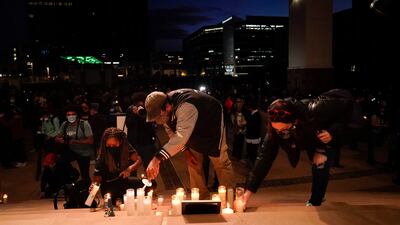
People light candles to honour Halyna Hutchins. AP
Additional reporting by Lisa Richwine

RACECARD
Mercer, the investment consulting arm of US services company Marsh & McLennan, expects its wealth division to at least double its assets under management (AUM) in the Middle East as wealth in the region continues to grow despite economic headwinds, a company official said.
Mercer Wealth, which globally has $160 billion in AUM, plans to boost its AUM in the region to $2-$3bn in the next 2-3 years from the present $1bn, said Yasir AbuShaban, a Dubai-based principal with Mercer Wealth.
“Within the next two to three years, we are looking at reaching $2 to $3 billion as a conservative estimate and we do see an opportunity to do so,” said Mr AbuShaban.
Mercer does not directly make investments, but allocates clients’ money they have discretion to, to professional asset managers. They also provide advice to clients.
“We have buying power. We can negotiate on their (client’s) behalf with asset managers to provide them lower fees than they otherwise would have to get on their own,” he added.
Mercer Wealth’s clients include sovereign wealth funds, family offices, and insurance companies among others.
From its office in Dubai, Mercer also looks after Africa, India and Turkey, where they also see opportunity for growth.
Wealth creation in Middle East and Africa (MEA) grew 8.5 per cent to $8.1 trillion last year from $7.5tn in 2015, higher than last year’s global average of 6 per cent and the second-highest growth in a region after Asia-Pacific which grew 9.9 per cent, according to consultancy Boston Consulting Group (BCG). In the region, where wealth grew just 1.9 per cent in 2015 compared with 2014, a pickup in oil prices has helped in wealth generation.
BCG is forecasting MEA wealth will rise to $12tn by 2021, growing at an annual average of 8 per cent.
Drivers of wealth generation in the region will be split evenly between new wealth creation and growth of performance of existing assets, according to BCG.
Another general trend in the region is clients’ looking for a comprehensive approach to investing, according to Mr AbuShaban.
“Institutional investors or some of the families are seeing a slowdown in the available capital they have to invest and in that sense they are looking at optimizing the way they manage their portfolios and making sure they are not investing haphazardly and different parts of their investment are working together,” said Mr AbuShaban.
Some clients also have a higher appetite for risk, given the low interest-rate environment that does not provide enough yield for some institutional investors. These clients are keen to invest in illiquid assets, such as private equity and infrastructure.
“What we have seen is a desire for higher returns in what has been a low-return environment specifically in various fixed income or bonds,” he said.
“In this environment, we have seen a de facto increase in the risk that clients are taking in things like illiquid investments, private equity investments, infrastructure and private debt, those kind of investments were higher illiquidity results in incrementally higher returns.”
The Abu Dhabi Investment Authority, one of the largest sovereign wealth funds, said in its 2016 report that has gradually increased its exposure in direct private equity and private credit transactions, mainly in Asian markets and especially in China and India. The authority’s private equity department focused on structured equities owing to “their defensive characteristics.”
WE%20NO%20LONGER%20PREFER%20MOUNTAINS
The Vile
Starring: Bdoor Mohammad, Jasem Alkharraz, Iman Tarik, Sarah Taibah
Director: Majid Al Ansari
Rating: 4/5
While you're here
Hend Al Otaiba: A year ago, Covid-19 forced us apart – now, vaccines can bring us back together
National Editorial: Iata travel pass – 'digital passports' will get the world moving again
Lucy Sherriff: Covid vaccine passports: safeguard or ethical nightmare?
The White Lotus: Season three
Creator: Mike White
Starring: Walton Goggins, Jason Isaacs, Natasha Rothwell
Rating: 4.5/5
Key figures in the life of the fort
Sheikh Dhiyab bin Isa (ruled 1761-1793) Built Qasr Al Hosn as a watchtower to guard over the only freshwater well on Abu Dhabi island.
Sheikh Shakhbut bin Dhiyab (ruled 1793-1816) Expanded the tower into a small fort and transferred his ruling place of residence from Liwa Oasis to the fort on the island.
Sheikh Tahnoon bin Shakhbut (ruled 1818-1833) Expanded Qasr Al Hosn further as Abu Dhabi grew from a small village of palm huts to a town of more than 5,000 inhabitants.
Sheikh Khalifa bin Shakhbut (ruled 1833-1845) Repaired and fortified the fort.
Sheikh Saeed bin Tahnoon (ruled 1845-1855) Turned Qasr Al Hosn into a strong two-storied structure.
Sheikh Zayed bin Khalifa (ruled 1855-1909) Expanded Qasr Al Hosn further to reflect the emirate's increasing prominence.
Sheikh Shakhbut bin Sultan (ruled 1928-1966) Renovated and enlarged Qasr Al Hosn, adding a decorative arch and two new villas.
Sheikh Zayed bin Sultan (ruled 1966-2004) Moved the royal residence to Al Manhal palace and kept his diwan at Qasr Al Hosn.
Sources: Jayanti Maitra, www.adach.ae
Whiile you're here
Damien McElroy: Anti-science attitudes in America are proving lethal
Editorial: What makes the UAE such a good place to test vaccines?
Editorial: The fight against Covid-19 should be guided by science
Who was Alfred Nobel?
The Nobel Prize was created by wealthy Swedish chemist and entrepreneur Alfred Nobel.
- In his will he dictated that the bulk of his estate should be used to fund "prizes to those who, during the preceding year, have conferred the greatest benefit to humankind".
- Nobel is best known as the inventor of dynamite, but also wrote poetry and drama and could speak Russian, French, English and German by the age of 17. The five original prize categories reflect the interests closest to his heart.
- Nobel died in 1896 but it took until 1901, following a legal battle over his will, before the first prizes were awarded.
COMPANY%20PROFILE%20
Groom and Two Brides
Director: Elie Semaan
Starring: Abdullah Boushehri, Laila Abdallah, Lulwa Almulla
Rating: 3/5
School uniforms report
War on waste
Greatest of All Time
Globalization and its Discontents Revisited
Joseph E. Stiglitz
W. W. Norton & Company
The%20specs
The%20specs
Who's who in Yemen conflict
Houthis: Iran-backed rebels who occupy Sanaa and run unrecognised government
Yemeni government: Exiled government in Aden led by eight-member Presidential Leadership Council
Southern Transitional Council: Faction in Yemeni government that seeks autonomy for the south
Habrish 'rebels': Tribal-backed forces feuding with STC over control of oil in government territory
You might also like
Players Selected for La Liga Trials
U18 Age Group
Name: Ahmed Salam (Malaga)
Position: Right Wing
Nationality: Jordanian
Name: Yahia Iraqi (Malaga)
Position: Left Wing
Nationality: Morocco
Name: Mohammed Bouherrafa (Almeria)
Position: Centre-Midfield
Nationality: French
Name: Mohammed Rajeh (Cadiz)
Position: Striker
Nationality: Jordanian
U16 Age Group
Name: Mehdi Elkhamlichi (Malaga)
Position: Lead Striker
Nationality: Morocco
The burning issue
The internal combustion engine is facing a watershed moment – major manufacturer Volvo is to stop producing petroleum-powered vehicles by 2021 and countries in Europe, including the UK, have vowed to ban their sale before 2040. The National takes a look at the story of one of the most successful technologies of the last 100 years and how it has impacted life in the UAE.
Read part four: an affection for classic cars lives on
Read part three: the age of the electric vehicle begins
Read part one: how cars came to the UAE
While you're here
Gavin Esler: The Good Friday Agreement teaches us some important lessons
Damien McElroy: Boris must listen to Churchill's comments on Irish divisions
Janine di Giovanni: Track 2 diplomacy key to lasting peace in 21st century
HIV on the rise in the region
A 2019 United Nations special analysis on Aids reveals 37 per cent of new HIV infections in the Mena region are from people injecting drugs.
New HIV infections have also risen by 29 per cent in western Europe and Asia, and by 7 per cent in Latin America, but declined elsewhere.
Egypt has shown the highest increase in recorded cases of HIV since 2010, up by 196 per cent.
Access to HIV testing, treatment and care in the region is well below the global average.
Few statistics have been published on the number of cases in the UAE, although a UNAIDS report said 1.5 per cent of the prison population has the virus.
• Remittance charges will be tackled by blockchain
• UAE's monumental and risky Mars Mission to inspire future generations, says minister
• Could the UAE drive India's economy?
• News has a bright future and the UAE is at the heart of it
• Architecture is over - here's cybertecture
• The National announces Future of News journalism competition
• Round up: Experts share their visions of the world to come
Email sent to Uber team from chief executive Dara Khosrowshahi
From: Dara
To: Team@
Date: March 25, 2019 at 11:45pm PT
Subj: Accelerating in the Middle East
Five years ago, Uber launched in the Middle East. It was the start of an incredible journey, with millions of riders and drivers finding new ways to move and work in a dynamic region that’s become so important to Uber. Now Pakistan is one of our fastest-growing markets in the world, women are driving with Uber across Saudi Arabia, and we chose Cairo to launch our first Uber Bus product late last year.
Today we are taking the next step in this journey—well, it’s more like a leap, and a big one: in a few minutes, we’ll announce that we’ve agreed to acquire Careem. Importantly, we intend to operate Careem independently, under the leadership of co-founder and current CEO Mudassir Sheikha. I’ve gotten to know both co-founders, Mudassir and Magnus Olsson, and what they have built is truly extraordinary. They are first-class entrepreneurs who share our platform vision and, like us, have launched a wide range of products—from digital payments to food delivery—to serve consumers.
I expect many of you will ask how we arrived at this structure, meaning allowing Careem to maintain an independent brand and operate separately. After careful consideration, we decided that this framework has the advantage of letting us build new products and try new ideas across not one, but two, strong brands, with strong operators within each. Over time, by integrating parts of our networks, we can operate more efficiently, achieve even lower wait times, expand new products like high-capacity vehicles and payments, and quicken the already remarkable pace of innovation in the region.
This acquisition is subject to regulatory approval in various countries, which we don’t expect before Q1 2020. Until then, nothing changes. And since both companies will continue to largely operate separately after the acquisition, very little will change in either teams’ day-to-day operations post-close. Today’s news is a testament to the incredible business our team has worked so hard to build.
It’s a great day for the Middle East, for the region’s thriving tech sector, for Careem, and for Uber.
Uber on,
Dara
The specs
Engine: 3.8-litre twin-turbo flat-six
Power: 650hp at 6,750rpm
Torque: 800Nm from 2,500-4,000rpm
Transmission: 8-speed dual-clutch auto
Fuel consumption: 11.12L/100km
Price: From Dh796,600
On sale: now
Real estate tokenisation project
Dubai launched the pilot phase of its real estate tokenisation project last month.
The initiative focuses on converting real estate assets into digital tokens recorded on blockchain technology and helps in streamlining the process of buying, selling and investing, the Dubai Land Department said.
Dubai’s real estate tokenisation market is projected to reach Dh60 billion ($16.33 billion) by 2033, representing 7 per cent of the emirate’s total property transactions, according to the DLD.


