

Massive losses and large deductions in Donald Trump’s returns reveal how the former US president was able to use the tax code to minimise payments.
Democrats on the House of Representatives Ways and Means Committee released Mr Trump’s tax returns on Friday, after he lost a multiyear legal battle to keep them private.
The documents show the president’s complex, and sometimes unusual, financial situation.
The records illustrate how Mr Trump, as a business owner and a real estate developer, is eligible for a bevy of tax breaks that most taxpayers cannot claim.
The filings, which cover 2015 to 2020, also detail how Mr Trump was affected by the 2017 tax-cut bill he signed into law.
The documents further show the sheer complexity of the tax code. As for many US business owners, the filings span hundreds of pages to account for domestic and foreign assets, credits, deductions, depreciation and more.
Here are some of the key takeaways from six years of Mr Trump’s tax returns:
$0 tax payment
Mr Trump paid no federal income taxes in 2020, reporting losses at dozens of properties and holding companies. The pandemic almost certainly played a role. An Irish golf resort owned by the former president previously reported a 69 per cent plunge in revenue in 2020.
Nonetheless, some properties still made money. Losses of $65.9 million at a variety of entities were offset by $54.5 million in gains at others that year, according to the returns.
In 2018, the year Mr Trump had the biggest personal tax bill — $999,466 — he paid an effective rate of 4.1 per cent on his income, well below the top 37 per cent individual rate set in his 2017 law.
Democrats have cited the low tax bills as a reason to overhaul the tax code, but were unable to find agreement on ways to make major changes during the two years they held majorities in both the House and Senate.
Republicans gain control of the House next week, meaning that any significant tax law changes are likely to be years off.
Tax law consequences
Mr Trump was able to benefit from some provisions in his own tax law, including expanded write-offs for business expenses and the scaling back of the alternative minimum tax, or AMT, allowing him to claim more individual deductions.
The AMT was originally designed to capture income from wealthy people like Mr Trump who managed to avoid paying taxes because of a series of write-offs, such as depreciating real estate that is actually gaining value.
State and local tax limit
Mr Trump’s returns also reflect the $10,000 cap he and fellow Republicans enacted in their 2017 tax law on the state and local tax, or Salt, deduction, negating millions he otherwise could have claimed each year from state and local taxes paid.
For 2019, Mr Trump’s return says he paid $8.4 million in state and local taxes, but could only claim $10,000 under his tax law. The following year was similar: $8.5 million paid but again subject to the $10,000 limitation.
Mr Trump’s $10,000 Salt deduction limitation curbed the tax breaks for many high-income taxpayers, and angered Democrats in high-tax states, including New York and New Jersey. Previously, the deduction was unlimited for some itemising taxpayers.
Audit risk
The non-partisan Congressional Joint Committee on Taxation has noted dozens of potential deductions and other manoeuvres that would probably have been raised during an audit.
House Democrats found that the Internal Revenue Service did not complete an audit of Mr Trump while he was in office, but the potential red flags raised by the committee could provide an audit map for the IRS if it pursues an examination.
Tax accountants have also noted that Mr Trump’s use of sole proprietorship entities, which are usually used for small, single-person businesses such as hairdressers or lawncare providers, is also a potential audit trigger for the IRS.
Bloomberg contributed to this report
Donald Trump's taxes and business interests — in photos
-

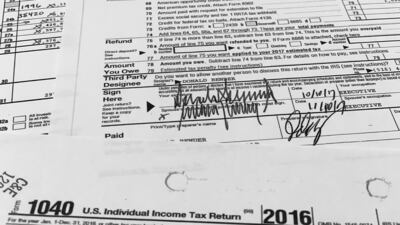
Former president Donald Trump's signature on one of his tax returns released by the House Ways and Means Committee on Friday. EPA -
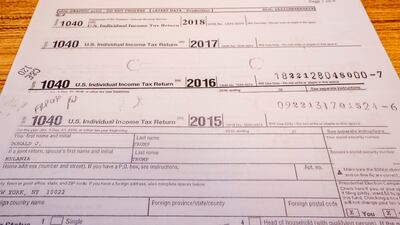
Mr Trump said in a statement: 'The Democrats should have never done it, the supreme court should have never approved it, and it's going to lead to horrible things for so many people.' EPA -

US House Ways and Means Committee staff members transport boxes of documents after a meeting to discuss Mr Trump's tax returns in Washington on December 20, 2022. Reuters -
The returns, which include redactions of some personal sensitive information such as Social Security and bank account numbers, span nearly 6,000 pages. AP -
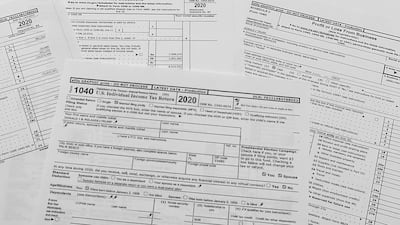
The returns also include more than 2,700 pages of individual returns, and more than 3,000 pages in returns for Mr Trump's business entities. AP -

A view of Trump Tower in Manhattan, New York, New York, US. AP -
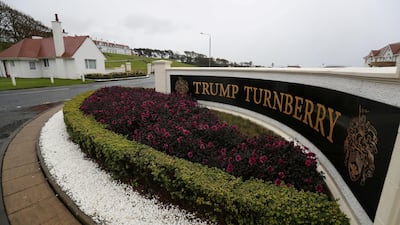
A look at the hotel at the Turnberry Golf Resort, bought by The Trump Organisation for $63 million in 2014, Mr Trump's taxes revealed. Reuters. -
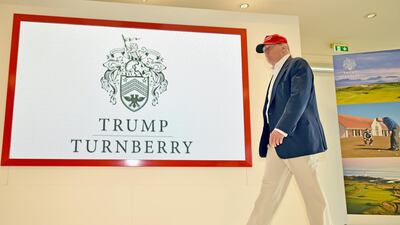
Donald Trump lost millions of dollars with his Scotland golf course and resort, his tax returns revealed. Getty Images -

Mr Trump lost more than $70 million with his Trump International Hotel at the Old Post Office building in Washington, his tax returns revealed. AP -
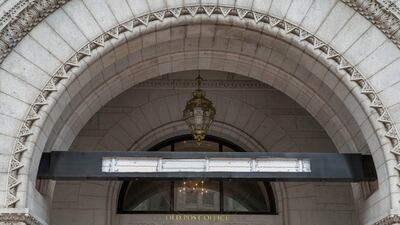
Workers removed the signage of the Trump Hotel in May 2022 after it was sold to a Miami-based investor fund. AP



