


US President Joe Biden's administration announced on Tuesday that all incoming travellers from China must show a negative Covid-19 test dated no more than two days before flying, as cases continue to rise in Beijing and other parts of the country.
The decision was made after US officials cited a lack of transparency from Beijing and comes on the heels of new travel rules put in place by Japan, India and Malaysia amid the rapid rise of infections in China.
“We know these measures will not eliminate all risk or completely prevent people who are infected from entering the United States … [but] taken together, they will help limit the number of infected people and provide us an early warning about new variants,” a federal health official said.
The tests can be either a PCR test or an antigen self-test administered through a telehealth service, with negative results required before boarding US-bound aircraft, officials said.
The new requirement will also apply to passengers travelling through third-country gateways, including Seoul, Toronto and Vancouver, and will go into effect at 12.01am ET on January 5.
“There are mounting concerns in the international community on the ongoing Covid-19 surges in China and the lack of transparent data, including viral genomic sequence data,” US officials said on Tuesday.
Last week, Beijing reported about 4,000 new Covid infections a day, though very few deaths.
On Sunday, China’s National Health Commission said it would stop publishing daily Covid-19 numbers, saying that a sub-department would instead issue “relevant epidemic information”.
The surge in cases comes weeks after Beijing scrapped its tough “zero-Covid” policy of mass lockdowns, which triggered nationwide protests.
-
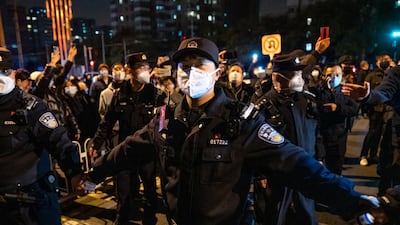
Police stand guard during a protest against Covid-19 restrictions, in China's capital Beijing. Bloomberg -
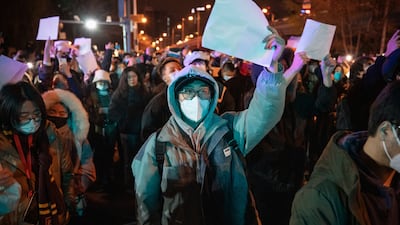
Demonstrators hold blank signs during a protest in Beijing, China. Bloomberg -
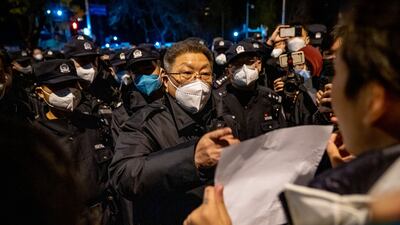
An official speaks with a demonstrator holding a blank sign, during a protest in Beijing. Bloomberg -
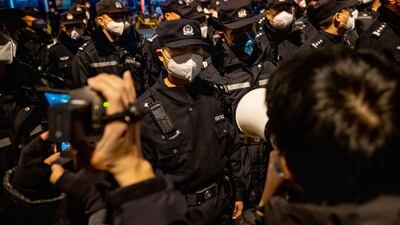
The death of at least 10 people in a fire in Urumqi, north-west China, which is under strict Covid restrictions, has led to protests nationwide. Bloomberg -
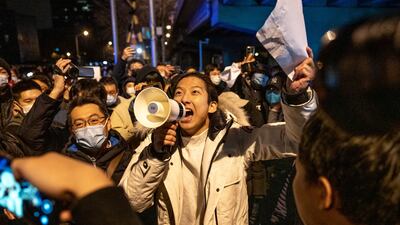
Demonstrators in Beijing. Protesters blame the deaths in Urumqi on strict Covid restrictions on leaving buildings. The authorities deny this. Bloomberg -
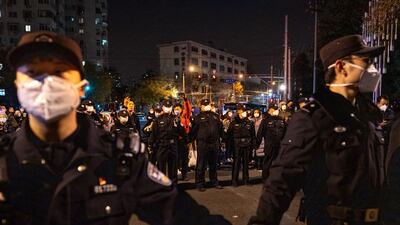
Police form a chain at Beijing protests. Demonstrations have also been reported in cities including, Shanghai, Nanjing, Chengdu, Lanzhou, Guangzhou and Wuhan – where Covid-19 was first reported. Bloomberg -
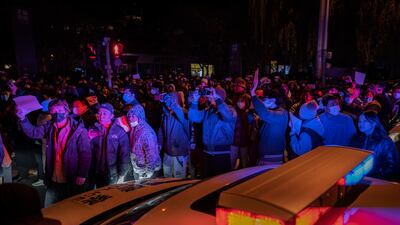
Protesters march past a police vehicle during a demonstration against China's strict zero-Covid measures, in Beijing. Getty -
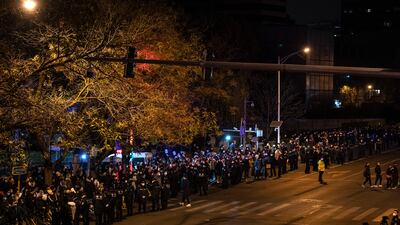
Protesters and police in Beijing. Chinese stocks fell over concerns about the impact of the demonstrations. Getty -

Demonstrators rally in Beijing. China reported more than 40,000 new cases of Covid-19 on Monday. AFP


Contributing to the caseload is a low overall uptake of booster vaccines among over-80s, which some experts point to as China's rationale for maintaining the strict zero-Covid policy for so long.
US officials said they were “following the science and advice of public health experts” and “consulting with partners” — prompting Beijing to counter that Covid rules should be enacted on a “scientific” basis.
China's foreign ministry spokesman Wang Wenbin called the western media's reporting on the surge “completely biased”.
“Hyping, smearing and political manipulation with ulterior motives can't stand the test of facts,” Mr Wang said.
Chinese immigration authorities said on Monday that the country would stop requiring inbound travellers to quarantine from January 8 — a major move towards opening its borders, which have been essentially closed since 2020.
US Secretary of State Antony Blinken last week offered to share Covid-19 vaccines with China while calling on Beijing to release its outbreak data.
“We want to see China get this outbreak under control,” he said.
“It is very important for all countries, including China, to focus on people getting vaccinated, making testing and treatment available and, importantly, sharing information with the world about what they're experiencing.”
Mr Blinken added that China, which the US considers its top global competitor, has not requested any help as it tackles the rise in cases.
“We're the largest donor of vaccines,” he said. “As you know, we're prepared to continue to support people around the world, including in China, with [vaccines] and with other Covid-related health support.
“China's not asked, to date, for that help.”
The Secretary of State is scheduled to visit Beijing in 2023.
On Monday, China said it would scrap the mandated quarantine for inbound travellers from January 8 in a bid to ease restrictions at its borders, which have been largely closed since the pandemic began.
Travellers will still have to undergo a PCR test 48 hours before their arrival, health authorities said.
Last Wednesday, China's National Health Commission said nearly 37 million people in the country may have been infected with the virus on a single day this week, with as many as 248 million — or 18 per cent of the population — contracting the disease in the first 20 days of this month alone.
-
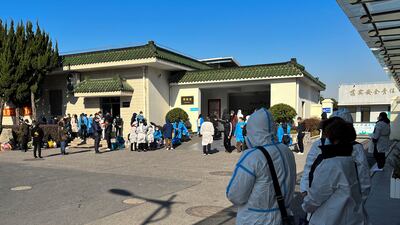
People stand outside a funeral home in Shanghai, as cases of Covid-19 surge in China. Reuters -
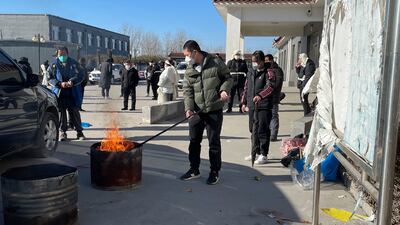
Relatives burn paper offerings for a relative who died, at the Gaobeidian Funeral Home in northern China's Hebei province. AP -
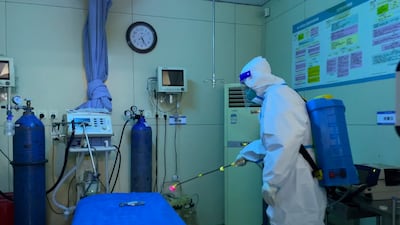
A worker disinfects a bed in the emergency department of a hospital in Baigou, Hebei province. AP -
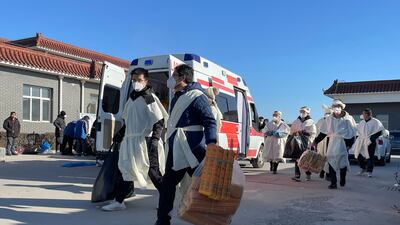
Cities across the country have struggled to cope as the surge in cases has emptied pharmacy shelves, filled hospital wards and appeared to cause backlogs at crematoriums and funeral homes. AP -
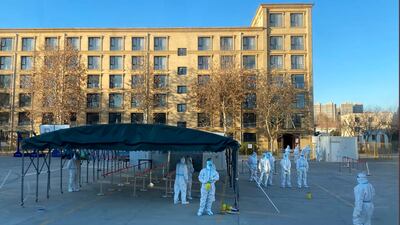
It comes after China dismantled key pillars of its zero-Covid strategy. AP -
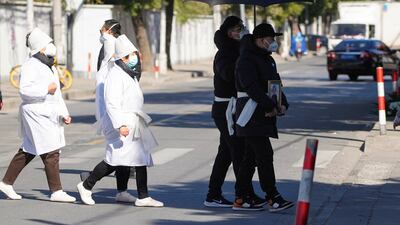
Authorities have lifted snap lockdowns, lengthy quarantines and travel curbs in a reversal of the country's hallmark containment strategy. Reuters -
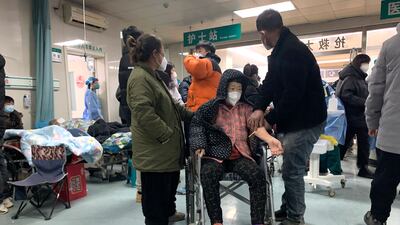
Relatives attend to a patient. AP -
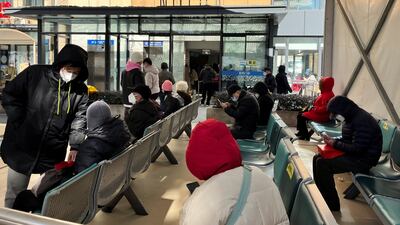
People wait outside a fever clinic at a hospital in Shanghai. Reuters



