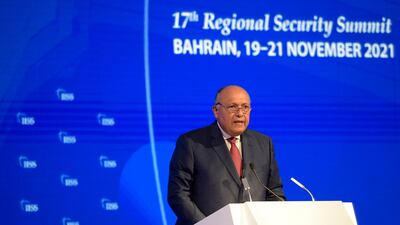
US State Department Counsellor Derek Chollet will seek to boost security co-operation on a trip this week to Kuwait and Bahrain, Washington announced on Monday.
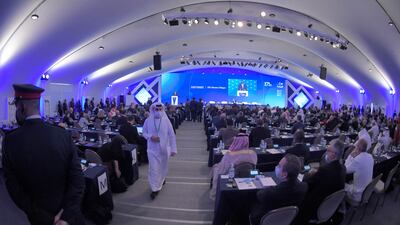
Mr Chollet will travel to the region on Tuesday, weeks after Bahrain hosted the critical Manama Dialogue, where US Central Command chief Gen Michael Kurilla said more than 100 unmanned vessels would be deployed in Gulf waters by next year to stave off Iranian maritime threats.
The State Department said Mr Chollet will partake in bilateral talks in Bahrain, communicating “America’s unwavering commitment both to Bahrain and the region”, as well as examining ways to enhance security co-operation, promote human rights and combat human trafficking.
During his time in Bahrain, the counsellor will also focus on promoting the Negev Forum, which aims to foster stronger ties between Israel and its Arab neighbours, as a means of advancing regional integration.
Representatives from the US, Israel, the UAE, Bahrain, Morocco and Egypt met in Manama for talks in June to discuss the next steps for the forum after the first Negev Summit was held in March.
In Kuwait, Mr Chollet will work to “advance mutual interests” on defence, trade, climate change and health issues.
Kuwait recently detected a cholera infection in a citizen who had travelled “from a neighbouring country where there is a cholera outbreak”, the health ministry said.
Mr Chollet's visit comes weeks after Kuwait made headlines for executing seven prisoners convicted of premeditated murder and other charges.
“The United States and Kuwait have a shared commitment to promoting the stability and security of the region, built on six decades of strong relations and people-to-people ties,” the State Department said in a statement.
The department did not immediately respond to requests about who specifically Mr Chollet will meet during bilateral discussions.
The rhetoric surrounding increased co-operation, particularly on defence, follows the White House's continued pivot away from the Middle East and towards Asia in its broader national security strategy.
“It is time to eschew grand designs in favour of more practical steps that can advance US interests and help regional partners lay the foundation for greater stability, prosperity and opportunity for the people of the Middle East and for the American people,” the strategy states.
US National Security Council spokesman John Kirby has also repeatedly stated that President Joe Biden will “review” its bilateral relationship with Saudi Arabia as a result of the Opec+ bloc's decision to cut oil production amid economic uncertainty.
Ten tax points to be aware of in 2026
1. Domestic VAT refund amendments: request your refund within five years
If a business does not apply for the refund on time, they lose their credit.
2. E-invoicing in the UAE
Businesses should continue preparing for the implementation of e-invoicing in the UAE, with 2026 a preparation and transition period ahead of phased mandatory adoption.
3. More tax audits
Tax authorities are increasingly using data already available across multiple filings to identify audit risks.
4. More beneficial VAT and excise tax penalty regime
Tax disputes are expected to become more frequent and more structured, with clearer administrative objection and appeal processes. The UAE has adopted a new penalty regime for VAT and excise disputes, which now mirrors the penalty regime for corporate tax.
5. Greater emphasis on statutory audit
There is a greater need for the accuracy of financial statements. The International Financial Reporting Standards standards need to be strictly adhered to and, as a result, the quality of the audits will need to increase.
6. Further transfer pricing enforcement
Transfer pricing enforcement, which refers to the practice of establishing prices for internal transactions between related entities, is expected to broaden in scope. The UAE will shortly open the possibility to negotiate advance pricing agreements, or essentially rulings for transfer pricing purposes.
7. Limited time periods for audits
Recent amendments also introduce a default five-year limitation period for tax audits and assessments, subject to specific statutory exceptions. While the standard audit and assessment period is five years, this may be extended to up to 15 years in cases involving fraud or tax evasion.
8. Pillar 2 implementation
Many multinational groups will begin to feel the practical effect of the Domestic Minimum Top-Up Tax (DMTT), the UAE's implementation of the OECD’s global minimum tax under Pillar 2. While the rules apply for financial years starting on or after January 1, 2025, it is 2026 that marks the transition to an operational phase.
9. Reduced compliance obligations for imported goods and services
Businesses that apply the reverse-charge mechanism for VAT purposes in the UAE may benefit from reduced compliance obligations.
10. Substance and CbC reporting focus
Tax authorities are expected to continue strengthening the enforcement of economic substance and Country-by-Country (CbC) reporting frameworks. In the UAE, these regimes are increasingly being used as risk-assessment tools, providing tax authorities with a comprehensive view of multinational groups’ global footprints and enabling them to assess whether profits are aligned with real economic activity.
Contributed by Thomas Vanhee and Hend Rashwan, Aurifer
Skoda Superb Specs
Engine: 2-litre TSI petrol
Power: 190hp
Torque: 320Nm
Price: From Dh147,000
Available: Now
Mercer, the investment consulting arm of US services company Marsh & McLennan, expects its wealth division to at least double its assets under management (AUM) in the Middle East as wealth in the region continues to grow despite economic headwinds, a company official said.
Mercer Wealth, which globally has $160 billion in AUM, plans to boost its AUM in the region to $2-$3bn in the next 2-3 years from the present $1bn, said Yasir AbuShaban, a Dubai-based principal with Mercer Wealth.
“Within the next two to three years, we are looking at reaching $2 to $3 billion as a conservative estimate and we do see an opportunity to do so,” said Mr AbuShaban.
Mercer does not directly make investments, but allocates clients’ money they have discretion to, to professional asset managers. They also provide advice to clients.
“We have buying power. We can negotiate on their (client’s) behalf with asset managers to provide them lower fees than they otherwise would have to get on their own,” he added.
Mercer Wealth’s clients include sovereign wealth funds, family offices, and insurance companies among others.
From its office in Dubai, Mercer also looks after Africa, India and Turkey, where they also see opportunity for growth.
Wealth creation in Middle East and Africa (MEA) grew 8.5 per cent to $8.1 trillion last year from $7.5tn in 2015, higher than last year’s global average of 6 per cent and the second-highest growth in a region after Asia-Pacific which grew 9.9 per cent, according to consultancy Boston Consulting Group (BCG). In the region, where wealth grew just 1.9 per cent in 2015 compared with 2014, a pickup in oil prices has helped in wealth generation.
BCG is forecasting MEA wealth will rise to $12tn by 2021, growing at an annual average of 8 per cent.
Drivers of wealth generation in the region will be split evenly between new wealth creation and growth of performance of existing assets, according to BCG.
Another general trend in the region is clients’ looking for a comprehensive approach to investing, according to Mr AbuShaban.
“Institutional investors or some of the families are seeing a slowdown in the available capital they have to invest and in that sense they are looking at optimizing the way they manage their portfolios and making sure they are not investing haphazardly and different parts of their investment are working together,” said Mr AbuShaban.
Some clients also have a higher appetite for risk, given the low interest-rate environment that does not provide enough yield for some institutional investors. These clients are keen to invest in illiquid assets, such as private equity and infrastructure.
“What we have seen is a desire for higher returns in what has been a low-return environment specifically in various fixed income or bonds,” he said.
“In this environment, we have seen a de facto increase in the risk that clients are taking in things like illiquid investments, private equity investments, infrastructure and private debt, those kind of investments were higher illiquidity results in incrementally higher returns.”
The Abu Dhabi Investment Authority, one of the largest sovereign wealth funds, said in its 2016 report that has gradually increased its exposure in direct private equity and private credit transactions, mainly in Asian markets and especially in China and India. The authority’s private equity department focused on structured equities owing to “their defensive characteristics.”
The specs
- Engine: 3.9-litre twin-turbo V8
- Power: 640hp
- Torque: 760nm
- On sale: 2026
- Price: Not announced yet
The%20specs%20
%3Cp%3E%3Cstrong%3EEngine%3A%20%3C%2Fstrong%3E2.0-litre%204cyl%20turbo%0D%3Cbr%3E%3Cstrong%3EPower%3A%20%3C%2Fstrong%3E261hp%20at%205%2C500rpm%0D%3Cbr%3E%3Cstrong%3ETorque%3A%20%3C%2Fstrong%3E400Nm%20at%201%2C750-4%2C000rpm%0D%3Cbr%3E%3Cstrong%3ETransmission%3A%20%3C%2Fstrong%3E7-speed%20dual-clutch%20auto%0D%3Cbr%3E%3Cstrong%3EFuel%20consumption%3A%20%3C%2Fstrong%3E10.5L%2F100km%0D%3Cbr%3E%3Cstrong%3EOn%20sale%3A%20%3C%2Fstrong%3ENow%0D%3Cbr%3E%3Cstrong%3EPrice%3A%20%3C%2Fstrong%3EFrom%20Dh129%2C999%20(VX%20Luxury)%3B%20from%20Dh149%2C999%20(VX%20Black%20Gold)%3C%2Fp%3E%0A
MATCH INFO
Uefa Champions League semi-final, first leg
Tottenham 0-1 Ajax, Tuesday
Second leg
Ajax v Tottenham, Wednesday, May 8, 11pm
Game is on BeIN Sports