

On a hot, humid East Coast day this summer, a massive container ship pulled into the Port of Baltimore in Maryland loaded with sheets of plywood, aluminium rods and radioactive material — all sourced from the fields, forests and factories of Russia.
US President Joe Biden promised to “inflict pain” and deal “a crushing blow” on Russian President Vladimir Putin through trade restrictions on commodities such as vodka, diamonds and gasoline after Russia’s invasion of Ukraine six months ago. But hundreds of other types of unsanctioned goods worth billions of dollars, including those found on the ship bound for Baltimore from St Petersburg, continue arrive at US ports.
The Associated Press found more than 3,600 shipments of wood, metals, rubber and other goods have arrived at US ports from Russia since it began launching missiles and air strikes into its neighbour in February. That is a significant drop from the same period in 2021 when about 6,000 shipments arrived. However, it still adds up to more than $1 billion worth of commerce a month.
In reality, no one involved actually expected trade to drag to a halt after the invasion. Banning imports of certain items would likely do more harm to those sectors in the US than in Russia.
The Ukraine crisis - in pictures
-
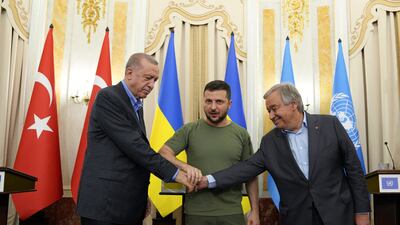
Turkish President Recep Tayyip Erdogan, Ukrainian President Volodymyr Zelenskyy and UN Secretary General Antonio Guterres shake hands after their meeting in Lviv, Ukraine. AP -

Russian missiles headed for Ukraine are launched from Russia's Belgorod region. AP -
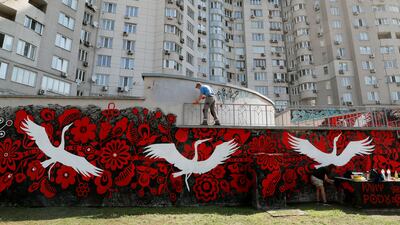
Street artists paint a mural on to a wall near a building in a residential area in Kyiv, Ukraine. EPA -
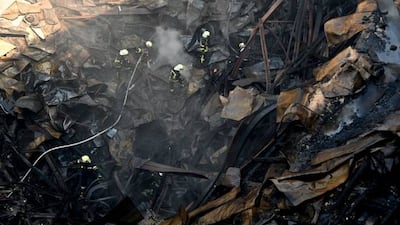
Firefighters put out flames and search through the rubble of the Culture Palace, which was destroyed by a Russian missile, in Ukraine's second-largest city of Kharkiv. Getty -

Seamstresses sew soft toys at the Kopytsia toy factory in Nizhyn, Ukraine. The factory makes toys that have became patriotic symbols for Ukrainians during Russia's invasion. EPA -

The logo of a new cafe called 'Stars Coffee', which opened in Moscow after Starbucks pulled out of Russia due to its invasion of Ukraine. Reuters -

Rescue officials gather in front of the bodies of victims killed in a Russian missile strike on Kharkiv. AFP -
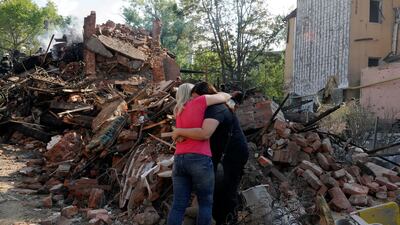
Women hug near the debris of a building that was destroyed after a rocket hit the Saltivka area in Kharkiv. EPA -
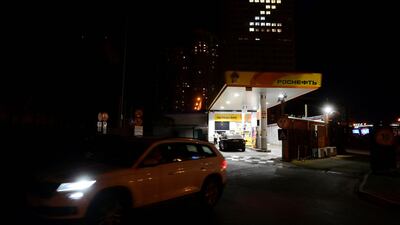
The letter 'Z', a symbol of support for Russia's invasion of Ukraine, is projected on to a building in Moscow. AFP -
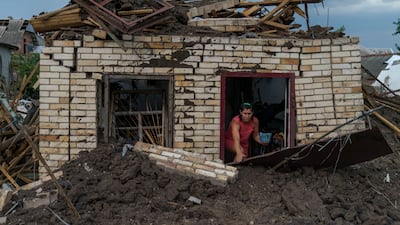
A woman recovers an item from the damaged home of her elderly neighbour after a Russian missile strike yesterday in Druzhkivka, in Ukraine's Donetsk enclave. AP -

Bronze medalist Andriy Protsenko of Ukraine celebrates after the men's high jump final on day eight of the European Championships in Munich, Germany. Getty


“When we impose sanctions, it could disrupt global trade. So our job is to think about which sanctions deliver the most impact, while also allowing global trade to work,” ambassador Jim O’Brien, who heads the State Department’s Office of Sanctions Co-ordination, told the AP.
Experts say the global economy is so intertwined that sanctions must be limited in scope to avoid driving up prices in an already unstable market.
Also, US sanctions do not exist in a vacuum; layers of EU and UK bans result in convoluted trade rules that can be confusing to buyers, sellers and policymakers.
For example, the Biden administration and the EU released separate lists of Russian companies that cannot receive exports. However, at least one of those companies — which supplies the Russian military with metal to make fighter jets currently dropping bombs in Ukraine —- is still selling millions of dollars of metal to American and European firms, AP found.
While some US importers are sourcing alternative materials elsewhere, others say they have no choice. In the case of wood imports, Russia’s dense birch forests create such hard, strong timber that most American wooden classroom furniture, and much home flooring, is made from it. Shipping containers of Russian items — groats, weightlifting shoes, crypto mining gear, even pillows — arrive at US ports almost every day.
A breakdown of imported goods from Russia shows some items are clearly legal and even encouraged by the Biden administration. These include the more than 100 shipments of fertiliser that have arrived since the invasion. Now-banned products such as Russian oil and gas continued to arrive in US ports long after the announcement of sanctions owing to “wind-down” periods, allowing companies to complete existing contracts.
Los Angeles port - in pictures
-
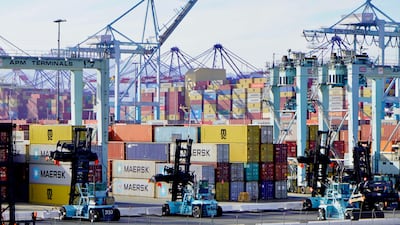
Earlier this year, the Port of Los Angeles became the Western Hemisphere's first to process 10 million container units in a year. Holly Aguirre / The National -
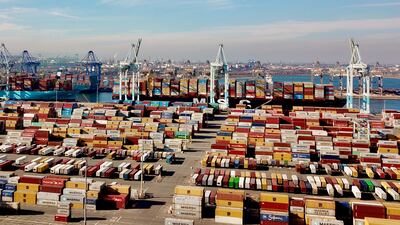
The Port of Los Angeles is one of the world's busiest and shipments are up 30 per cent since the pandemic. Photo: Sven Kamm -
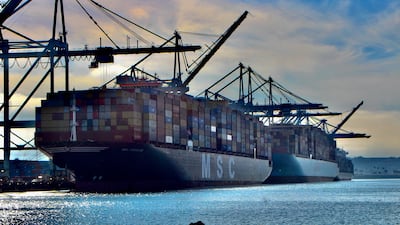
Most of the container ships entering the Port of Los Angeles are carrying 14,000 containers ready to be unloaded. Holly Aguirre / The National -
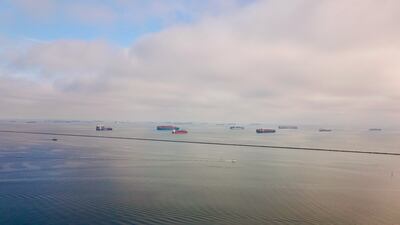
Last week, more than 78 cargo ships sat waiting for a berthing spot. Photo: Sven Kamm -
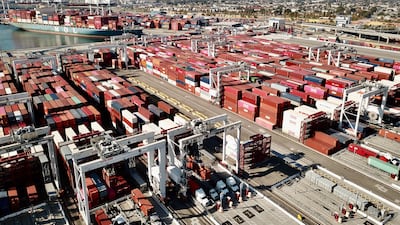
Commercial drivers are now working around the clock in an effort to clear the backlog at the Port of Los Angeles. Photo: Sven Kamm -
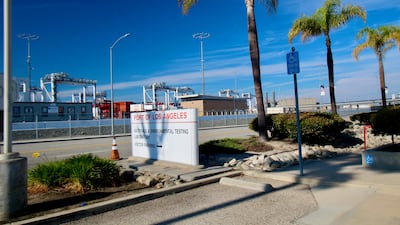
This year, the Port of Los Angeles in San Pedro, California, received more shipping containers since its foundation more than 100 years ago. Holly Aguirre / The National


In some cases, the origin of products shipped out of Russian ports can be difficult to discern. US energy companies are continuing to import oil from Kazakhstan through Russian ports, even though that oil is sometimes mixed with Russian fuel. Trade experts warn that Russian suppliers are unreliable, and opaque corporate structures of most major Russian companies make it difficult to determine whether they have ties to the government.
“It is a general rule: when you have sanctions, you’ll have all kinds of murky schemes and illicit trade,” said Russian economist Konstantin Sonin, who teaches at the University of Chicago. “Still, sanctions make sense because even though you cannot kill 100 per cent of revenue, you can reduce them.”
Russia and the US were never major trading partners, and so sanctioning imports is only a very small slice of the retaliatory strategy. Restrictions on exports from the US cause more damage to the Russian economy. Sanctioning the Russian Central Bank has frozen Russia’s access to roughly $600bn in currency reserves held across the US and Europe.
Nonetheless, sanctions carry a symbolic weight beyond the financial harm they might inflict, particularly for American consumers horrified by the war.
US sanctions more Russian oligarchs — in pictures
-

Witanhurst is located in Highgate Village above Hampstead Heath, London. Photo: Keith Newformula -
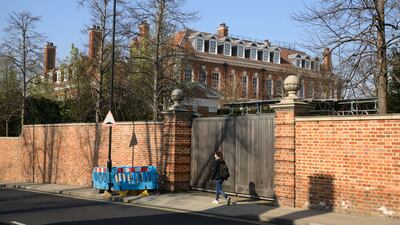
London neighbourhoods favoured by Russian owners are Belgravia, Knightsbridge, Chelsea, Hampstead and Highgate, the wealthiest areas of the capital. Getty Images -

The Russian billionaire Andrey Guryev owns Witanhurst, the second largest private residence in London after Buckingham Palace, and has 65 rooms, 25 bedrooms and a ballroom. Getty Images -
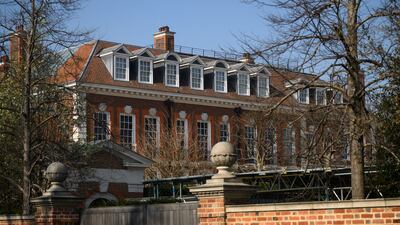
Witanhurst was bought by the Guryev family through an offshore company called Safran Holdings, located in the tax haven of the British Virgin Islands, for £50 million in 2008. Getty Images -
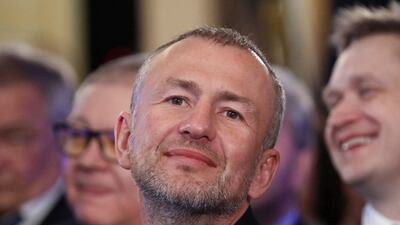
Russian billionaire Andrey Melnichenko in Moscow, Russia, in February 9, 2018. Reuters -
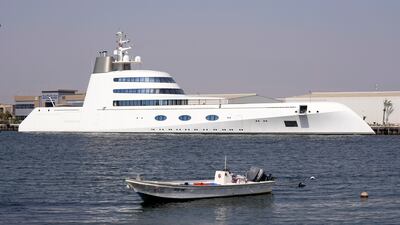
The 118-metre superyacht belonging to Mr Melnichenko anchored in the port of Ras Al Khaimah. AP -

Mr Melnichenko was slapped with sanctions by the US Treasury Department on Tuesday. AP -
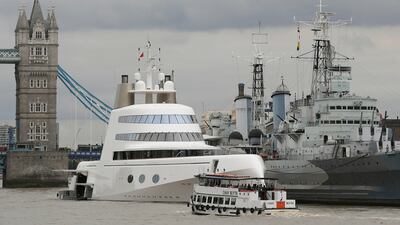
'Motor Yacht A' is seen moored on the River Thames beside the 'HMS Belfast' in London in 2016. Reuters -
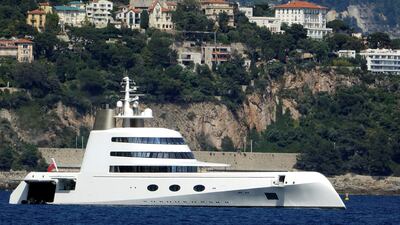
'Motor Yacht A' is seen near the harbour in Monaco on May 4, 2017. Reuters -
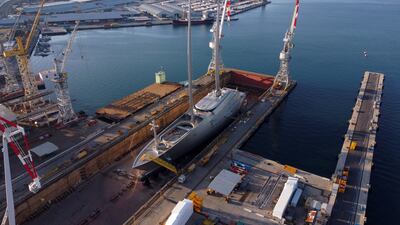
The superyacht belonging to Russian billionaire Andrey Melnichenko, which has been sequestered by Italian police, is seen at the port of Trieste, Italy, on March 12, 2022. Reuters -

Mr Melnichenko's sailing yacht in Trieste, Italy, on March 10, 2022. It is the largest private sail-assisted motor yacht in the world. AFP -
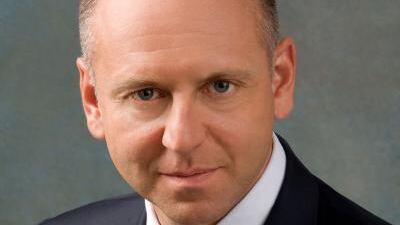
Russian oligarch Dmitry Pumpyanskiy. Photo: Kremlin.ru -
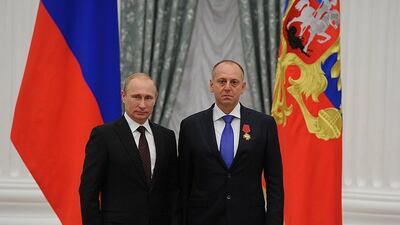
Russian President Vladimir Putin with Mr Pumpyanskiy in July 2014. Photo: Kremlin.ru -
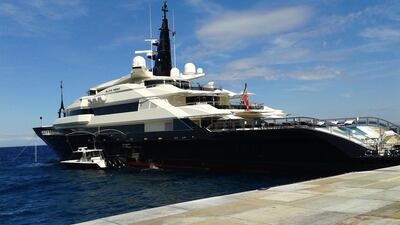
The superyacht 'Alfa Nero' is owned by Andrey Guryev. Photo: Schnippchen -
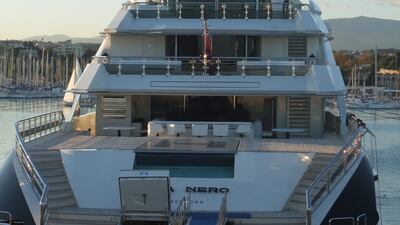
The 'Alfa Nero' in the Port of Antibes on the French Riviera. Photo: Wikipedia



