


The rise in alleged assassination plots tied to the Iranian regime, which have been uncovered by the US government, has raised questions on Tehran’s threat and capabilities within America.
Last month, the FBI said that Iranian-American activist Masih Alinejad was a target of a Tehran plot to kidnap her from the dissident’s Brooklyn home.
Iranian authorities have rejected this claim, but the alleged assailant, Khalid Mehdiyev, is in US custody facing charges.
Only last Wednesday, the US Justice Department charged Shahram Poursafi, identified by US officials as a member of Iran's Islamic Revolutionary Guard Corps, in a plot to assassinate former national security adviser John Bolton as well as former US Secretary of State Mike Pompeo in a separate mission.
On Friday, Hadi Matar, a Lebanese-American man stabbed renowned author Salman Rushdie at an event in New York and now is facing charges. In an interview with the Daily Mail, his mother, Silvana Fardos, said her son had “changed” during a four-week trip to Lebanon in 2018.
-
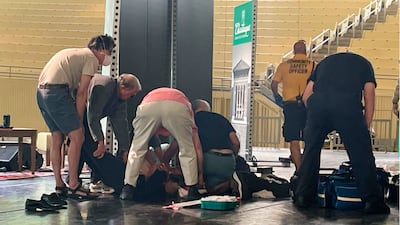
A man stormed the stage at the Chautauqua Institution in the US state of New York and began assaulting Salman Rushdie as he was being introduced. AP -

Rushdie, whose writing led to death threats from Iran in the 1980s, was attacked on Friday while giving a lecture in western New York. AP -

Bloodstains mark a screen on the stage where Rushdie was attacked. AP -
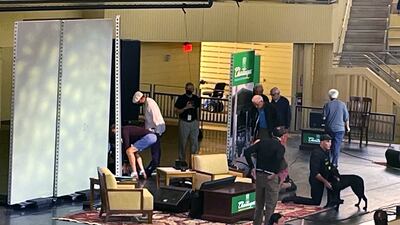
Rushdie, behind screen left, is tended to after being attacked on stage. AP -
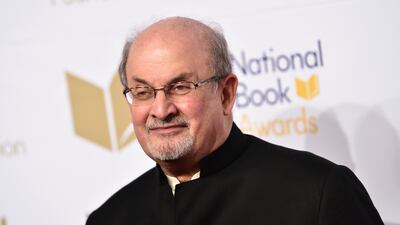
Rushdie’s condition was not immediately known. AP -
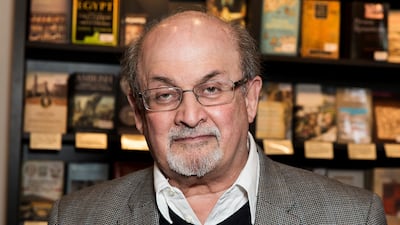
Concerns about the author's security have been raised in the past. AP -
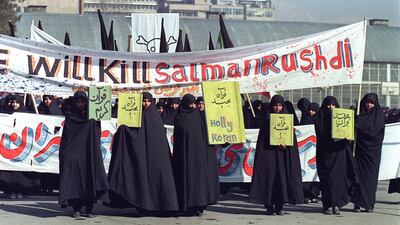
Iranian women hold banners during a demonstration against Rushdie in Tehran. AFP -
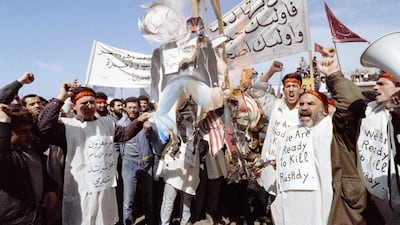
Pro-Iranian Hezbollah protesters burn an effigy of Rushdie in Beirut, Lebanon. AFP -

Though born in India, Rushdie has lived mostly between London and New York City. Reuters


“I was expecting him to come back motivated, to complete school, to get his degree and a job. But instead, he locked himself in the basement. He had changed a lot, he didn't say anything to me or his sisters for months,” she said.
A US government official following the case told The National on condition of anonymity that the attacker “has sympathies to the Iranian regime and Shia Jihadism", but that it is unknown if he acted alone or under instructions from Tehran.
Vice News, citing “European and Middle Eastern intelligence officials”, reported that Mr Matar, who pleaded not guilty and will appear back in court on Friday, “had been in direct contact with members of the Islamic Revolutionary Guard Corps on social media".
Colin Clarke, director of policy and research at the Soufan Centre and an expert in counter-terrorism, said the events of the last few weeks demonstrate “that Iran has both the intent and capability to strike at targets on US soil".
“These weren't the first plots and they won't be the last. Rather than expose Iranian ineptitude, [the events] show that the Iranians are brazen and cavalier in their approach to conducting acts of terrorism inside the US,” Mr Clarke told The National.
-
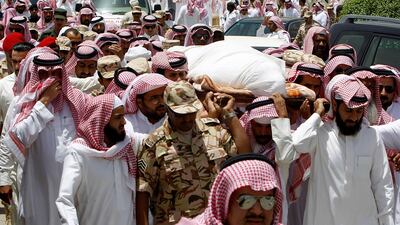
Relatives carry the body of Hassan Al Qahtani outside the Grand Mosque in Riyadh in May 2011. The Saudi diplomat was shot dead in Karachi by a man believed to have been linked to Iran's Islamic Revolutionary Guard Corps' Quds Force. Reuters -
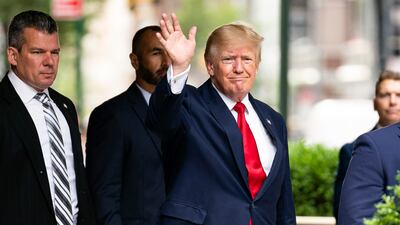
Iran has been attempting to kill or capture former US president Donald Trump after he ordered the air strike that killed the IRGC's Quds Force commander, Qassem Suleimani, in January 2020. AP -
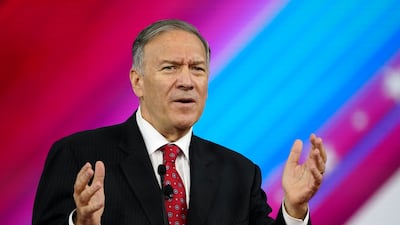
Former secretary of state Mike Pompeo is believed to have been Iran's second target, after former national security adviser John Bolton, marked for assassination. AP -

Gen Kenneth McKenzie, former commander of the US Central Command, has been high on Iran's list of people to be killed in retribution following Suleimani's death. AFP -

Abdul Rahman Ghassemlou, secretary general of the Democratic Party of Iranian Kurdistan, was shot dead in July 1989 by suspected Iranian agents in Vienna. Getty -
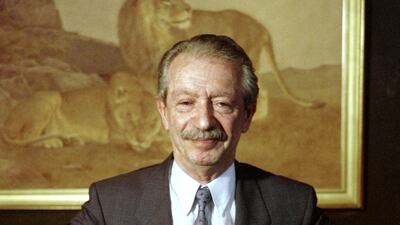
Shapour Bakhtiar, the last Iranian prime minister under the Shah, was killed at his home in August 1991 by assassins believed to have been sent by Tehran. AFP -
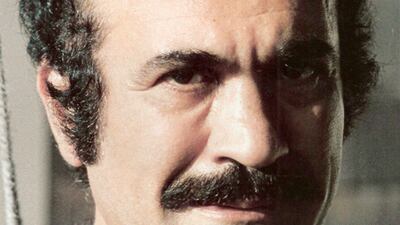
Iranian poet and entertainer Fereydoun Farrokhzad's death has never been solved but German police believe he was killed by Iranian operatives.


The author of several reports and books on violent extremism, believes the timing of the revelations is possibly tied to the stalled nuclear talks with Iran. He said these were planned either to increase pressure on Washington, or to show divergent views within Tehran on the return to the deal.
But such plans will ultimately backfire, Mr Clarke said, as they would pressurise the Biden administration into not compromising with the Iranian regime.
As far as assessing the Iranian threat and Tehran’s ability to recruit or inspire lone wolf attacks, Mr Clarke argued that Tehran has the capability.
“If the Iranians were really determined to encourage home-grown violent extremists in the US to launch attacks, they certainly could do so, especially if this is something occurring at the level of the IRGC," he said.
“There are also options with Lebanon's Hezbollah, its supporters, and the broader network of Iranian proxies that exist around the world."
But Holly Dagres, a senior fellow at the Atlantic Council, said there was another reason for the rise in alleged Iranian attacks, which is directly linked with the internal situation in Tehran.
“At the end of June, Iran’s supreme leader Ayatollah Ali Khamenei delivered a controversial speech in which he threatened a violent crackdown on dissent similar to what we saw in 1981, when there were mass executions and arrests in the country, Ms Dagres told The National.
"This gave the security apparatus the blessing to aggressively implement a large-scale crackdown on dissent not just at home, but arguably abroad as well."
The supreme leader’s rhetoric was accompanied with “a shake-up in the IRGC’s intelligence arm. Hossein Taeb, who was the intelligence chief from 2009 until June, was suddenly replaced after numerous incidents — assassinations, cyber attacks, and sabotage inside Iran — that successfully took place and were blamed on Israel", she said.
Mr Taeb was replaced by Mohammad Kazemi, who now “has to prove himself capable of the role and has the backing of the supreme leader to act out brutally", she added.
Successful attacks on Mr Bolton and Ms Alinejad, “would've been big wins for Kazemi had they been assassinated".
Asked about the Salman Rushdie case, Ms Dagres said it is unknown whether the assailant was a paid agent of Iran or merely ideologically inspired by the regime.
Ms Dagres issued a warning that the threat will unlikely diminish as long as the US and EU “appear to have a high threshold for what the Islamic Republic does".
“The attempted assassination of critics and dissidents of the Islamic Republic won't deter the [nuclear] talks because the West sees the nuclear file as separate from everything else, be it human rights, transnational repression, and so forth," she said.
The Iranian government has not commented on the Rushdie attack, but some Iranian media outlets have praised the stabbing.
-
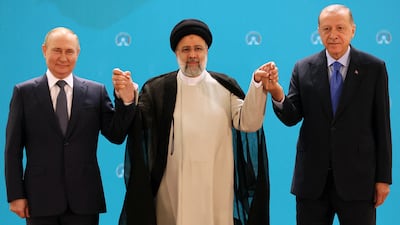
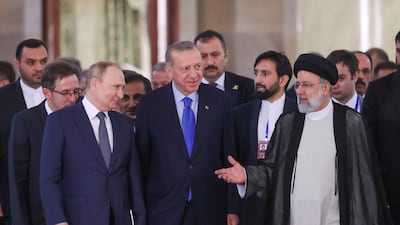
Russian President Vladimir Putin, Iranian President Ebrahim Raisi and Turkish President Recep Tayyip Erdogan pose for a photo in Tehran before holding a meeting on Syria. AFP -
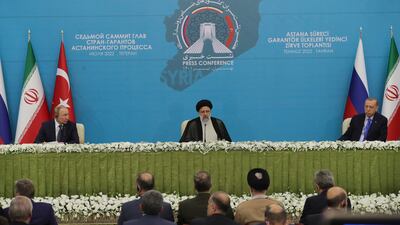
The meeting followed the so-called Astana Format discussions on Syria. AFP -
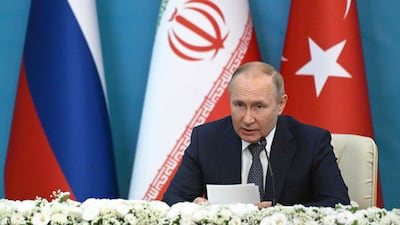
It was Mr Putin's first overseas trip outside Russia since his country's invasion of Ukraine began in February. AFP -
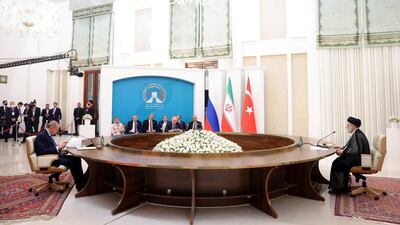
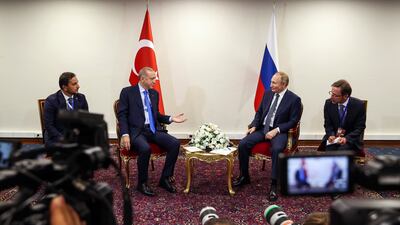
Mr Putin was also expected to discuss the Ukraine war with Mr Erdogan at the meeting. Reuters -
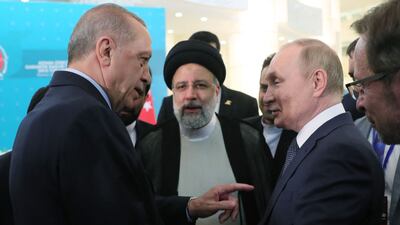
The meeting comes only days after Russian and Ukrainian officials met Turkish officials to mediate an agreement on grain exports. AFP -
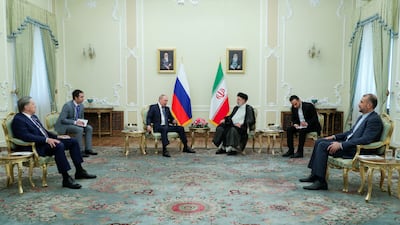
Mr Putin was also expected to discuss the stalled international discussions on reviving the 2015 nuclear agreement with Iranian officials. AFP -
The connection between Russia and Iran has deepened as they both support Syria's President Bashar Al Assad while Turkey, by contrast, backs rebel factions in the north-western parts of the country. AP -
The US issued a warning last week that Iran was preparing to send Russia hundreds of drones, including models capable of carrying weapons, amid significant losses by Moscow’s military as Mr Putin's war approaches its sixth month. Reuters -
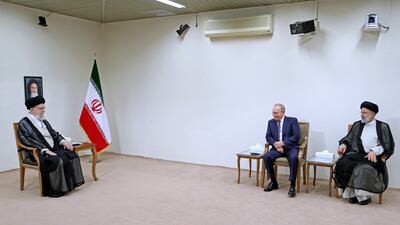
Iranian supreme leader Ayatollah Ali Khamenei holds talks with Mr Putin and Mr Raisi in Tehran. EPA -
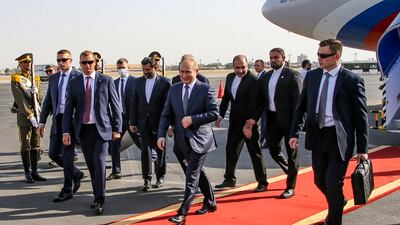
Mr Putin is in Iran to deepen ties with regional heavyweights as part of a challenge to the US and Europe, which have imposed sanctions on Moscow over its war in Ukraine. AP



