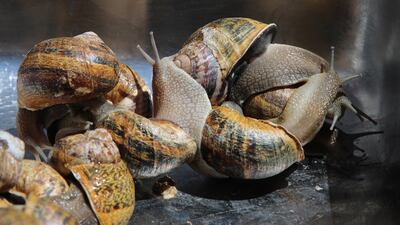
Invasive giant African land snails that can eat building plaster and stucco, consume hundreds of varieties of plants and carry diseases that affect humans have been detected once again in Florida. AP

Invasion of giant African land snails puts Florida on offensive


  • English
  • Arabic

Hundreds of giant African land snails have turned up on Florida's Gulf Coast, officials said on Friday, threatening to destroy a vast array of plants and trees, and posing the risk of transmitting a rare type of meningitis to humans.

The snail, native to east Africa, is one of the most damaging in the world, eating at least 500 different types of plants, tree bark, and even paint and stucco on houses, the US Department of Agriculture's website said.

The gastropod, whose shell can grow to the size of a human fist, often carries a parasite known as rat lungworm that can transmit a type of meningitis whose symptoms include muscle aches, headache, stiff neck, fever and vomiting.

More than a thousand of the creatures have been collected in the Tampa, Florida suburb of New Port Richey in Pasco County, officials said.

All of those tested as of Thursday were not carrying the rat lungworm parasite, Greg Hodges, assistant director of the state's Division of Plant Industry, said.

State officials first detected the infestation on June 23.

Officials stressed the importance of not touching nor ingesting the snail to prevent infections.

“Most importantly, do not eat them. This is not a snail to be put on butter and oil and garlic. This is not something you want to touch. This is not something you want to eat,” Nikki Fried, commissioner of the Florida Department of Agriculture, said.

To eradicate the snails, the state has placed an area of the county around New Port Richey under watch and will treat all properties within the zone until the snails are eliminated, the department's website said.

The treatment with metaldehyde, a pesticide used to control snails and slugs, will take 18 months, and the area will be monitored for two years after the last snail find.

It is unclear how the snail made its way to Florida, but the US Department of Agriculture's website said it is a common hitchhiker on cargo or is illegally imported by people for the purpose of food or as pets.

It is the third time that the giant African land snail has been found in Florida. In the 1960s, it took $1 million and 10 years to eradicate. In 2010, a second infestation took another decade and $23m to eradicate.

If the snails turn up beyond a core concentration in the New Port Richey area, it may take longer than expected to eradicate the pest, state officials said.

  • Snails at a farm in the village of Sanhaja, Manouba, north-east Tunisia. A higher demand for snails, from restaurants and the cosmetics industry for the mucin they produce, has led to an increase in the number of breeding farms. All photos by EPA
    Snails at a farm in the village of Sanhaja, Manouba, north-east Tunisia. A higher demand for snails, from restaurants and the cosmetics industry for the mucin they produce, has led to an increase in the number of breeding farms. All photos by EPA
  • Rising demand means business is not slow for snail farmer Fadwa Sellami from the village of Sanhaja, Manouba, north-east Tunisia
    Rising demand means business is not slow for snail farmer Fadwa Sellami from the village of Sanhaja, Manouba, north-east Tunisia
  • Snail breeding has become a flourishing business in Tunisia as farms capitalise on demand from restaurants and the beauty industry.
    Snail breeding has become a flourishing business in Tunisia as farms capitalise on demand from restaurants and the beauty industry.
  • Snails sit in a box at a farm in the village of Sanhaja, Manouba, north-east Tunisia. Cosmetic firms want snail mucus rich in Vitamin E, hyaluronic acid and collagen for skincare products.
    Snails sit in a box at a farm in the village of Sanhaja, Manouba, north-east Tunisia. Cosmetic firms want snail mucus rich in Vitamin E, hyaluronic acid and collagen for skincare products.
  • Snail wrangling at a farm in the village of Sanhaja, Manouba, north-east Tunisia. Snails are a feature of dining in many cultures and are appreciated as low cholesterol, high protein delicacies.
    Snail wrangling at a farm in the village of Sanhaja, Manouba, north-east Tunisia. Snails are a feature of dining in many cultures and are appreciated as low cholesterol, high protein delicacies.
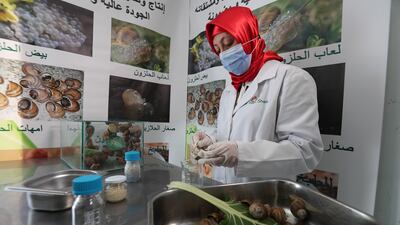
  • Snail farmer Fadwa Sellami at her farm in the village of Sanhaja, Manouba, north-east Tunisia.
    Snail farmer Fadwa Sellami at her farm in the village of Sanhaja, Manouba, north-east Tunisia.
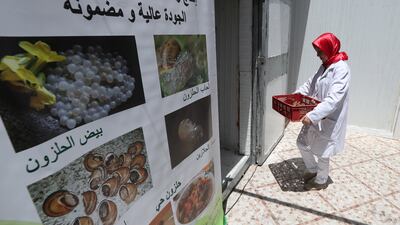
  • Snail farmer Fadwa Sellami prepares a batch for shipping. Figures on Tunisian agriculture suggest that about 95 per cent of the snail crop is exported and that farmers, many of them young people, are as adept with IT and marketing as they are with agriculture.
    Snail farmer Fadwa Sellami prepares a batch for shipping. Figures on Tunisian agriculture suggest that about 95 per cent of the snail crop is exported and that farmers, many of them young people, are as adept with IT and marketing as they are with agriculture.
  • Fadwa Sellami extracts mucin from snails at her farm in the village of Sanhaja, Manouba, north-east Tunisia. Snail farming is referred to as heliciculture.
    Fadwa Sellami extracts mucin from snails at her farm in the village of Sanhaja, Manouba, north-east Tunisia. Snail farming is referred to as heliciculture.
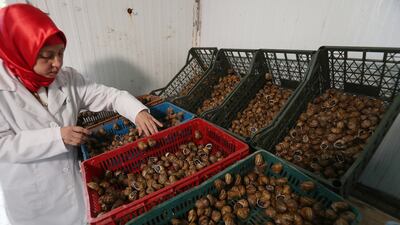
  • Snail farmer Fadwa Sellami skims through snails at her farm in the village of Sanhaja.
    Snail farmer Fadwa Sellami skims through snails at her farm in the village of Sanhaja.
Pharaoh's curse

British aristocrat Lord Carnarvon, who funded the expedition to find the Tutankhamun tomb, died in a Cairo hotel four months after the crypt was opened.
He had been in poor health for many years after a car crash, and a mosquito bite made worse by a shaving cut led to blood poisoning and pneumonia.
Reports at the time said Lord Carnarvon suffered from “pain as the inflammation affected the nasal passages and eyes”.
Decades later, scientists contended he had died of aspergillosis after inhaling spores of the fungus aspergillus in the tomb, which can lie dormant for months. The fact several others who entered were also found dead withiin a short time led to the myth of the curse.

Meydan Racecourse racecard:

6.30pm: The Madjani Stakes Listed (PA) | Dh175,000 1,900m

7.05pm: Maiden for 2-year-old fillies (TB) Dh165,000 1,400m

7.40pm: The Dubai Creek Mile Listed (TB) Dh265,000 1,600m

8.15pm: Maiden for 2-year-old colts (TB) Dh165,000 1,600m

8.50pm: The Entisar Listed (TB) Dh265,000 2,000m

9.25pm: Handicap (TB) Dh190,000 1,200m

10pm: Handicap (TB) Dh190,000 1,600m.

The%20specs%3A%20Panamera%20Turbo%20E-Hybrid
%3Cp%3E%3Cstrong%3EEngine%3A%20%3C%2Fstrong%3E4.0-litre%20twin-turbo%20V8%20hybrid%0D%3Cbr%3E%3Cstrong%3EPower%3A%20%3C%2Fstrong%3E680hp%0D%3Cbr%3E%3Cstrong%3ETorque%3A%20%3C%2Fstrong%3E930Nm%0D%3Cbr%3E%3Cstrong%3ETransmission%3A%20%3C%2Fstrong%3EEight-speed%20dual-clutch%20auto%0D%3Cbr%3E%3Cstrong%3EPrice%3A%20%3C%2Fstrong%3EFrom%20Dh749%2C000%0D%3Cbr%3E%3Cstrong%3EOn%20sale%3A%20%3C%2Fstrong%3ENow%3C%2Fp%3E%0A
The%20specs%3A%202024%20Panamera
%3Cp%3E%3Cstrong%3EEngine%3A%20%3C%2Fstrong%3E2.9-litre%20twin-turbo%20V6%0D%3Cbr%3E%3Cstrong%3EPower%3A%20%3C%2Fstrong%3E353hp%0D%3Cbr%3E%3Cstrong%3ETorque%3A%20%3C%2Fstrong%3E500Nm%0D%3Cbr%3E%3Cstrong%3ETransmission%3A%20%3C%2Fstrong%3EEight-speed%20dual-clutch%20auto%0D%3Cbr%3E%3Cstrong%3EPrice%3A%20%3C%2Fstrong%3EFrom%20Dh408%2C200%0D%3Cbr%3E%3Cstrong%3EOn%20sale%3A%3C%2Fstrong%3E%20Now%3C%2Fp%3E%0A

Innotech Profile

Date started: 2013

Founder/CEO: Othman Al Mandhari

Based: Muscat, Oman

Sector: Additive manufacturing, 3D printing technologies

Size: 15 full-time employees

Stage: Seed stage and seeking Series A round of financing 

Investors: Oman Technology Fund from 2017 to 2019, exited through an agreement with a new investor to secure new funding that it under negotiation right now. 

Updated: July 09, 2022, 7:48 AM