

The legislature in the US state of Oklahoma this week passed a bill banning abortions from the moment of fertilisation, with some exceptions, the strictest ban so far in the country.
The action by Oklahoma follows steps taken in other Republican-led states to restrict access to abortions in anticipation of the US Supreme Court soon overturning Roe v Wade, the 1973 decision allowing nationwide access to the procedure.
The bill now heads to the desk of Governor Kevin Stitt, a Republican, who is expected to sign it — at which point it would immediately come into effect.
Democratic Vice President Kamala Harris condemned the new law in a tweet, saying it is “the latest in a series of blatant attacks on women by extremist legislators”.
Other Republican-led states such as Florida, Mississippi and Texas have all enacted laws that previously would have been rejected by the Supreme Court under its Roe v Wade precedent, but a new conservative majority seems likely to now permit them.
Of the nine justices on the highest US court, six are conservative. Three were appointed by former president Donald Trump, who promised to pick only jurists who would overturn the nearly 50-year Roe v Wade precedent.
The Oklahoma legislation uses a novel enforcement procedure first enacted by Texas that allows private citizens — not the state — to sue anyone who “performs or induces an abortion” or “aids or abets” someone seeking an abortion.
The Oklahoma bill includes exceptions for instances of rape or incest, but requires that they be first reported to authorities.
It also allows exceptions for pregnancies which pose a risk to the life of the mother.
Oklahoma also followed in Texas's footsteps last month by enacting a law banning abortions after a heartbeat can be detected, usually around six weeks into pregnancy.
This month, a highly uncommon leak of a draft Supreme Court decision showed that the conservative justices were considering overturning Roe v Wade in favour of state-by-state legislating on the matter.
That leak prompted protests across the country and promises from Democrats to make access to abortion a key part of their electoral campaign in the November midterm elections.
“It has never been more urgent that we elect pro-choice leaders at the local, state and federal level,” Ms Harris said in her tweet, echoing similar calls by President Joe Biden and Democratic congressional leaders.
The Supreme Court's final decision should be known by the end of June.
-
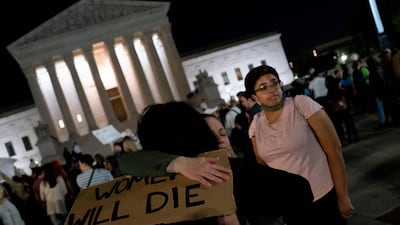
A person holds a sign reading "Women Will Die" as activists gather at the US Supreme Court in Washington, DC. AFP -

An anti-abortion protester speaks outside the US Supreme Court after the leak of a draft majority opinion written by Justice Samuel Alito preparing for the court to overturn the Roe v Wade abortion rights decision later this year. Reuters -
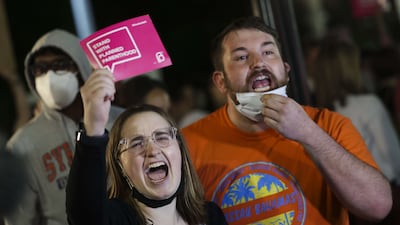
A protester holds a sign for the pro-choice Planned Parenthood organisation. AFP -

The Roe v Wade decision recognised that the right to personal privacy under the US Constitution protects a woman's ability to terminate her pregnancy. Getty Images -
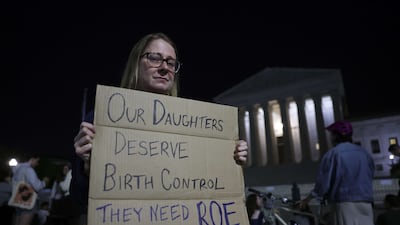
A demonstrator outside the court. AFP -

A woman cries during the protests. AFP -
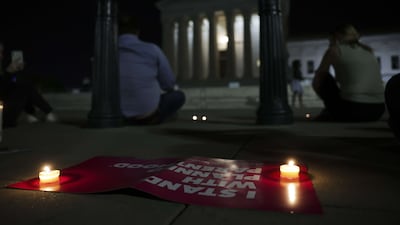
Demonstrators place candles outside the court. AFP -

Protesters chant slogans. Reuters -

Police installed metal barricades to prevent protesters from entering the court building. AFP -

Demonstrators use candlelight during the evening protest. AFP -
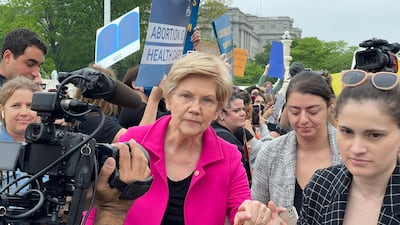
US Senator Elizabeth Warren joined abortion rights activists outside the US Supreme Court on Tuesday. Photo: Public Domain



