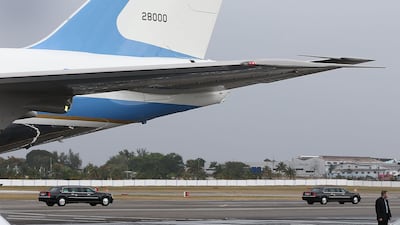
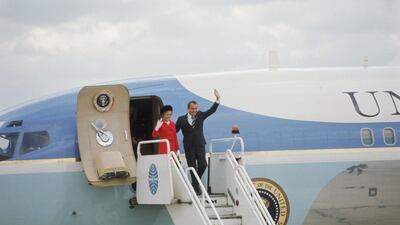
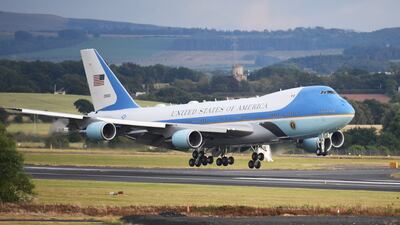
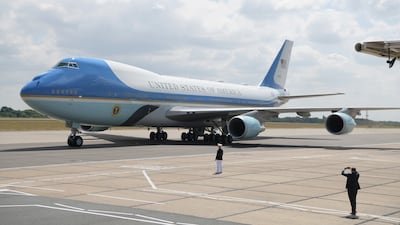
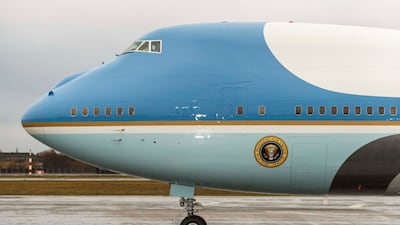
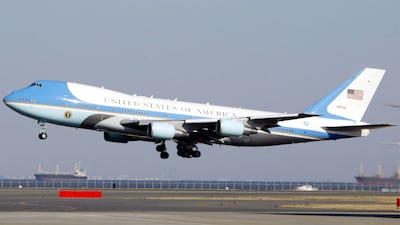
Boeing chief executive Dave Calhoun spoke of his regret at entering into a deal to modify the US presidential jet, Air Force one, which cost the company at least $1 billion in losses.
Mr Calhoun made the remarks during a call with business analysts in which he discussed a series of setbacks for the company, ranging from delays to the forthcoming 777 aircraft and intense scrutiny after two fatal crashes of the 737 Max, which entered service in 2017 but was found to have a catastrophic design flaw, which Boeing has worked to rectify.
“Air Force One I’m just going to call a very unique moment, a very unique negotiation, a very unique set of risks that Boeing probably shouldn’t have taken,’ he said.
In 2018, the aviation giant signed a $3.9 billion contract to replace Air Force One, the technical name for any aircraft carrying the president of the US, but generally used to refer to the presidential Boeing 747.
Under Barack Obama, spiralling costs to keep the aircraft maintained led to a decision to replace the Boeing 747 VC-25 – a military version of the 747 used by the president since the Reagan administration.
Donald Trump called these costs “out of control”, but nonetheless went ahead with the plan to replace the aircraft with new, specially modified Boeing 747-8 planes.
President Trump said at the time he wanted the aircraft to appear “more American looking”, shunning the traditional light blue colour of the presidential plane, which was introduced in the 1960s.
Work began in March 2020 with a significant overhaul of the 747-8’s design, to include a new medical unit, a new presidential lounge and new secure communications technology.
Air Force One suffered from "higher supplier costs, higher costs to finalise technical requirements and schedule delays", Mr Calhoun said.
The highly sophisticated aircraft, known as the “flying White House”, is designed to keep the president and 70 other senior staff and crew safe in any eventuality, including a nuclear attack on the US mainland.

Mohammed bin Zayed Majlis
COMPANY PROFILE
Company name: Blah
Started: 2018
Founder: Aliyah Al Abbar and Hend Al Marri
Based: Dubai
Industry: Technology and talent management
Initial investment: Dh20,000
Investors: Self-funded
Total customers: 40
Key figures in the life of the fort
Sheikh Dhiyab bin Isa (ruled 1761-1793) Built Qasr Al Hosn as a watchtower to guard over the only freshwater well on Abu Dhabi island.
Sheikh Shakhbut bin Dhiyab (ruled 1793-1816) Expanded the tower into a small fort and transferred his ruling place of residence from Liwa Oasis to the fort on the island.
Sheikh Tahnoon bin Shakhbut (ruled 1818-1833) Expanded Qasr Al Hosn further as Abu Dhabi grew from a small village of palm huts to a town of more than 5,000 inhabitants.
Sheikh Khalifa bin Shakhbut (ruled 1833-1845) Repaired and fortified the fort.
Sheikh Saeed bin Tahnoon (ruled 1845-1855) Turned Qasr Al Hosn into a strong two-storied structure.
Sheikh Zayed bin Khalifa (ruled 1855-1909) Expanded Qasr Al Hosn further to reflect the emirate's increasing prominence.
Sheikh Shakhbut bin Sultan (ruled 1928-1966) Renovated and enlarged Qasr Al Hosn, adding a decorative arch and two new villas.
Sheikh Zayed bin Sultan (ruled 1966-2004) Moved the royal residence to Al Manhal palace and kept his diwan at Qasr Al Hosn.
Sources: Jayanti Maitra, www.adach.ae
The%20specs
%3Cp%3E%3Cstrong%3EEngine%3A%20%3C%2Fstrong%3E3.0%20twin-turbo%20inline%20six-cylinder%0D%3Cbr%3E%3Cstrong%3ETransmission%3A%20%3C%2Fstrong%3Eeight-speed%0D%3Cbr%3E%3Cstrong%3EPower%3A%20%3C%2Fstrong%3E503hp%0D%3Cbr%3E%3Cstrong%3ETorque%3A%20%3C%2Fstrong%3E600Nm%0D%3Cbr%3E%3Cstrong%3EPrice%3A%20%3C%2Fstrong%3Efrom%20Dh450%2C000%0D%3Cbr%3E%3Cstrong%3EOn%20sale%3A%20%3C%2Fstrong%3Enow%3C%2Fp%3E%0A
The%20specs
%3Cp%3E%3Cstrong%3EEngine%3A%3C%2Fstrong%3E%201.8-litre%204-cyl%20turbo%0D%3Cbr%3E%3Cstrong%3EPower%3A%20%3C%2Fstrong%3E190hp%20at%205%2C200rpm%0D%3Cbr%3E%3Cstrong%3ETorque%3A%3C%2Fstrong%3E%20320Nm%20from%201%2C800-5%2C000rpm%0D%3Cbr%3E%3Cstrong%3ETransmission%3A%20%3C%2Fstrong%3ESeven-speed%20dual-clutch%20auto%0D%3Cbr%3E%3Cstrong%3EFuel%20consumption%3A%3C%2Fstrong%3E%206.7L%2F100km%0D%3Cbr%3E%3Cstrong%3EPrice%3A%3C%2Fstrong%3E%20From%20Dh111%2C195%0D%3Cbr%3E%3Cstrong%3EOn%20sale%3A%20%3C%2Fstrong%3ENow%3C%2Fp%3E%0A
World Cricket League Division 2
In Windhoek, Namibia - Top two teams qualify for the World Cup Qualifier in Zimbabwe, which starts on March 4.
UAE fixtures
Thursday, February 8 v Kenya; Friday, February 9 v Canada; Sunday, February 11 v Nepal; Monday, February 12 v Oman; Wednesday, February 14 v Namibia; Thursday, February 15 final
Ten tax points to be aware of in 2026
1. Domestic VAT refund amendments: request your refund within five years
If a business does not apply for the refund on time, they lose their credit.
2. E-invoicing in the UAE
Businesses should continue preparing for the implementation of e-invoicing in the UAE, with 2026 a preparation and transition period ahead of phased mandatory adoption.
3. More tax audits
Tax authorities are increasingly using data already available across multiple filings to identify audit risks.
4. More beneficial VAT and excise tax penalty regime
Tax disputes are expected to become more frequent and more structured, with clearer administrative objection and appeal processes. The UAE has adopted a new penalty regime for VAT and excise disputes, which now mirrors the penalty regime for corporate tax.
5. Greater emphasis on statutory audit
There is a greater need for the accuracy of financial statements. The International Financial Reporting Standards standards need to be strictly adhered to and, as a result, the quality of the audits will need to increase.
6. Further transfer pricing enforcement
Transfer pricing enforcement, which refers to the practice of establishing prices for internal transactions between related entities, is expected to broaden in scope. The UAE will shortly open the possibility to negotiate advance pricing agreements, or essentially rulings for transfer pricing purposes.
7. Limited time periods for audits
Recent amendments also introduce a default five-year limitation period for tax audits and assessments, subject to specific statutory exceptions. While the standard audit and assessment period is five years, this may be extended to up to 15 years in cases involving fraud or tax evasion.
8. Pillar 2 implementation
Many multinational groups will begin to feel the practical effect of the Domestic Minimum Top-Up Tax (DMTT), the UAE's implementation of the OECD’s global minimum tax under Pillar 2. While the rules apply for financial years starting on or after January 1, 2025, it is 2026 that marks the transition to an operational phase.
9. Reduced compliance obligations for imported goods and services
Businesses that apply the reverse-charge mechanism for VAT purposes in the UAE may benefit from reduced compliance obligations.
10. Substance and CbC reporting focus
Tax authorities are expected to continue strengthening the enforcement of economic substance and Country-by-Country (CbC) reporting frameworks. In the UAE, these regimes are increasingly being used as risk-assessment tools, providing tax authorities with a comprehensive view of multinational groups’ global footprints and enabling them to assess whether profits are aligned with real economic activity.
Contributed by Thomas Vanhee and Hend Rashwan, Aurifer
Tamkeen's offering
- Option 1: 70% in year 1, 50% in year 2, 30% in year 3
- Option 2: 50% across three years
- Option 3: 30% across five years
The specs: 2018 Chevrolet Trailblazer
Price, base / as tested Dh99,000 / Dh132,000
Engine 3.6L V6
Transmission: Six-speed automatic
Power 275hp @ 6,000rpm
Torque 350Nm @ 3,700rpm
Fuel economy combined 12.2L / 100km
The specs
Engine: 2.0-litre 4cyl turbo
Power: 261hp at 5,500rpm
Torque: 405Nm at 1,750-3,500rpm
Transmission: 9-speed auto
Fuel consumption: 6.9L/100km
On sale: Now
Price: From Dh117,059