


Live updates: follow the latest news on Russia-Ukraine
With an overwhelming force bearing down on them, everyday Ukrainians have taken up arms in defence of their nation, with about 100,000 people joining the Territorial Defence Forces, the National Guard of Ukraine reported.
Many of those volunteering have little to no military experience, with some resorting to Google to learn how to use weapons.
Ward Carroll, a former F-14 Radar Intercept Officer in the US Navy and host of a popular YouTube show that focuses on the military, said civilians can be trained to fight in less than a day and they can help to form a powerful, effective insurgency.
“Let's just call it a resistance or an insurgency of a populace that is educated and motivated,” he said.
“That's a heady brew right there.”
Mr Carroll said volunteers should first learn to build and use Molotov cocktails, incendiary devices that consist of glass bottles and an accelerant (usually petrol), with a rag or cloth acting as a wick.
The home-made device can be devastatingly effective.
“The liquid pours into the cracks and can be fatal and very damaging,” Mr Carroll told The National. “So if you chuck three of those at an armoured personnel carrier or even a tank, you can halt the progress of that vehicle.”
The weapon's name, coined by the Finns during the First Soviet-Finnish War in 1939, is a derogatory reference to former Soviet foreign minister Vyacheslav Molotov.
Ukrainians have been mass producing Molotov cocktails since the war began more than two weeks ago.
In addition to mastering the construction of Molotov cocktails, volunteer fighters must learn how to use firearms.
Mr Carroll said a civilian can learn the basics in only 15 minutes.
-

Newlyweds Maria and David during their wedding ceremony in Oak Park, Illinois. Maria, who asked to be referred to only by her first name over fears for her family's safety, plans to fly to Poland then make her way to the Ukrainian border, ultimately aiming to volunteer to fight for her home country. AP -

Sergey Korenev says goodbye to his two daughters in Portland, Oregon, before travelling to Ukraine to help in the war effort. He has gathered about $50,000 in donated medical aid which he plans to take to Ukraine before joining the fight. Getty Images / AFP -
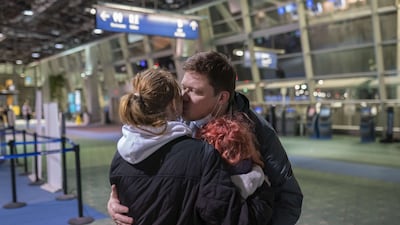
Sergey Korenev says goodbye to his two daughters. Getty Images / AFP -
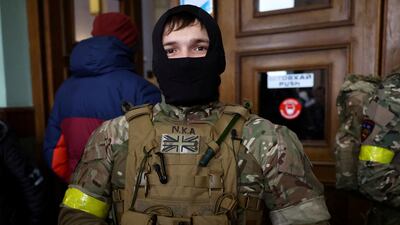
A foreign fighter from the UK prepares to depart to the front line in the east of Ukraine. Reuters -
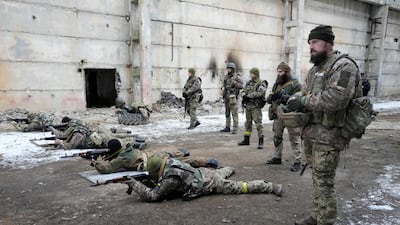
Belarusian volunteers receive military training at the Belarusian Company base in Kyiv, Ukraine. Hundreds of Belarusians have arrived in Ukraine to help the Ukrainian army fight against the Russians. AP -
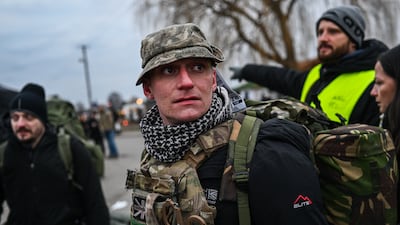
'Alex' from the UK arrives at the Polish-Ukrainian border looking for transport to Lviv to join the fight. Getty Images -
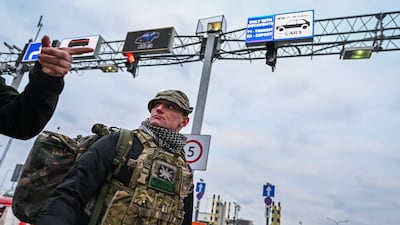
In a report issued by the Ukrainian military, Ukraine's President Voldymyr Zelenskyy appealed to foreigners to join his army in the fight against Russia. Getty Images -
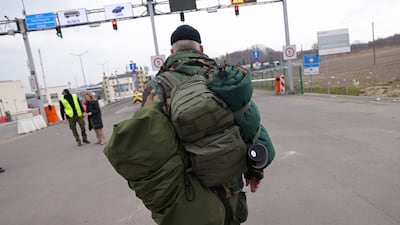
'Ian' from a town near Liverpool in the UK prepares to enter Ukraine from Poland to join the fight against the Russian army. Getty Images


“It's not complicated,” he said. “All the volunteers need to know immediately is how to load, aim and fire a rifle.”
He added the volunteers must also learn how to use their environment to “conceal” themselves from Russian forces.
While the odds may appear to be against them, Mr Carroll said the ad hoc forces have more motivation and better knowledge of the surrounding terrain than the invading Russian forces.
“The war is going to go sort of asymmetric,” he explained.
“If it's a Russian soldier versus a Ukrainian civilian, this is not a pure conflict, and as they get mired in urban areas, the advantage can go to the locals, as we've seen in places like Iraq and Afghanistan.”

