Live updates: follow the latest news on Russia-Ukraine
US Secretary of State Anthony Blinken on Tuesday told the UN’s human rights body that Russian “crimes” were mounting in Ukraine, with strikes claiming civilian lives and devastating homes and public buildings.
“Russian strikes are hitting schools, hospitals and residential buildings,” Mr Blinken said in a video message to the Geneva-based Human Rights Council.
“Reports of Russia's human rights abuses and violations of international humanitarian law mount by the hour.”
His comments were the latest in a chorus of international condemnation of Russia — coupled with biting economic sanctions — over its assault on Ukraine, which Moscow says is aimed at ousting a “Nazi” government from the capital Kiev.
Earlier, more than 100 diplomats from about 40 countries walked out of the UN chamber during a speech by Russian Foreign Minister Sergey Lavrov in protest over the escalating conflict.
Still, President Vladimir Putin is pressing ahead with his assault on Ukraine, where fierce fighting and a Russian bombardment have claimed dozens of lives and forced hundreds of thousands to flee their homes.
An urgent UN Human Rights Council debate on Ukraine is scheduled for Thursday, where a resolution brought by Kiev and its allies would establish an international probe into abuses committed during the advance of Russian forces.
Mr Blinken urged council members to “send a resolute and unified message that President Putin should unconditionally stop this”.
“We must reject Russia's attempts to falsely justify this attack as a defence of human rights — misappropriating terms that we reserve for the worst atrocities and disrespecting every victim of those crimes,” he added.
At UN headquarters in New York, the 193-nation General Assembly was holding a two-day debate on Ukraine, which was expected to lead to a vote on a draft resolution condemning the invasion on Wednesday morning.
Almost 100 UN members have co-sponsored the resolution. The draft document, a copy of which was obtained by The National, condemns Russia’s invasion and its decision to “increase the readiness of its nuclear forces” and calls on Moscow to pull its troops out of Ukraine.
The draft also “deplores the involvement of Belarus in this unlawful use of force against Ukraine and calls on it to abide by its international obligations".
International Criminal Court prosecutor Karim Khan on Monday announced plans to launch an investigation into the Russian assault, saying there was a “reasonable basis” to believe war crimes were being committed.
UN agencies on Tuesday launched an appeal for $1.7 billion appeal to respond to the escalating humanitarian crisis in Ukraine.
At a press conference in Geneva, UN aid chief Martin Griffiths said Russia’s assault on its smaller neighbour had “turned very ugly very fast” and urged donors to give generously.
“Families with small children are hunkered down in basements and subway stations or running for their lives to the terrifying sound of explosions and wailing sirens,” said Mr Griffiths.
“This is the darkest hour for the people of Ukraine. We need to ramp up our response now to protect the lives and dignity of ordinary Ukrainians. We must respond with compassion and solidarity.”
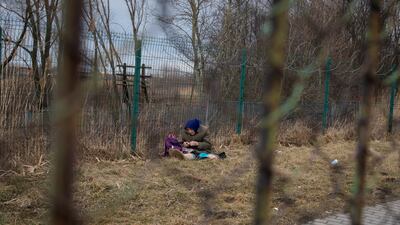
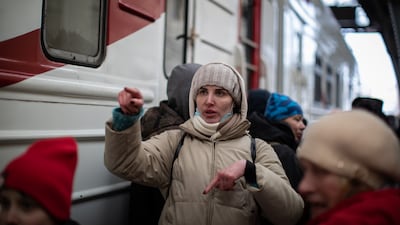
The UNHCR reported that as many as 150,000 people have fled Ukraine in the past 24 hours, bringing the total number of refugees to about 677,000.
SECRET%20INVASION
%3Cp%3E%3Cstrong%3EDirector%3A%3C%2Fstrong%3E%20Ali%20Selim%20%3Cbr%3E%3Cstrong%3EStars%3A%3C%2Fstrong%3E%20Samuel%20L%20Jackson%2C%20Olivia%20Coleman%2C%20Kingsley%20Ben-Adir%2C%20Emilia%20Clarke%20%3Cbr%3E%3Cstrong%3ERating%3A%3C%2Fstrong%3E%203%2F5%26nbsp%3B%3C%2Fp%3E%0A
Moral education needed in a 'rapidly changing world'
Moral education lessons for young people is needed in a rapidly changing world, the head of the programme said.
Alanood Al Kaabi, head of programmes at the Education Affairs Office of the Crown Price Court - Abu Dhabi, said: "The Crown Price Court is fully behind this initiative and have already seen the curriculum succeed in empowering young people and providing them with the necessary tools to succeed in building the future of the nation at all levels.
"Moral education touches on every aspect and subject that children engage in.
"It is not just limited to science or maths but it is involved in all subjects and it is helping children to adapt to integral moral practises.
"The moral education programme has been designed to develop children holistically in a world being rapidly transformed by technology and globalisation."
First Person
Richard Flanagan
Chatto & Windus
Our legal consultant
Name: Hassan Mohsen Elhais
Position: legal consultant with Al Rowaad Advocates and Legal Consultants.
How%20to%20avoid%20getting%20scammed
%3Cul%3E%0A%3Cli%3ENever%20click%20on%20links%20provided%20via%20app%20or%20SMS%2C%20even%20if%20they%20seem%20to%20come%20from%20authorised%20senders%20at%20first%20glance%3C%2Fli%3E%0A%3Cli%3EAlways%20double-check%20the%20authenticity%20of%20websites%3C%2Fli%3E%0A%3Cli%3EEnable%20Two-Factor%20Authentication%20(2FA)%20for%20all%20your%20working%20and%20personal%20services%3C%2Fli%3E%0A%3Cli%3EOnly%20use%20official%20links%20published%20by%20the%20respective%20entity%3C%2Fli%3E%0A%3Cli%3EDouble-check%20the%20web%20addresses%20to%20reduce%20exposure%20to%20fake%20sites%20created%20with%20domain%20names%20containing%20spelling%20errors%3C%2Fli%3E%0A%3C%2Ful%3E%0A
BEETLEJUICE BEETLEJUICE
Starring: Winona Ryder, Michael Keaton, Jenny Ortega
Director: Tim Burton
Rating: 3/5
The biog
Favourite book: You Are the Placebo – Making your mind matter, by Dr Joe Dispenza
Hobby: Running and watching Welsh rugby
Travel destination: Cyprus in the summer
Life goals: To be an aspirational and passionate University educator, enjoy life, be healthy and be the best dad possible.
Ten tax points to be aware of in 2026
1. Domestic VAT refund amendments: request your refund within five years
If a business does not apply for the refund on time, they lose their credit.
2. E-invoicing in the UAE
Businesses should continue preparing for the implementation of e-invoicing in the UAE, with 2026 a preparation and transition period ahead of phased mandatory adoption.
3. More tax audits
Tax authorities are increasingly using data already available across multiple filings to identify audit risks.
4. More beneficial VAT and excise tax penalty regime
Tax disputes are expected to become more frequent and more structured, with clearer administrative objection and appeal processes. The UAE has adopted a new penalty regime for VAT and excise disputes, which now mirrors the penalty regime for corporate tax.
5. Greater emphasis on statutory audit
There is a greater need for the accuracy of financial statements. The International Financial Reporting Standards standards need to be strictly adhered to and, as a result, the quality of the audits will need to increase.
6. Further transfer pricing enforcement
Transfer pricing enforcement, which refers to the practice of establishing prices for internal transactions between related entities, is expected to broaden in scope. The UAE will shortly open the possibility to negotiate advance pricing agreements, or essentially rulings for transfer pricing purposes.
7. Limited time periods for audits
Recent amendments also introduce a default five-year limitation period for tax audits and assessments, subject to specific statutory exceptions. While the standard audit and assessment period is five years, this may be extended to up to 15 years in cases involving fraud or tax evasion.
8. Pillar 2 implementation
Many multinational groups will begin to feel the practical effect of the Domestic Minimum Top-Up Tax (DMTT), the UAE's implementation of the OECD’s global minimum tax under Pillar 2. While the rules apply for financial years starting on or after January 1, 2025, it is 2026 that marks the transition to an operational phase.
9. Reduced compliance obligations for imported goods and services
Businesses that apply the reverse-charge mechanism for VAT purposes in the UAE may benefit from reduced compliance obligations.
10. Substance and CbC reporting focus
Tax authorities are expected to continue strengthening the enforcement of economic substance and Country-by-Country (CbC) reporting frameworks. In the UAE, these regimes are increasingly being used as risk-assessment tools, providing tax authorities with a comprehensive view of multinational groups’ global footprints and enabling them to assess whether profits are aligned with real economic activity.
Contributed by Thomas Vanhee and Hend Rashwan, Aurifer
The specs: 2018 Nissan 370Z Nismo
Price, base / as tested: Dh182,178
Engine: 3.7-litre V6
Power: 350hp @ 7,400rpm
Torque: 374Nm @ 5,200rpm
Transmission: Seven-speed automatic
Fuel consumption, combined: 10.5L / 100km
Mercer, the investment consulting arm of US services company Marsh & McLennan, expects its wealth division to at least double its assets under management (AUM) in the Middle East as wealth in the region continues to grow despite economic headwinds, a company official said.
Mercer Wealth, which globally has $160 billion in AUM, plans to boost its AUM in the region to $2-$3bn in the next 2-3 years from the present $1bn, said Yasir AbuShaban, a Dubai-based principal with Mercer Wealth.
“Within the next two to three years, we are looking at reaching $2 to $3 billion as a conservative estimate and we do see an opportunity to do so,” said Mr AbuShaban.
Mercer does not directly make investments, but allocates clients’ money they have discretion to, to professional asset managers. They also provide advice to clients.
“We have buying power. We can negotiate on their (client’s) behalf with asset managers to provide them lower fees than they otherwise would have to get on their own,” he added.
Mercer Wealth’s clients include sovereign wealth funds, family offices, and insurance companies among others.
From its office in Dubai, Mercer also looks after Africa, India and Turkey, where they also see opportunity for growth.
Wealth creation in Middle East and Africa (MEA) grew 8.5 per cent to $8.1 trillion last year from $7.5tn in 2015, higher than last year’s global average of 6 per cent and the second-highest growth in a region after Asia-Pacific which grew 9.9 per cent, according to consultancy Boston Consulting Group (BCG). In the region, where wealth grew just 1.9 per cent in 2015 compared with 2014, a pickup in oil prices has helped in wealth generation.
BCG is forecasting MEA wealth will rise to $12tn by 2021, growing at an annual average of 8 per cent.
Drivers of wealth generation in the region will be split evenly between new wealth creation and growth of performance of existing assets, according to BCG.
Another general trend in the region is clients’ looking for a comprehensive approach to investing, according to Mr AbuShaban.
“Institutional investors or some of the families are seeing a slowdown in the available capital they have to invest and in that sense they are looking at optimizing the way they manage their portfolios and making sure they are not investing haphazardly and different parts of their investment are working together,” said Mr AbuShaban.
Some clients also have a higher appetite for risk, given the low interest-rate environment that does not provide enough yield for some institutional investors. These clients are keen to invest in illiquid assets, such as private equity and infrastructure.
“What we have seen is a desire for higher returns in what has been a low-return environment specifically in various fixed income or bonds,” he said.
“In this environment, we have seen a de facto increase in the risk that clients are taking in things like illiquid investments, private equity investments, infrastructure and private debt, those kind of investments were higher illiquidity results in incrementally higher returns.”
The Abu Dhabi Investment Authority, one of the largest sovereign wealth funds, said in its 2016 report that has gradually increased its exposure in direct private equity and private credit transactions, mainly in Asian markets and especially in China and India. The authority’s private equity department focused on structured equities owing to “their defensive characteristics.”