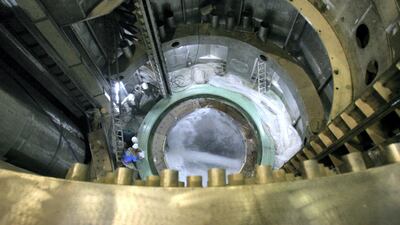
The waiver allows other countries and companies to participate in Iran's civilian nuclear programme without triggering US sanctions on them. EPA

US waives sanctions for Iran civil nuclear programme


  • English
  • Arabic

The US State Department is waiving sanctions on Iran's civilian nuclear programme in a technical step necessary to return to the 2015 nuclear agreement, a senior official said on Friday.

The resumption of the waiver, ended by the Donald Trump administration in 2020, “would be essential to ensuring Iran's swift compliance” if a new deal on controlling Tehran's nuclear programme can be reached in talks in Vienna, the State Department official said.

The waiver allows other countries and companies to participate in Iran's civilian nuclear programme without triggering US sanctions on them, in the name of promoting safety and non-proliferation.

Iran's civilian nuclear programme includes the country's increasing stockpiles of enriched uranium.

“Absent this sanctions waiver, detailed technical discussions with third parties regarding disposition of stockpiles and other activities of non-proliferation value cannot take place,” the official said, insisting on anonymity.

A State Department report to Congress says that restoring the waiver "is designed to facilitate discussions that would help to close a deal on a mutual return to full implementation" of the nuclear deal, according to a copy seen by Reuters.

"It is also designed to serve US non-proliferation and nuclear safety interests and constrain Iran's nuclear activities. It is being issued as a matter of policy discretion with these objectives in mind, and not pursuant to a commitment or as part of a quid pro quo," the report said.

The waiver came as talks to restore the 2015 Joint Comprehensive Plan of Action, or JCPOA, which Mr Trump unilaterally withdrew from in 2018, were at an advanced stage.

US President Joe Biden moved quickly to return to the agreement after he entered office a year ago, but Iran in the meantime has moved increasingly closer to producing enough fissile material for a nuclear weapon.

The Vienna talks, which include Iran, the US, Britain, China, France, Germany and Russia, are at a key stage where the parties have to make “critical political decisions”, a senior US official said last week.

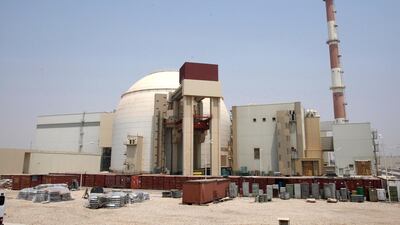
  • Russian contractors work at the Bushehr nuclear reactor site in 2007. The plant opened four years later. Bloomberg
    Russian contractors work at the Bushehr nuclear reactor site in 2007. The plant opened four years later. Bloomberg
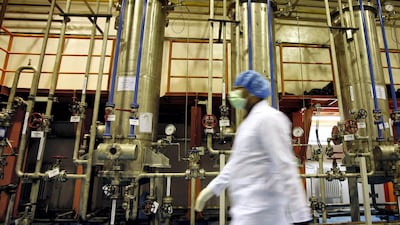
  • An Iranian technician at the International Atomic Energy Agency inspects the country's Isfahan plant in 2007. Tehran is no longer co-operating with the agency at nuclear sites across the country. EPA
    An Iranian technician at the International Atomic Energy Agency inspects the country's Isfahan plant in 2007. Tehran is no longer co-operating with the agency at nuclear sites across the country. EPA
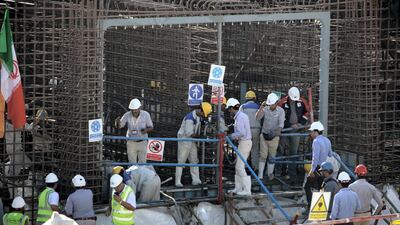
  • Workers wait to begin constructing a second reactor at the Bushehr nuclear power plant in 2019. AFP
    Workers wait to begin constructing a second reactor at the Bushehr nuclear power plant in 2019. AFP
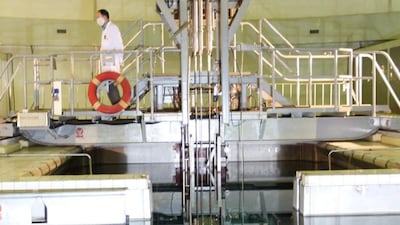
  • A metal-encased rod with 20 per cent enriched nuclear fuel is inserted into a reactor in Tehran in 2012. AFP
    A metal-encased rod with 20 per cent enriched nuclear fuel is inserted into a reactor in Tehran in 2012. AFP
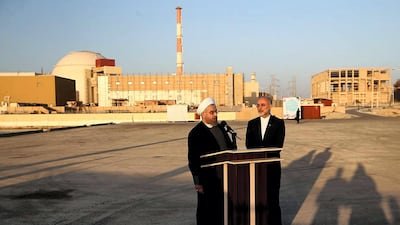
  • Fomer Iranian President Hassan Rouhani and the country's Atomic Energy Organisation chief Ali Akbar Salehi speak at the Bushehr nuclear site in 2015. AFP
    Fomer Iranian President Hassan Rouhani and the country's Atomic Energy Organisation chief Ali Akbar Salehi speak at the Bushehr nuclear site in 2015. AFP
  • Iran's Bushehr nuclear plant has been restarted. EPA
    Iran's Bushehr nuclear plant has been restarted. EPA
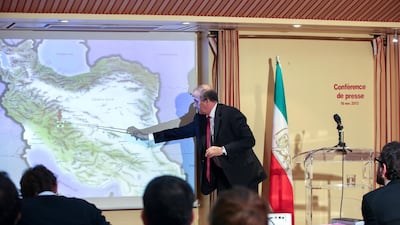
  • Mehdi Abrichamtchi, chairman of the Peace and Security Committee at the National Council of Resistance of Iran, shows journalists the location of a secret nuclear site in Iran in 2013. AFP
    Mehdi Abrichamtchi, chairman of the Peace and Security Committee at the National Council of Resistance of Iran, shows journalists the location of a secret nuclear site in Iran in 2013. AFP
  • Workers prepare to begin the construction of a second reactor at the Bushehr site. AFP
    Workers prepare to begin the construction of a second reactor at the Bushehr site. AFP

“The technical discussions facilitated by the waiver are necessary in the final weeks of JCPOA talks,” the State Department official said.

But even if a final deal is not reached, the official said, the waiver is important to holding discussions on the non-proliferation of nuclear weapons, which is of interest to the entire world.

The official said that the move was not “part of a quid pro quo”, as the partners in the JCPOA talks await Iran's response on key issues.

But the senior administration official, who briefed reporters on the talks last week, said time was running out and urged Tehran to make important decisions.

“I think we're at the point where some of the most critical political decisions have to be made by all sides,” the official said.

The official proposed direct talks between Washington and Tehran to focus on the most difficult issues separating the sides.

“If our goal is to reach an understanding quickly … the optimal way to do that, in any negotiation, is for the parties that have the most at stake to meet directly,” the official said.


Ten tax points to be aware of in 2026

1. Domestic VAT refund amendments: request your refund within five years

If a business does not apply for the refund on time, they lose their credit.

2. E-invoicing in the UAE

Businesses should continue preparing for the implementation of e-invoicing in the UAE, with 2026 a preparation and transition period ahead of phased mandatory adoption. 

3. More tax audits

Tax authorities are increasingly using data already available across multiple filings to identify audit risks. 

4. More beneficial VAT and excise tax penalty regime

Tax disputes are expected to become more frequent and more structured, with clearer administrative objection and appeal processes. The UAE has adopted a new penalty regime for VAT and excise disputes, which now mirrors the penalty regime for corporate tax.

5. Greater emphasis on statutory audit

There is a greater need for the accuracy of financial statements. The International Financial Reporting Standards standards need to be strictly adhered to and, as a result, the quality of the audits will need to increase.

6. Further transfer pricing enforcement

Transfer pricing enforcement, which refers to the practice of establishing prices for internal transactions between related entities, is expected to broaden in scope. The UAE will shortly open the possibility to negotiate advance pricing agreements, or essentially rulings for transfer pricing purposes. 

7. Limited time periods for audits

Recent amendments also introduce a default five-year limitation period for tax audits and assessments, subject to specific statutory exceptions. While the standard audit and assessment period is five years, this may be extended to up to 15 years in cases involving fraud or tax evasion. 

8. Pillar 2 implementation 

Many multinational groups will begin to feel the practical effect of the Domestic Minimum Top-Up Tax (DMTT), the UAE's implementation of the OECD’s global minimum tax under Pillar 2. While the rules apply for financial years starting on or after January 1, 2025, it is 2026 that marks the transition to an operational phase.

9. Reduced compliance obligations for imported goods and services

Businesses that apply the reverse-charge mechanism for VAT purposes in the UAE may benefit from reduced compliance obligations. 

10. Substance and CbC reporting focus

Tax authorities are expected to continue strengthening the enforcement of economic substance and Country-by-Country (CbC) reporting frameworks. In the UAE, these regimes are increasingly being used as risk-assessment tools, providing tax authorities with a comprehensive view of multinational groups’ global footprints and enabling them to assess whether profits are aligned with real economic activity. 

Contributed by Thomas Vanhee and Hend Rashwan, Aurifer

Updated: June 20, 2023, 10:56 AM