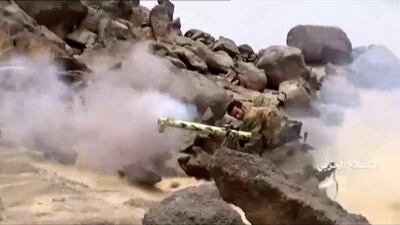
The new commander of the Iranian Revolutionary Guards Corps is struggling to exert control over Tehran's proxies, a top US general said on Thursday, giving warning that it was only a matter of time before an Iran-backed militia kills Americans in Iraq.
Esmail Qaani took over as head of the IRGC's elite Quds Force following the US assassination of his predecessor Qassem Suleimani in 2020, but he “does not exercise the same degree of control over Iranian-aligned militia groups”, Gen Frank McKenzie, head of the US military's Central Command, told the Middle East Institute.
This is increasingly the case in places like Iraq, where Gen McKenzie argued Iran could be dragged into a wider confrontation with the US as Tehran-backed militias carry out attacks on US forces.
“Tehran is well aware of our red lines [in Iraq], yet the evidence is also clear that many of these militia groups are trying in earnest to kill Americans with these attacks. Sooner or later, it’s almost inevitable that they will succeed, and Iran will provoke precisely what it seeks to avoid,” he said.
He called Iran a “main threat” and noted that the regime relies “on proxies to do its dirty work, by funnelling them arms and other resources".
The war in Yemen has dragged on for more than seven years largely because of Iran's support of the Houthi rebels, he added.
“As we have recently seen with their complex attacks on the UAE, not to mention their persistent campaign against the Kingdom of Saudi Arabia, the Houthis are less interested than Iran in waging a limited war,” he said.
“Rather, they will recklessly use whatever capabilities that Iran puts in their hands in pursuit of victory, regardless of the risk to human life.”
The US commander accused the Houthis and Iran of “using the population of the southern Arabian peninsula as human lab rats and in the Yemeni civil war as an inhuman experiment in modern war".
He listed ballistic missiles, land-attack cruise missiles and unmanned aerial vehicles as some of the weaponry that Iran provides to the Houthis.
The four-star general urged an integrated, regional strategy that includes Israel to counter the threat.
“Centcom is prepared for all contingencies,” he said, and added that Iran is weighing various moves including “everything from de-escalation and diplomatic normalisation to ramping up attacks against coalition forces".
While arguing that de-escalation and normalisation serve Iran best, Gen McKenzie expressed doubt Tehran would take such a path.
“Tehran has an established habit, ordering a little bit of everything on the menu, including incompatible courses that should never be paired,” the general said.

What is graphene?
Graphene is a single layer of carbon atoms arranged like honeycomb.
It was discovered in 2004, when Russian-born Manchester scientists Andrei Geim and Kostya Novoselov were "playing about" with sticky tape and graphite - the material used as "lead" in pencils.
Placing the tape on the graphite and peeling it, they managed to rip off thin flakes of carbon. In the beginning they got flakes consisting of many layers of graphene. But as they repeated the process many times, the flakes got thinner.
By separating the graphite fragments repeatedly, they managed to create flakes that were just one atom thick. Their experiment had led to graphene being isolated for the very first time.
At the time, many believed it was impossible for such thin crystalline materials to be stable. But examined under a microscope, the material remained stable, and when tested was found to have incredible properties.
It is many times times stronger than steel, yet incredibly lightweight and flexible. It is electrically and thermally conductive but also transparent. The world's first 2D material, it is one million times thinner than the diameter of a single human hair.
But the 'sticky tape' method would not work on an industrial scale. Since then, scientists have been working on manufacturing graphene, to make use of its incredible properties.
In 2010, Geim and Novoselov were awarded the Nobel Prize for Physics. Their discovery meant physicists could study a new class of two-dimensional materials with unique properties.
GOODBYE%20JULIA
%3Cp%3E%3Cstrong%3EDirector%3A%20%3C%2Fstrong%3EMohamed%20Kordofani%3C%2Fp%3E%0A%3Cp%3E%3Cstrong%3EStarring%3A%20%3C%2Fstrong%3ESiran%20Riak%2C%20Eiman%20Yousif%2C%20Nazar%20Goma%3C%2Fp%3E%0A%3Cp%3E%3Cstrong%3ERating%3A%3C%2Fstrong%3E%205%2F5%3C%2Fp%3E%0A
GROUPS
Group Gustavo Kuerten
Novak Djokovic (x1)
Alexander Zverev (x3)
Marin Cilic (x5)
John Isner (x8)
Group Lleyton Hewitt
Roger Federer (x2)
Kevin Anderson (x4)
Dominic Thiem (x6)
Kei Nishikori (x7)
RACECARD%20
%3Cp%3E%0D%3Cstrong%3E9pm%3C%2Fstrong%3E%20Maiden%20(PA)%20Dh70%2C000%20(Dirt)%202%2C000m%0D%3Cbr%3E%3Cstrong%3E9.30pm%3C%2Fstrong%3E%20Handicap%20(TB)%20Dh70%2C000%20(D)%202%2C000m%0D%3Cbr%3E%3Cstrong%3E10pm%3C%2Fstrong%3E%20Al%20Ain%20Cup%20%E2%80%93%20Prestige%20(PA)%20Dh100%2C000%20(D)%202%2C000m%0D%3Cbr%3E%3Cstrong%3E10.30pm%3C%2Fstrong%3E%20Maiden%20(PA)%20Dh70%2C000%20(D)%201%2C800m%0D%3Cbr%3E%3Cstrong%3E11pm%20%3C%2Fstrong%3EWathba%20Stallions%20Cup%20%E2%80%93%20Handicap%20(PA)%20Dh70%2C000%20(D)%201%2C600m%0D%3Cbr%3E%3Cstrong%3E11.30pm%3C%2Fstrong%3E%20Maiden%20(PA)%20Dh70%2C000%20(D)%201%2C400m%0D%3Cbr%3E%3Cstrong%3E12am%3C%2Fstrong%3E%20Maiden%20(PA)%20Dh70%2C000%20(D)%201%2C400m%3C%2Fp%3E%0A
AIDA%20RETURNS
%3Cp%3E%3Cstrong%3EDirector%3A%20%3C%2Fstrong%3ECarol%20Mansour%3C%2Fp%3E%0A%3Cp%3E%3Cstrong%3EStarring%3A%20%3C%2Fstrong%3EAida%20Abboud%2C%20Carol%20Mansour%3C%2Fp%3E%0A%3Cp%3E%3Cstrong%3ERating%3A%3C%2Fstrong%3E%203.5.%2F5%3C%2Fp%3E%0A
%20Ramez%20Gab%20Min%20El%20Akher
%3Cp%3E%3Cstrong%3ECreator%3A%3C%2Fstrong%3E%20Ramez%20Galal%3C%2Fp%3E%0A%3Cp%3E%3Cstrong%3EStarring%3A%3C%2Fstrong%3E%20Ramez%20Galal%3C%2Fp%3E%0A%3Cp%3E%3Cstrong%3EStreaming%20on%3A%20%3C%2Fstrong%3EMBC%20Shahid%3C%2Fp%3E%0A%3Cp%3E%3Cstrong%3ERating%3A%20%3C%2Fstrong%3E2.5%2F5%3C%2Fp%3E%0A
Key changes
Commission caps
For life insurance products with a savings component, Peter Hodgins of Clyde & Co said different caps apply to the saving and protection elements:
• For the saving component, a cap of 4.5 per cent of the annualised premium per year (which may not exceed 90 per cent of the annualised premium over the policy term).
• On the protection component, there is a cap of 10 per cent of the annualised premium per year (which may not exceed 160 per cent of the annualised premium over the policy term).
• Indemnity commission, the amount of commission that can be advanced to a product salesperson, can be 50 per cent of the annualised premium for the first year or 50 per cent of the total commissions on the policy calculated.
• The remaining commission after deduction of the indemnity commission is paid equally over the premium payment term.
• For pure protection products, which only offer a life insurance component, the maximum commission will be 10 per cent of the annualised premium multiplied by the length of the policy in years.
Disclosure
Customers must now be provided with a full illustration of the product they are buying to ensure they understand the potential returns on savings products as well as the effects of any charges. There is also a “free-look” period of 30 days, where insurers must provide a full refund if the buyer wishes to cancel the policy.
“The illustration should provide for at least two scenarios to illustrate the performance of the product,” said Mr Hodgins. “All illustrations are required to be signed by the customer.”
Another illustration must outline surrender charges to ensure they understand the costs of exiting a fixed-term product early.
Illustrations must also be kept updatedand insurers must provide information on the top five investment funds available annually, including at least five years' performance data.
“This may be segregated based on the risk appetite of the customer (in which case, the top five funds for each segment must be provided),” said Mr Hodgins.
Product providers must also disclose the ratio of protection benefit to savings benefits. If a protection benefit ratio is less than 10 per cent "the product must carry a warning stating that it has limited or no protection benefit" Mr Hodgins added.
COMPANY%20PROFILE%20
%3Cp%3E%3Cstrong%3ECompany%20name%3A%20%3C%2Fstrong%3ENomad%20Homes%3Cbr%3E%3Cstrong%3EStarted%3A%20%3C%2Fstrong%3E2020%3Cbr%3E%3Cstrong%3EFounders%3A%20%3C%2Fstrong%3EHelen%20Chen%2C%20Damien%20Drap%2C%20and%20Dan%20Piehler%3Cbr%3E%3Cstrong%3EBased%3A%3C%2Fstrong%3E%20UAE%20and%20Europe%3Cbr%3E%3Cstrong%3EIndustry%3C%2Fstrong%3E%3A%20PropTech%3Cbr%3E%3Cstrong%3EFunds%20raised%20so%20far%3A%3C%2Fstrong%3E%20%2444m%3Cbr%3E%3Cstrong%3EInvestors%3A%3C%2Fstrong%3E%20Acrew%20Capital%2C%2001%20Advisors%2C%20HighSage%20Ventures%2C%20Abstract%20Ventures%2C%20Partech%2C%20Precursor%20Ventures%2C%20Potluck%20Ventures%2C%20Knollwood%20and%20several%20undisclosed%20hedge%20funds%3C%2Fp%3E%0A
The specs
Engine: 6.2-litre V8
Transmission: seven-speed auto
Power: 420 bhp
Torque: 624Nm
Price: from Dh293,200
On sale: now