Former President of Afghanistan Ashraf Ghani meets US President Joe Biden in Washington in June 2021, a few months before Afghanistan fell to the Taliban. AFP

Biden’s first year adds progressive shakeups to centrist foreign policy agenda


Bryant Harris
  • English
  • Arabic

US President Joe Biden ran his 2020 election campaign as the unabashedly centrist candidate in a field dominated by Democratic primary opponents making broad appeals to the left and a Republican general election opponent leaning further and further to the right.

Throughout his first year in office, Mr Biden has kept most of his foreign policy agenda in line with the traditional centrist ethos that has long dominated much of Washington’s Democratic foreign policy establishment.

Still, he has made some slight adjustments — coupled with one major overhaul in Afghanistan — to his centrist agenda with initiatives favoured by progressive foreign policy advocacy groups that had gained increasing clout among Democrats in Congress under former president Donald Trump.

“Biden has been an interesting mix,” said Greg Treverton, an international relations scholar at the University of Southern California and former chairman of the National Intelligence council.

“On balance, with a couple of exceptions like Afghanistan, I think he’s been a fairly traditional centrist Democrat on foreign policy.”

The notable exception to Mr Biden’s centrist track record was the US withdrawal from Afghanistan, a move lobbied for by an alliance of both progressive and conservative advocacy organisations that occurred despite warnings from the congressionally mandated Afghanistan Study Group.

Mr Biden had opposed US troop surges in Afghanistan under the Obama administration and had pledged to withdraw US combat troops from the country while campaigning for the presidency.

“He long wanted to get out of Afghanistan, however badly that got executed,” said Mr Treverton. “And I still think on balance, it was the right thing to do, but it would have been nice to do it a little more gracefully.”

A Harvard CAPS-Harris Poll from September found that 58 per cent of American voters approved of withdrawing from Afghanistan, even as 59 per cent disapproved of the way Mr Biden did it.

Trita Parsi, executive vice president at the Quincy Institute for Responsible Statecraft, noted that large parts of both the Democratic and Republican electoral bases supported withdrawing from Afghanistan despite widespread resistance to the move among Washington foreign policymakers.

“It’s more whether Biden has pursued the status quo, pro-blob foreign policy or if he has deviated from it,” said Mr Parsi. “I can’t point to a lot of things besides Afghanistan or the early policy on Yemen to indicate that we’re going to shift away from the blob.”

“Blob”, in reference to Washington’s foreign policy establishment, is a concept first coined by Mr Obama’s then-foreign policy adviser Ben Rhodes in response to critiques over the former president’s policies in places such as Iran and Syria.

Upon taking office, Mr Biden announced the end of offensive American support to the Saudi-led coalition fighting the Houthis in Yemen and revoked Mr Trump’s last-minute designation of the group as a terrorist organisation — an action that had blocked the delivery of US humanitarian aid to areas in Yemen controlled by the Iran-backed rebels.

But the Biden administration has approved a $650 million arms sale to replenish Saudi Arabia's stock of air-to-air missiles depleted by countering Houthi drone attacks and a separate $500m deal to service and maintain attack helicopters that the kingdom already has in its possession.

“Saudi policy, certainly early on, was absolutely a nod to the progressives and their desires to castigate Saudi Arabia,” said Jonathan Schanzer, senior vice president at the Foundation for Defence of Democracies.

Still, Mr Schanzer called Mr Biden’s foreign policy “a mixed bag” between the centrist and leftist forces within the Democratic party and framed it as to “an attempt to hearken back to Obama administration policies, which are left but not hard left".

“A prime example of that would be the Gaza war in May of last year,” he said. “For the first nine days, there was a sense that Biden was hewing to that centrist Democrat pro-Israel perspective to let Israel take care of its own business.”

However, Mr Schanzer noted that “the president began to issue harsher statements with regard to Israel” and “specifically to then-prime minister [Benjamin] Netanyahu” before an Egyptian-brokered ceasefire took effect.

At the same time, Mr Biden has resisted growing calls within his party to restrict military aid to Israel and has endorsed a $1 billion increase in Iron Dome missile defence funding for the close US ally.

Nonetheless, an August poll from the Chicago Council survey found that only 22 per cent of Democrats view Israel as an ally while 62 per cent of the party’s voters support restrictions on US military aid to the country.

Iraq and Syria mark another area where Mr Biden has resisted domestic calls to scale back the US military presence in the Middle East.

Mr Biden said during the Democratic primary that it would be a “mistake to pull out the small number of troops” in Syria and Iraq, citing ISIS as a concern.

In addition to maintaining the 2,500 US troops in Iraq and 900 soldiers in Syria, Mr Biden has also launched air strikes against Iran-backed militias in each country after attacks on American forces.

“Pulling out of Iraq would not have led to the chaos of Afghanistan, would not have led to the falling of the Baghdad government, would not have led to people falling [off] planes on to the tarmac,” said Mr Parsi. “In Syria, we don’t even have an authorisation there.”

While Mr Biden has lined up behind Democratic efforts in Congress to revoke the 2002 authorisation that allowed for the invasion of Iraq — a repeal that would not affect the current US force posture there — his White House has balked at efforts to repeal the 2001 authorisation that serves as the basis for American counter-terrorism operations across the globe.

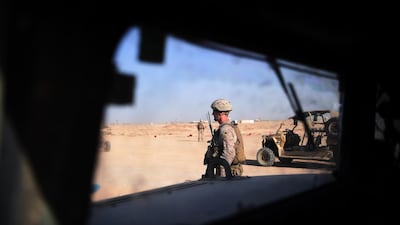
  • US Marines keep watch as unseen Afghan National Army soldiers participate in an IED (improvised explosive device) training exercise at the Shorab Military Camp in 2017. AFP
    US Marines keep watch as unseen Afghan National Army soldiers participate in an IED (improvised explosive device) training exercise at the Shorab Military Camp in 2017. AFP
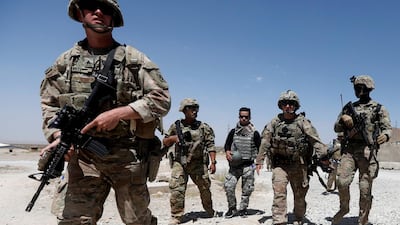
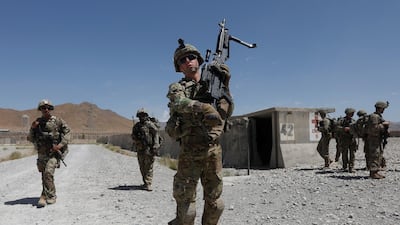
  • US troops patrol at an Afghan army Base in Logar province on August 7, 2018. Reuters
    US troops patrol at an Afghan army Base in Logar province on August 7, 2018. Reuters
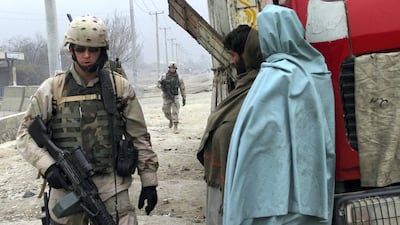
  • US soldiers patrol a street in central Kabul December 11, 2004. Reuters
    US soldiers patrol a street in central Kabul December 11, 2004. Reuters
  • US troops under Afghanistan's International Security Assistance Force, and Afghan National Army soldiers conduct a joint security patrol in the centre of Kandalay village. AFP
    US troops under Afghanistan's International Security Assistance Force, and Afghan National Army soldiers conduct a joint security patrol in the centre of Kandalay village. AFP
  • US troops patrol at an Afghan National Army (ANA) base in Logar province, Afghanistan in 2018. Reuters
    US troops patrol at an Afghan National Army (ANA) base in Logar province, Afghanistan in 2018. Reuters
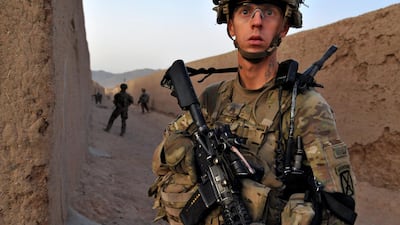
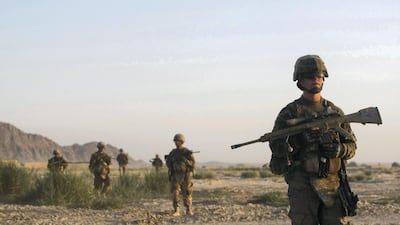
  • US Army soldiers patrol in the village of Chariagen in the Panjwai district of Kandahar province southern Afghanistan in 2011. Reuters
    US Army soldiers patrol in the village of Chariagen in the Panjwai district of Kandahar province southern Afghanistan in 2011. Reuters
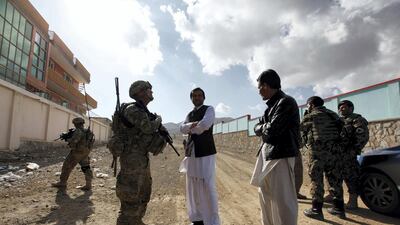
  • Afghan residents chat with US. Army Lieutenant Steven Gibbs as he patrols with his platoon in Pul-e Alam, a town in Logar province, eastern Afghanistan in 2011. Reuters
    Afghan residents chat with US. Army Lieutenant Steven Gibbs as he patrols with his platoon in Pul-e Alam, a town in Logar province, eastern Afghanistan in 2011. Reuters
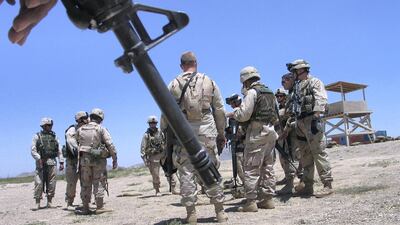
  • US soldiers gather during an exercise at the Kandahar airbase in Afghanistan in 2005. Reuters
    US soldiers gather during an exercise at the Kandahar airbase in Afghanistan in 2005. Reuters
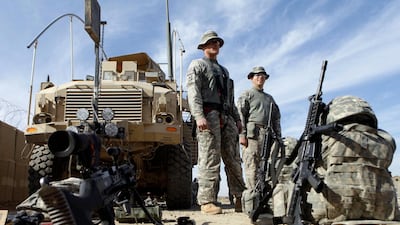
  • U.S. Army soldiers with 1st Brigade, 1st Cavalry Division stand near their armored vehicles before they start their journey home at Contingency Operating Site Kalsu, south of Baghdad, Iraq. AP
    U.S. Army soldiers with 1st Brigade, 1st Cavalry Division stand near their armored vehicles before they start their journey home at Contingency Operating Site Kalsu, south of Baghdad, Iraq. AP
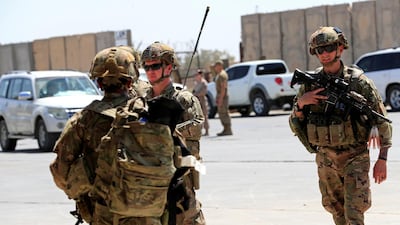
  • A handout photo made available by the US Marine Corps shows US Marines inside the perimeter of Al Asad Air Base in Iraq. EPA
    A handout photo made available by the US Marine Corps shows US Marines inside the perimeter of Al Asad Air Base in Iraq. EPA
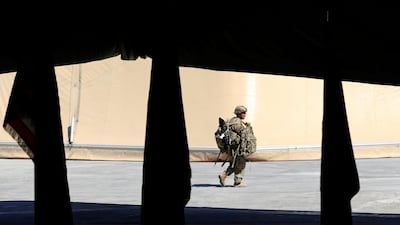
  • A US soldier is seen during a handover ceremony of Taji military base from US-led coalition troops to Iraqi security forces, in the base north of Baghdad, Iraq August 23, 2020. Reuters
    A US soldier is seen during a handover ceremony of Taji military base from US-led coalition troops to Iraqi security forces, in the base north of Baghdad, Iraq August 23, 2020. Reuters
  • US soldiers have been in Iraq for nearly two decades. AFP
    US soldiers have been in Iraq for nearly two decades. AFP
  • US soldiers are seen during a handover ceremony of Taji military base from US-led coalition troops to Iraqi security forces, in the base north of Baghdad, Iraq on August 23, 2020. Reuters
    US soldiers are seen during a handover ceremony of Taji military base from US-led coalition troops to Iraqi security forces, in the base north of Baghdad, Iraq on August 23, 2020. Reuters

The Biden administration has cited the authorisation as the legal rationale to maintain US troops in Syria as well as continue counter-terrorism operations throughout the Middle East, Africa and Asia.

“He’s snakebitten after Afghanistan,” said Mr Schanzer.

“It’s very hard to do that again in another place and precipitate a collapse of the US-led order after having already done it.

“I think a lesson must have been learnt, and at a minimum, it’s probably prompting the White House to take a beat, if not longer, before considering something like that again.”


HAJJAN
%3Cp%3EDirector%3A%20Abu%20Bakr%20Shawky%C2%A0%3C%2Fp%3E%0A%3Cp%3E%3Cbr%3EStarring%3A%20Omar%20Alatawi%2C%20Tulin%20Essam%2C%20Ibrahim%20Al-Hasawi%C2%A0%3C%2Fp%3E%0A%3Cp%3E%3Cbr%3ERating%3A%204%2F5%3C%2Fp%3E%0A
The specs

Engine: 3.9-litre twin-turbo V8

Transmission: seven-speed

Power: 620bhp

Torque: 760Nm

Price: Dh898,000

On sale: now

Libya's Gold

UN Panel of Experts found regime secretly sold a fifth of the country's gold reserves. 

The panel’s 2017 report followed a trail to West Africa where large sums of cash and gold were hidden by Abdullah Al Senussi, Qaddafi’s former intelligence chief, in 2011.

Cases filled with cash that was said to amount to $560m in 100 dollar notes, that was kept by a group of Libyans in Ouagadougou, Burkina Faso.

A second stash was said to have been held in Accra, Ghana, inside boxes at the local offices of an international human rights organisation based in France.

How much do leading UAE’s UK curriculum schools charge for Year 6?
  1. Nord Anglia International School (Dubai) – Dh85,032
  2. Kings School Al Barsha (Dubai) – Dh71,905
  3. Brighton College Abu Dhabi - Dh68,560
  4. Jumeirah English Speaking School (Dubai) – Dh59,728
  5. Gems Wellington International School – Dubai Branch – Dh58,488
  6. The British School Al Khubairat (Abu Dhabi) - Dh54,170
  7. Dubai English Speaking School – Dh51,269

*Annual tuition fees covering the 2024/2025 academic year

Who's who in Yemen conflict

Houthis: Iran-backed rebels who occupy Sanaa and run unrecognised government

Yemeni government: Exiled government in Aden led by eight-member Presidential Leadership Council

Southern Transitional Council: Faction in Yemeni government that seeks autonomy for the south

Habrish 'rebels': Tribal-backed forces feuding with STC over control of oil in government territory

SPEC SHEET

Display: 10.4-inch IPS LCD, 400 nits, toughened glass

CPU: Unisoc T610; Mali G52 GPU

Memory: 4GB

Storage: 64GB, up to 512GB microSD

Camera: 8MP rear, 5MP front

Connectivity: Wi-Fi, Bluetooth 5.0, USB-C, 3.5mm audio

Battery: 8200mAh, up to 10 hours video

Platform: Android 11

Audio: Stereo speakers, 2 mics

Durability: IP52

Biometrics: Face unlock

Price: Dh849

Mercer, the investment consulting arm of US services company Marsh & McLennan, expects its wealth division to at least double its assets under management (AUM) in the Middle East as wealth in the region continues to grow despite economic headwinds, a company official said.

Mercer Wealth, which globally has $160 billion in AUM, plans to boost its AUM in the region to $2-$3bn in the next 2-3 years from the present $1bn, said Yasir AbuShaban, a Dubai-based principal with Mercer Wealth.

Within the next two to three years, we are looking at reaching $2 to $3 billion as a conservative estimate and we do see an opportunity to do so,” said Mr AbuShaban.

Mercer does not directly make investments, but allocates clients’ money they have discretion to, to professional asset managers. They also provide advice to clients.

“We have buying power. We can negotiate on their (client’s) behalf with asset managers to provide them lower fees than they otherwise would have to get on their own,” he added.

Mercer Wealth’s clients include sovereign wealth funds, family offices, and insurance companies among others.

From its office in Dubai, Mercer also looks after Africa, India and Turkey, where they also see opportunity for growth.

Wealth creation in Middle East and Africa (MEA) grew 8.5 per cent to $8.1 trillion last year from $7.5tn in 2015, higher than last year’s global average of 6 per cent and the second-highest growth in a region after Asia-Pacific which grew 9.9 per cent, according to consultancy Boston Consulting Group (BCG). In the region, where wealth grew just 1.9 per cent in 2015 compared with 2014, a pickup in oil prices has helped in wealth generation.

BCG is forecasting MEA wealth will rise to $12tn by 2021, growing at an annual average of 8 per cent.

Drivers of wealth generation in the region will be split evenly between new wealth creation and growth of performance of existing assets, according to BCG.

Another general trend in the region is clients’ looking for a comprehensive approach to investing, according to Mr AbuShaban.

“Institutional investors or some of the families are seeing a slowdown in the available capital they have to invest and in that sense they are looking at optimizing the way they manage their portfolios and making sure they are not investing haphazardly and different parts of their investment are working together,” said Mr AbuShaban.

Some clients also have a higher appetite for risk, given the low interest-rate environment that does not provide enough yield for some institutional investors. These clients are keen to invest in illiquid assets, such as private equity and infrastructure.

“What we have seen is a desire for higher returns in what has been a low-return environment specifically in various fixed income or bonds,” he said.

“In this environment, we have seen a de facto increase in the risk that clients are taking in things like illiquid investments, private equity investments, infrastructure and private debt, those kind of investments were higher illiquidity results in incrementally higher returns.”

The Abu Dhabi Investment Authority, one of the largest sovereign wealth funds, said in its 2016 report that has gradually increased its exposure in direct private equity and private credit transactions, mainly in Asian markets and especially in China and India. The authority’s private equity department focused on structured equities owing to “their defensive characteristics.”

2019 ASIA CUP POTS

Pot 1
UAE, Iran, Australia, Japan, South Korea, Saudi Arabia

Pot 2
China, Syria, Uzbekistan, Iraq, Qatar, Thailand

Pot 3
Kyrgyzstan, Lebanon, Palestine, Oman, India, Vietnam

Pot 4
North Korea, Philippines, Bahrain, Jordan, Yemen, Turkmenistan

Who is Allegra Stratton?


  • Previously worked at The Guardian, BBC’s Newsnight programme and ITV News
  • Took up a public relations role for Chancellor Rishi Sunak in April 2020
  • In October 2020 she was hired to lead No 10’s planned daily televised press briefings
  • The idea was later scrapped and she was appointed spokeswoman for Cop26
  • Ms Stratton, 41, is married to James Forsyth, the political editor of The Spectator
  • She has strong connections to the Conservative establishment
  • Mr Sunak served as best man at her 2011 wedding to Mr Forsyth
Updated: January 20, 2022, 7:25 PM