

By his own account, Michael Lehnert was good at what he did. Perhaps, he wonders now, a bit too good.
In January 2002, shortly after the US-led invasion of Afghanistan, Mr Lehnert received orders to construct 100 prison cells on the US Naval Base in Guantanamo Bay, Cuba.
A US Marine Corps brigadier general at the time, he and a small contingent of his troops needed just 87 hours to build the wire cages that would eventually house many of America’s most-wanted suspects in its new war on terror.
“I would be hopeful that if we would have taken a little longer to get it set up, there may have been a bit more of a thoughtful policy developed in Washington DC,” Mr Lehnert, who retired a major general in 2009, told The National from his farm in Michigan.
Mr Lehnert's team picked a location called Camp X-Ray.
It was out of the way and had been used in the mid-1990s to house Cuban and Haitian refugees. The area, which Mr Lehnert already knew well thanks to previous work with Haitians and Cubans, had concrete slabs and access to electricity and water, the basics needed for what was supposed to be a temporary prison.
Twenty years later, he’s calling for President Joe Biden administration's to close what has become perhaps the world's most notorious detention centre.
“They gave me 96 hours to open it, let's give them 96 days to close it,” Mr Lehnert said.
He believes the Biden administration needs to appoint a person who has enough Washington “wasta” -- or clout -- to get the job done and whose sole function in the White House is to see the prison closed.
“You need to give it to somebody and say, 'If you don't get it done, you're finished,'” he explained.
President Barack Obama tried and failed to close the prison throughout his two terms. He issued an executive order calling for the prison’s closure on his third day in office. But after eight years of Republican obstruction, any hopes of closing the facility were dashed.
Mr Biden has also pledged to close the jail, but has so far taken few meaningful steps -- and has few options in the face of steadfast Republican opposition.
Mr Lehnert is under no illusions that the prison would have been built regardless of how he carried out his duties.
At the time, the US was reeling from the September 11, 2001 terror attacks that killed nearly 3,000 Americans. The war on terror was picking up and the the US found itself with hundreds of terror suspects, mostly snatched from Afghanistan, and nowhere to put them.
The George W Bush administration picked Guantanamo Bay because it was not technically in the US and therefore the detainees were not subject to rights afforded under the US Constitution.
What came next shocked the world.
From the very beginning, the prison has been mired by allegations of abuse and torture. Mr Lehnert’s tour in Guantanamo lasted three months, long enough for him to begin to feel deeply uncomfortable with what was happening.

Mr Lehnert said the evidentiary material that arrived with the first wave of detainees was pretty thin. In addition, he said many of the detainees were in bad health.
“We had a number of people that were sent to us largely because of their medical condition," he recalled.
When a team of investigators from the International Committee of the Red Cross came on base to interview the detainees, Mr Lehnert said they immediately started seeing problems.
"The ICRC started coming back to me and saying, 'you know, some of these guys may have been just in the wrong place at the wrong time, and others were clearly low-level,'" he said.
In the 20 years since his mission in Guantanamo ended, problems at the prison and the accompanying military justice court have snowballed. Several of the inmates are now being treated for geriatric conditions and the chances of them ever being released seem remote.
The initial wire cages his team constructed, long abandoned and now covered in thick weeds, have been replaced by a brick-and-mortar maximum security prison complex.
Making sure Mr Biden follows through on his pledge to close Guantanamo is personal for Mr Lehnert.
“I think we got it wrong as America, and because I was involved with it, I feel a personal responsibility to call for its closure."
-
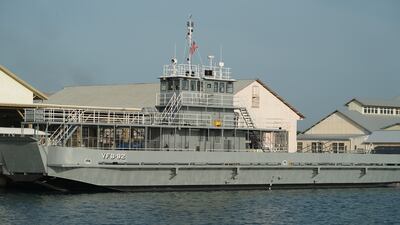
A passenger barge docked at US Naval Station Guantanamo Bay, on the south-east coast of Cuba. All photos: Willy Lowry / The National -
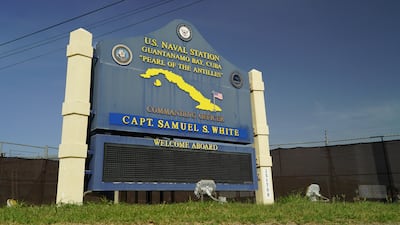
A welcome sign at US Naval Station Guantanamo Bay. -
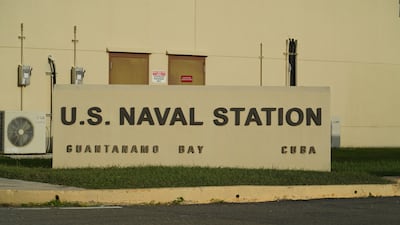
A US Naval Station sign at Guantanamo Bay. -
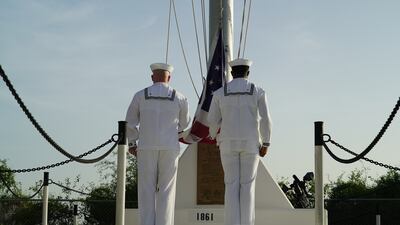
Two US Navy sailors stand at attention as they raise the American Flag at US Naval Station Guantanamo Bay. -
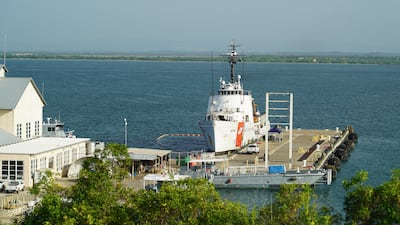
A US Navy cutter shipped docked at Guantanamo Bay. -
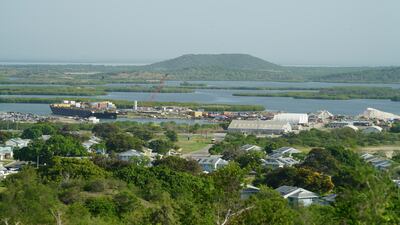
A view of US Naval Station Guantanamo Bay and the surrounding countryside. -
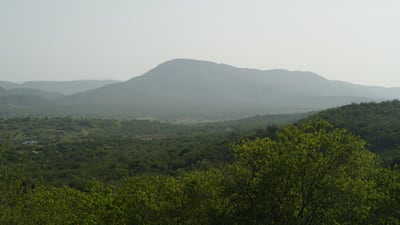
Hilly landscape surrounding Guantanamo Bay. -
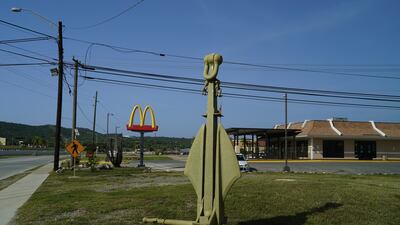
A McDonald's arch at US Naval Station Guantanamo Bay. -
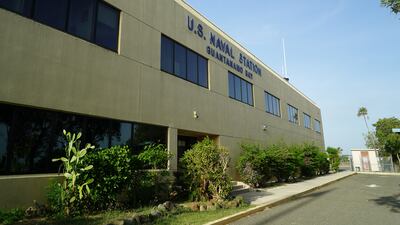
The exterior of a building at the US Naval Station at Guantanamo Bay -
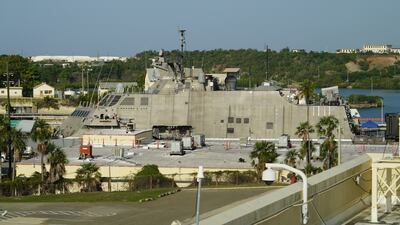
The 'USS Billings', a littoral combat ship, docked at US Naval Station Guantanamo Bay.



