Chain link fence and concertina wire surround Joint Task Force Guantanamo's Camp Delta at the US naval base in Guantanamo Bay, Cuba. Reuters

How Senate Democrats could block Biden from closing Guantanamo


Bryant Harris
  • English
  • Arabic

Senate Democrats are set to advance legislation this week that would effectively prevent US President Joe Biden from making good on his pledge to close the Guantanamo Bay prison, erecting the same hurdle that former president Barack Obama failed to overcome in his efforts to shutter the notorious detention site.

Although Democrats control the Senate, they have opted to maintain long-standing restrictions in the annual defence authorisation bill that would inhibit Mr Biden’s ability to close the military jail.

Senators are expected to vote on the legislation this week.

The Biden administration released a statement this month noting it “strongly objects” to the provisions in the Senate defence bill that would bar the transfer of detainees from Guantanamo — a key tactic it has sought to employ in closing the prison.

Critics around the world have long assailed the US for keeping Guantanamo open, pointing to its enormous costs and the military justice system's failure to score convictions against the men held there, decades after they were captured in Afghanistan and elsewhere.

Congress has maintained the provisions that effectively bar the closure of Guantanamo in defence authorisation and spending legislation for more than a decade, and the latest Senate defence bill indicates that Democrats in the upper chamber are still unwilling to bring their Guantanamo policy in line with the White House.

“Obviously the president’s intention is to close it, but there are a lot of details that have to be worked out before that can be done,” Jack Reed, the Democratic chairman of the Senate Armed Services Committee, told The National.

But he noted the Senate would still need to resolve its differences over the defence bill with the House of Representatives via a conference committee that would hammer out compromise legislation for Mr Biden to sign into law.

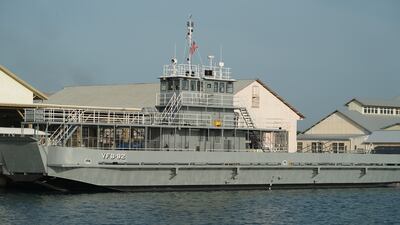
  • A passenger barge docked at US Naval Station Guantanamo Bay, on the south-east coast of Cuba. All photos: Willy Lowry / The National
    A passenger barge docked at US Naval Station Guantanamo Bay, on the south-east coast of Cuba. All photos: Willy Lowry / The National
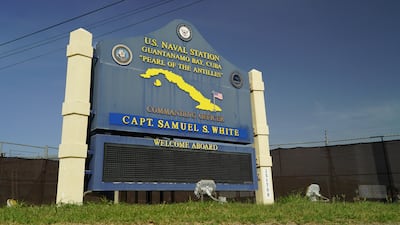
  • A welcome sign at US Naval Station Guantanamo Bay.
    A welcome sign at US Naval Station Guantanamo Bay.
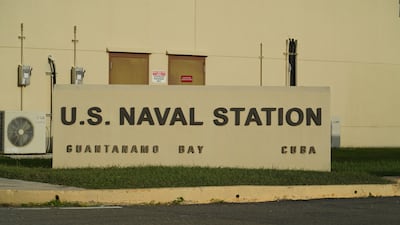
  • A US Naval Station sign at Guantanamo Bay.
    A US Naval Station sign at Guantanamo Bay.
  • Two US Navy sailors stand at attention as they raise the American Flag at US Naval Station Guantanamo Bay.
    Two US Navy sailors stand at attention as they raise the American Flag at US Naval Station Guantanamo Bay.
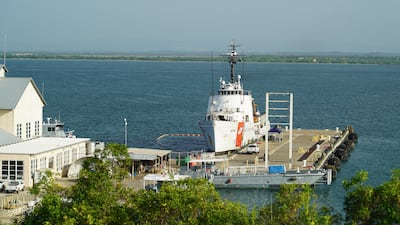
  • A US Navy cutter shipped docked at Guantanamo Bay.
    A US Navy cutter shipped docked at Guantanamo Bay.
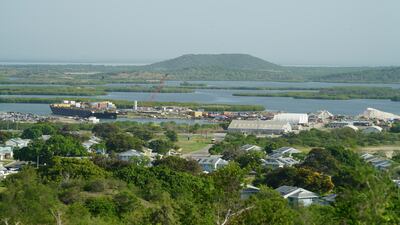
  • A view of US Naval Station Guantanamo Bay and the surrounding countryside.
    A view of US Naval Station Guantanamo Bay and the surrounding countryside.
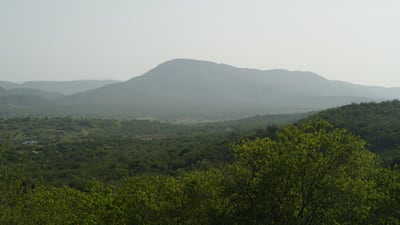
  • Hilly landscape surrounding Guantanamo Bay.
    Hilly landscape surrounding Guantanamo Bay.
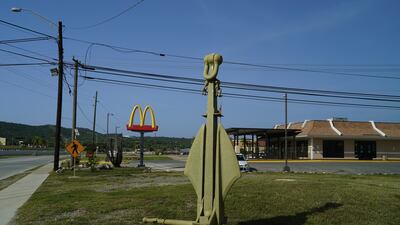
  • A McDonald's arch at US Naval Station Guantanamo Bay.
    A McDonald's arch at US Naval Station Guantanamo Bay.
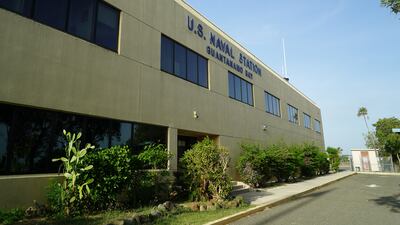
  • The exterior of a building at the US Naval Station at Guantanamo Bay
    The exterior of a building at the US Naval Station at Guantanamo Bay
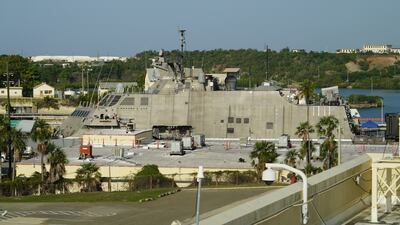
  • The 'USS Billings', a littoral combat ship, docked at US Naval Station Guantanamo Bay.
    The 'USS Billings', a littoral combat ship, docked at US Naval Station Guantanamo Bay.

Notably, House Democrats deleted the restrictions on closing Guantanamo from their version of the defence bill, which passed 316-113 in September.

The House defence spending panel even voted in June to defund the Guantanamo Bay prison.

House Democrats had previously voted to delete the Guantanamo restrictions from the defence bill under former president Donald Trump — who supported keeping the prison open — but ultimately yielded to Senate Republicans, ensuring that the limitations have remained law.

And even if the White House and House Democrats convince senators to drop the restrictions from the final defence bill, it could come at the cost of Republican votes that will be needed to pass the legislation.

A procedural mechanism called the filibuster requires 60 votes to pass legislation through the Senate — meaning Democrats will need at least 10 Republican votes to pass the defence bill.

Republicans largely favour keeping Guantanamo open, raising the prospect that Democrats may keep the restrictions in place to prevent a showdown over the legislation.

Guantanamo Bay held about 800 inmates at its peak under former president George W Bush, who first opened the site.

Mr Obama tried emptying it by transferring prisoners to third-party countries, but even progressive stalwarts such as Bernie Sanders and Elizabeth Warren voted against easing restrictions.

By the end of Mr Obama’s presidency, the prison held 41 inmates — down from 242 when he took office.

Mr Biden transferred his first detainee, Abdul Latif Nasser, to Morocco in July, and his administration also approved the release of two more detainees in October.


Dengue%20fever%20symptoms
%3Cul%3E%0A%3Cli%3EHigh%20fever%3C%2Fli%3E%0A%3Cli%3EIntense%20pain%20behind%20your%20eyes%3C%2Fli%3E%0A%3Cli%3ESevere%20headache%3C%2Fli%3E%0A%3Cli%3EMuscle%20and%20joint%20pains%3C%2Fli%3E%0A%3Cli%3ENausea%3C%2Fli%3E%0A%3Cli%3EVomiting%3C%2Fli%3E%0A%3Cli%3ESwollen%20glands%3C%2Fli%3E%0A%3Cli%3ERash%3C%2Fli%3E%0A%3C%2Ful%3E%0A%3Cp%3EIf%20symptoms%20occur%2C%20they%20usually%20last%20for%20two-seven%20days%3C%2Fp%3E%0A
The biog

Name: Dhabia Khalifa AlQubaisi

Age: 23

How she spends spare time: Playing with cats at the clinic and feeding them

Inspiration: My father. He’s a hard working man who has been through a lot to provide us with everything we need

Favourite book: Attitude, emotions and the psychology of cats by Dr Nicholes Dodman

Favourit film: 101 Dalmatians - it remind me of my childhood and began my love of dogs 

Word of advice: By being patient, good things will come and by staying positive you’ll have the will to continue to love what you're doing

If you go

The flights

There are direct flights from Dubai to Sofia with FlyDubai (www.flydubai.com) and Wizz Air (www.wizzair.com), from Dh1,164 and Dh822 return including taxes, respectively.

The trip

Plovdiv is 150km from Sofia, with an hourly bus service taking around 2 hours and costing $16 (Dh58). The Rhodopes can be reached from Sofia in between 2-4hours.

The trip was organised by Bulguides (www.bulguides.com), which organises guided trips throughout Bulgaria. Guiding, accommodation, food and transfers from Plovdiv to the mountains and back costs around 170 USD for a four-day, three-night trip.


Reputation

Taylor Swift

(Big Machine Records)

Mercer, the investment consulting arm of US services company Marsh & McLennan, expects its wealth division to at least double its assets under management (AUM) in the Middle East as wealth in the region continues to grow despite economic headwinds, a company official said.

Mercer Wealth, which globally has $160 billion in AUM, plans to boost its AUM in the region to $2-$3bn in the next 2-3 years from the present $1bn, said Yasir AbuShaban, a Dubai-based principal with Mercer Wealth.

Within the next two to three years, we are looking at reaching $2 to $3 billion as a conservative estimate and we do see an opportunity to do so,” said Mr AbuShaban.

Mercer does not directly make investments, but allocates clients’ money they have discretion to, to professional asset managers. They also provide advice to clients.

“We have buying power. We can negotiate on their (client’s) behalf with asset managers to provide them lower fees than they otherwise would have to get on their own,” he added.

Mercer Wealth’s clients include sovereign wealth funds, family offices, and insurance companies among others.

From its office in Dubai, Mercer also looks after Africa, India and Turkey, where they also see opportunity for growth.

Wealth creation in Middle East and Africa (MEA) grew 8.5 per cent to $8.1 trillion last year from $7.5tn in 2015, higher than last year’s global average of 6 per cent and the second-highest growth in a region after Asia-Pacific which grew 9.9 per cent, according to consultancy Boston Consulting Group (BCG). In the region, where wealth grew just 1.9 per cent in 2015 compared with 2014, a pickup in oil prices has helped in wealth generation.

BCG is forecasting MEA wealth will rise to $12tn by 2021, growing at an annual average of 8 per cent.

Drivers of wealth generation in the region will be split evenly between new wealth creation and growth of performance of existing assets, according to BCG.

Another general trend in the region is clients’ looking for a comprehensive approach to investing, according to Mr AbuShaban.

“Institutional investors or some of the families are seeing a slowdown in the available capital they have to invest and in that sense they are looking at optimizing the way they manage their portfolios and making sure they are not investing haphazardly and different parts of their investment are working together,” said Mr AbuShaban.

Some clients also have a higher appetite for risk, given the low interest-rate environment that does not provide enough yield for some institutional investors. These clients are keen to invest in illiquid assets, such as private equity and infrastructure.

“What we have seen is a desire for higher returns in what has been a low-return environment specifically in various fixed income or bonds,” he said.

“In this environment, we have seen a de facto increase in the risk that clients are taking in things like illiquid investments, private equity investments, infrastructure and private debt, those kind of investments were higher illiquidity results in incrementally higher returns.”

The Abu Dhabi Investment Authority, one of the largest sovereign wealth funds, said in its 2016 report that has gradually increased its exposure in direct private equity and private credit transactions, mainly in Asian markets and especially in China and India. The authority’s private equity department focused on structured equities owing to “their defensive characteristics.”

Updated: November 30, 2021, 10:16 PM