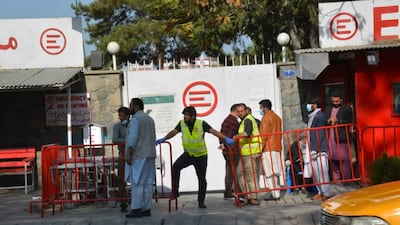
Taliban soldiers inspect the scene of an operation against militants at an ISIS hideout in Kabul. EPA

US sanctions key financier of ISIS in Afghanistan


Bryant Harris
  • English
  • Arabic

The US on Monday sanctioned a key financier of ISIS-Khorasan Province (ISIS-K), the branch of the group operating in Afghanistan.

The US Treasury Department said that Ismatullah Khalozai had enabled “international financial transactions that fund human trafficking networks” as well as “the movement of foreign fighters who seek to escalate tension in Afghanistan and the region".

In one instance, the department noted that Mr Khalozai had smuggled an ISIS-K courier from Afghanistan into Turkey.

“The Biden administration is committed to rooting out terrorist financing networks around the world,” Andrea Gacki, who oversees sanctions at the Treasury Department, said upon announcing the sanctions.

The sanctions on Mr Khalozai’s assets and property effectively cutting him off from the global banking system.

“Today’s designation underscores the United States’ determination to prevent ISIS-K and its members from exploiting the international financial system to support terrorist acts in Afghanistan and beyond,” said Ms Gacki.

The US also designated three other Afghans as global terrorists for holding leadership roles in ISIS-K: Sanaullah Ghafari, Sultan Aziz Azam and Maulawi Rajab.

ISIS-K has emerged as a growing threat in Afghanistan following the chaotic US withdrawal this year.

It already poses a significant threat to the Taliban following its takeover of Afghanistan, with the group launching a series of attacks that have threatened the Taliban’s hold on the country.

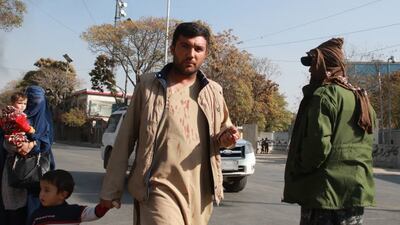
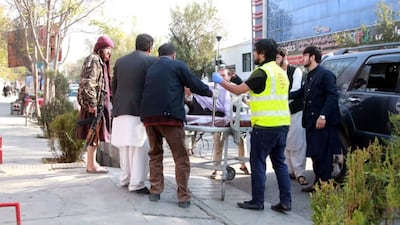
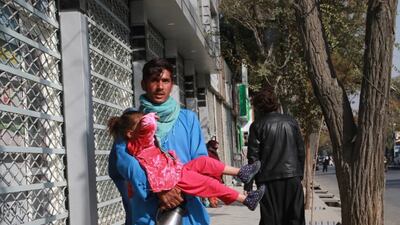
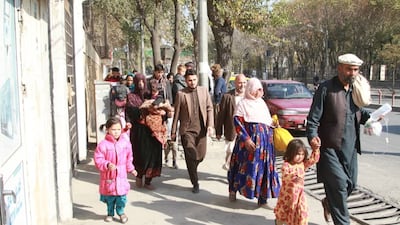
An ISIS-K attack on a military hospital in Kabul this month killed at least 25 people, including Taliban commander Mawlawi Hamdullah Rahmani, and wounded more than a dozen others.

  • A man with blood stains on his shirt flees the scene of bomb blasts at Afghanistan's biggest military hospital in Kabul. At least 19 people were thought to have been killed, it was reported on Tuesday afternoon. EPA
    A man with blood stains on his shirt flees the scene of bomb blasts at Afghanistan's biggest military hospital in Kabul. At least 19 people were thought to have been killed, it was reported on Tuesday afternoon. EPA
  • Surviving blast victims are moved to an emergency hospital in the Afghan capital for treatment. EPA
    Surviving blast victims are moved to an emergency hospital in the Afghan capital for treatment. EPA
  • A man carries his frightened child away from the scene of the deadly explosions. EPA
    A man carries his frightened child away from the scene of the deadly explosions. EPA
  • One witness also reported hearing gunfire, 'The Telegraph' reported. EPA
    One witness also reported hearing gunfire, 'The Telegraph' reported. EPA
  • Emergency hospital staff prepare to receive victims. EPA
    Emergency hospital staff prepare to receive victims. EPA
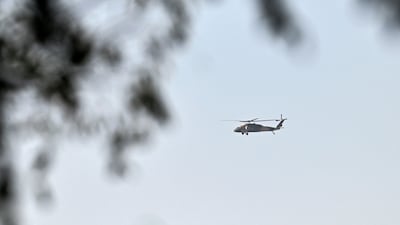
  • A helicopter flies over Kabul, after Afghanistan's capital was hit by two explosions. AFP
    A helicopter flies over Kabul, after Afghanistan's capital was hit by two explosions. AFP
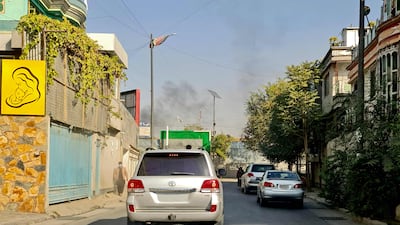
  • Vehicles drive along a road against the backdrop of smoke rising. AFP
    Vehicles drive along a road against the backdrop of smoke rising. AFP

Colin Kahl, the Pentagon’s undersecretary of defence for policy, told Congress last month that ISIS-K could have the capability to strike the US in as little as six months.

“The intelligence community currently assesses that both ISIS-K and Al Qaeda have the intent to conduct external operations, including against the United States,” said Mr Kahl.

He said that ISIS-K could generate that capability within six to 12 months, while Al Qaeda could do so between one and two years.


The specs: 2018 Nissan Patrol Nismo

Price: base / as tested: Dh382,000

Engine: 5.6-litre V8

Gearbox: Seven-speed automatic

Power: 428hp @ 5,800rpm

Torque: 560Nm @ 3,600rpm

Fuel economy, combined: 12.7L / 100km

MATCH INFO

Manchester United 2 (Heaton (og) 42', Lindelof 64')

Aston Villa 2 (Grealish 11', Mings 66')

Ten tax points to be aware of in 2026

1. Domestic VAT refund amendments: request your refund within five years

If a business does not apply for the refund on time, they lose their credit.

2. E-invoicing in the UAE

Businesses should continue preparing for the implementation of e-invoicing in the UAE, with 2026 a preparation and transition period ahead of phased mandatory adoption. 

3. More tax audits

Tax authorities are increasingly using data already available across multiple filings to identify audit risks. 

4. More beneficial VAT and excise tax penalty regime

Tax disputes are expected to become more frequent and more structured, with clearer administrative objection and appeal processes. The UAE has adopted a new penalty regime for VAT and excise disputes, which now mirrors the penalty regime for corporate tax.

5. Greater emphasis on statutory audit

There is a greater need for the accuracy of financial statements. The International Financial Reporting Standards standards need to be strictly adhered to and, as a result, the quality of the audits will need to increase.

6. Further transfer pricing enforcement

Transfer pricing enforcement, which refers to the practice of establishing prices for internal transactions between related entities, is expected to broaden in scope. The UAE will shortly open the possibility to negotiate advance pricing agreements, or essentially rulings for transfer pricing purposes. 

7. Limited time periods for audits

Recent amendments also introduce a default five-year limitation period for tax audits and assessments, subject to specific statutory exceptions. While the standard audit and assessment period is five years, this may be extended to up to 15 years in cases involving fraud or tax evasion. 

8. Pillar 2 implementation 

Many multinational groups will begin to feel the practical effect of the Domestic Minimum Top-Up Tax (DMTT), the UAE's implementation of the OECD’s global minimum tax under Pillar 2. While the rules apply for financial years starting on or after January 1, 2025, it is 2026 that marks the transition to an operational phase.

9. Reduced compliance obligations for imported goods and services

Businesses that apply the reverse-charge mechanism for VAT purposes in the UAE may benefit from reduced compliance obligations. 

10. Substance and CbC reporting focus

Tax authorities are expected to continue strengthening the enforcement of economic substance and Country-by-Country (CbC) reporting frameworks. In the UAE, these regimes are increasingly being used as risk-assessment tools, providing tax authorities with a comprehensive view of multinational groups’ global footprints and enabling them to assess whether profits are aligned with real economic activity. 

Contributed by Thomas Vanhee and Hend Rashwan, Aurifer

Water waste

In the UAE’s arid climate, small shrubs, bushes and flower beds usually require about six litres of water per square metre, daily. That increases to 12 litres per square metre a day for small trees, and 300 litres for palm trees.

Horticulturists suggest the best time for watering is before 8am or after 6pm, when water won't be dried up by the sun.

A global report published by the Water Resources Institute in August, ranked the UAE 10th out of 164 nations where water supplies are most stretched.

The Emirates is the world’s third largest per capita water consumer after the US and Canada.

Updated: November 22, 2021, 5:31 PM